No. 4 Origin entry
Froebel Gifts: A Ball, a Cube, Then Blocks Cut Into Parts
Who Decided the Inch Published
Origin card
Short answer
Froebel gifts are a numbered series of kindergarten playthings: a ball, then a sphere and a cube, then cubes cut into smaller blocks. Milton Bradley's catalog, dated 1896 by its library record, sold them by number, from the First Gift to a Twentieth Gift or Occupation, each with its own order number.
- Name
- Froebel gifts (German Fröbelgaben), the numbered kindergarten playthings of Friedrich Froebel
- Category
- Playthings
- Earliest known record
- 1896 · trade catalog of kindergarten material, dated by the library record of the scanned copy, the earliest dated document read for this page · Springfield, MassachusettsThe earliest known record is not the same as the time or place of invention.
- Origin attribution
- Documented: Froebel's own essays, in Josephine Jarvis's translation, set out the series as his; when he devised each gift was not read for this page
- Key document
- Friedrich Froebel's Pedagogics of the Kindergarten, translated by Josephine Jarvis, pp. 202-204, 238 page scan; Bradley's Kindergarten Material and School Aids (Milton Bradley Co., 1896 per library catalog record), pp. 3, 4, 12, 32 page scan
- Still in use?
- Not surveyed for this page as of 2026: no current maker's catalog was read
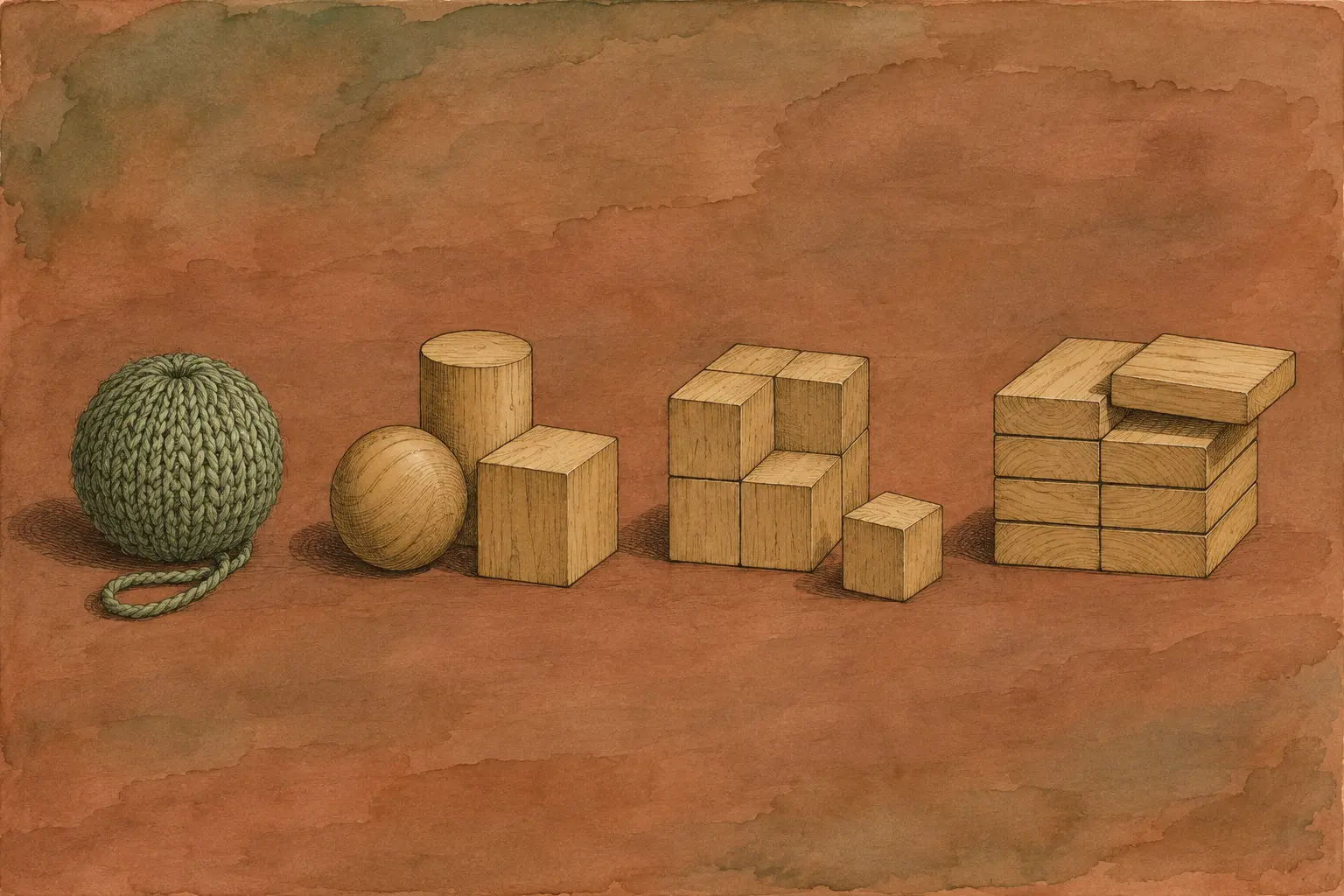
An illustration of the first four gifts in order: a soft ball, a sphere with a cylinder and cube, a cube cut into eight cubes, and a cube cut into eight bricks.
Illustration: Who Decided the Inch. Generated schematic image — not a photograph or historical record. No copyright is claimed in this generated illustration; if you reuse it, please keep this label.
Pick up a wooden building block and turn it until every face has had a turn. Nothing on a loose block says it belongs to a series, yet in an 1896 kindergarten catalog the blocks came as numbered gifts, one boxed set after another.
The catalog, issued by Milton Bradley Co. of Springfield, Massachusetts, and dated 1896 by the library record of the scanned copy, lists them that way page scan. It opens with a First Gift of six soft balls and a Second Gift of a sphere, a cylinder and a cube. Boxes of small cubes and bricks cut from larger cubes come next. The numbering keeps going until it reaches a Twentieth Gift or Occupation.
The same order appears in Friedrich Froebel's own essays on the gifts, which, in Josephine Jarvis's English translation, review the series from the ball to the bricks page scan.
What were the Froebel gifts?
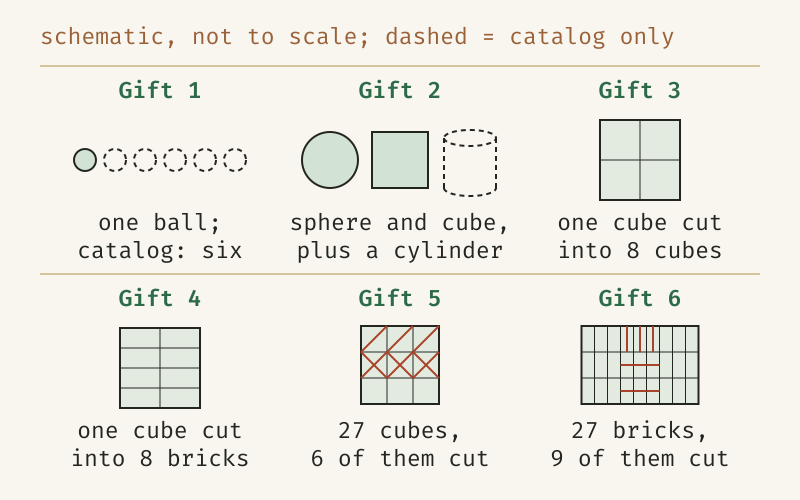
A schematic of the first six gifts in the order Froebel's essays give them, with the cylinder and the five extra balls that the 1896 catalog adds drawn dashed and the 27 bricks of the sixth laid out flat; not to scale.
Drawn from Froebel's Pedagogics of the Kindergarten in Jarvis's translation, pp. 202–204 and 238, and the 1896 Bradley catalog, pp. 3–4, both read from page scans; the parts of the fifth and sixth gifts recomputed to 27; a schematic, not a copy of any drawing.
"The first six Froebel gifts in order" by Who Decided the Inch, https://whodecidedtheinch.com/playthings/froebel-gifts/, licensed under CC BY 4.0, https://creativecommons.org/licenses/by/4.0/
Data: Friedrich Froebel's Pedagogics of the Kindergarten, translated by Josephine Jarvis, pp. 202-204, 238; Bradley's Kindergarten Material and School Aids (Milton Bradley Co., 1896), pp. 3-4
In Froebel's essays the gifts form a graded series of playthings, each one developing out of the one before it. Pedagogics of the Kindergarten, the Jarvis translation, prints Froebel's own review of the series on page 202, which moves from the soft ball to the hard sphere and then to the undivided cube. Next comes “the cube divided once in each dimension, and hence consisting of eight component cubes.”
The fourth gift is a cube divided “into eight bricks.” On page 203 the review concludes that “each successive gift in the series is not only implicit in but also demanded by its predecessor,” so in Froebel's telling the sequence itself is part of the design.
The fifth gift divides a cube twice in each direction. According to page 204, it contains “twenty-one undivided component cubes, three cubes divided diagonally into halves, and three divided diagonally into quarters,” which makes 27 small cubes altogether. On page 238 Froebel names a sixth gift, a cube of 27 bricks, but puts off explaining it.
| Gift | Froebel's essays, in translation | Bradley catalog, 1896 |
|---|---|---|
| 1 | the ball | six soft balls in six colors (item No. 1) |
| 2 | the sphere, then the cube | a two-inch sphere, cylinder and cube (No. 3) |
| 3 | a cube divided once each way, 8 cubes | eight one-inch maple cubes (No. 4) |
| 4 | a cube cut into 8 bricks | a two-inch cube of 8 blocks, 2 by 1 by 1/2 in (No. 5) |
| 5 | 27 cubes: 21 whole, 3 halved, 3 quartered | 21 whole cubes, 6 half cubes, 12 quarter cubes (No. 6) |
| 6 | 27 bricks, 3 cut lengthwise, 6 crosswise | 18 blocks, plus 3 cut lengthwise and 6 crosswise (No. 7) |
The table as data (CSV, froebel-gifts.csv) (source and license notes) Data: Friedrich Froebel's Pedagogics of the Kindergarten, translated by Josephine Jarvis, pp. 202-204, 238; Bradley's Kindergarten Material and School Aids (Milton Bradley Co., 1896), pp. 3, 4, 12, 32
Where both documents count pieces, the counts agree, since three cubes cut in half produce the catalog's six half cubes and three cut into quarters produce its twelve quarter cubes. Two details differ. For the second gift, Froebel's review names the sphere and the cube, while the catalog's box adds a cylinder; for the first, the review speaks of the ball, while the catalog's box holds six.
How many gifts were there?
The answer depends on the document consulted. In the pages read for this entry, the translated essays describe the gifts up to the fifth and, on page 238, only mention the sixth, whereas the 1896 catalog keeps counting well beyond them. Its Tenth Gift or Occupation is drawing on slates ruled in squares. Its Twentieth Gift or Occupation is a set of wooden tools for modeling clay, so by that point the numbers cover work with paper, peas and clay as well as blocks.
How were the gifts sold?
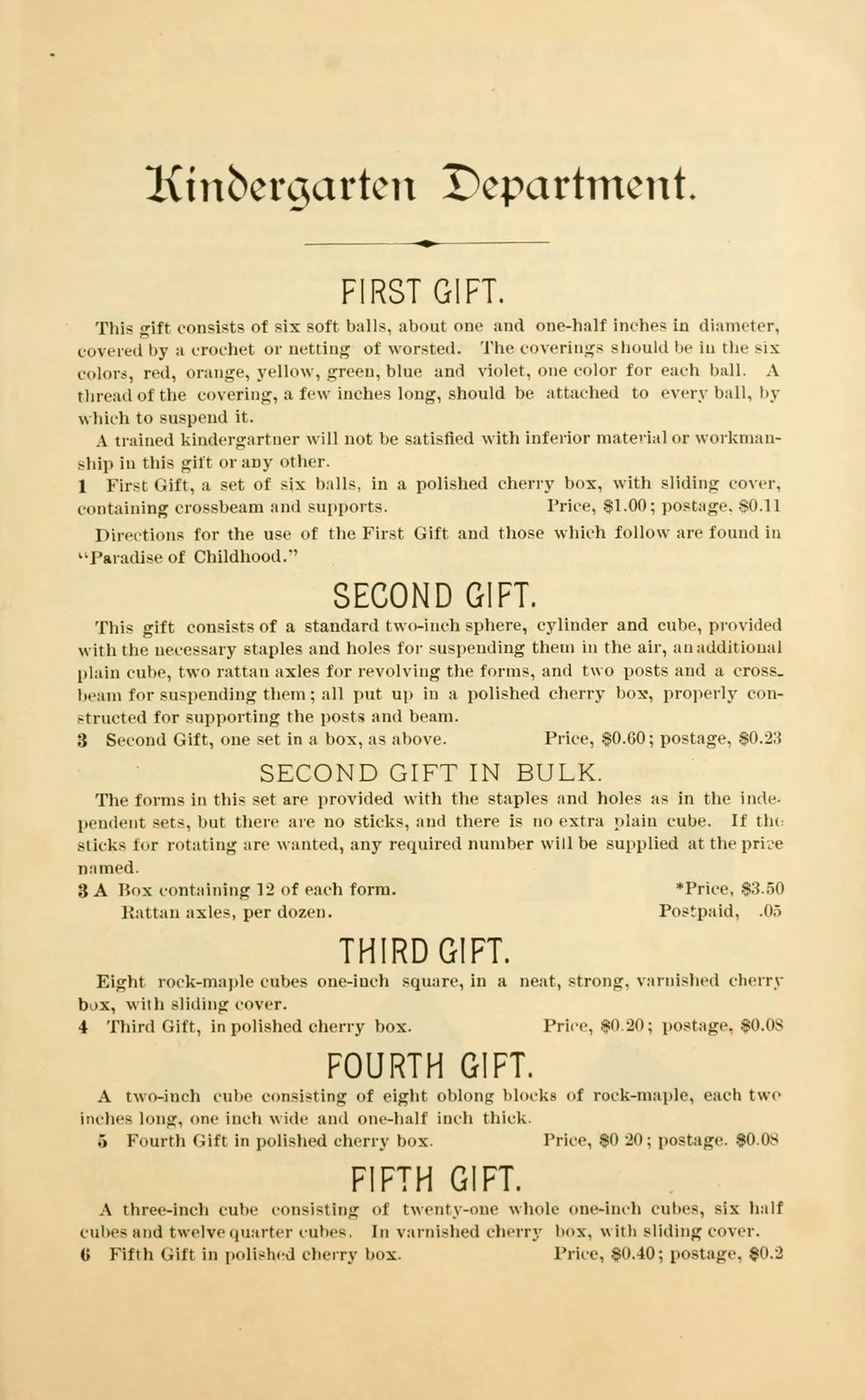
Page 3 of the 1896 catalog: each gift gets a short description, then a numbered line with its price and postage.
“Bradley's Kindergarten Material and School Aids, 1896, page 3”, Milton Bradley Co., Bradley's Kindergarten Material and School Aids (Springfield, Mass., 1896), page 3; public domain.
Full credit
"Bradley's Kindergarten Material and School Aids, 1896, page 3" by Milton Bradley Co., Bradley's Kindergarten Material and School Aids (Springfield, Mass., 1896), page 3 — https://archive.org/details/bradleyskinderga00milt — Public domain (EU: anonymous trade catalog issued by Milton Bradley Co. with no individual author named, published 1896, more than 70 years ago (70 years from publication); US: published before 1931); modified: resized from 2,100 x 3,397 to 1,100 x 1,779 px
The company sent goods by mail and by express. At the front of the catalog, the Special Directions for Kindergartners tell customers how to order: “Each item of kindergarten material is numbered in bold type, on the left-hand side of the page. Always use this number when ordering material, so as to avoid mistakes.”
Each set therefore carried two separate numbers. In US dollars, as printed in the catalog, the First Gift was item No. 1, costing $1.00 plus 11 cents postage. The Third Gift, eight cubes in a cherry box, was No. 4 at 20 cents plus 8 cents postage, and a variant called Fifth Gift B was item No. 10. The Publishers' Note on the same page warns that page numbers “may not be the same in different editions,” which left the bold item number as the dependable reference.
The catalog gives these sizes in inches. The Third Gift's cubes are one inch on a side, so eight of them make a two-inch cube, the size the catalog gives for the Fourth Gift. The inch itself is a measure built up from one small unit, much as that two-inch cube is built up from one-inch blocks. About Fifth Gift B, the catalog remarks that it “has been made and used in Germany for a long time.”
What survives of the sets?
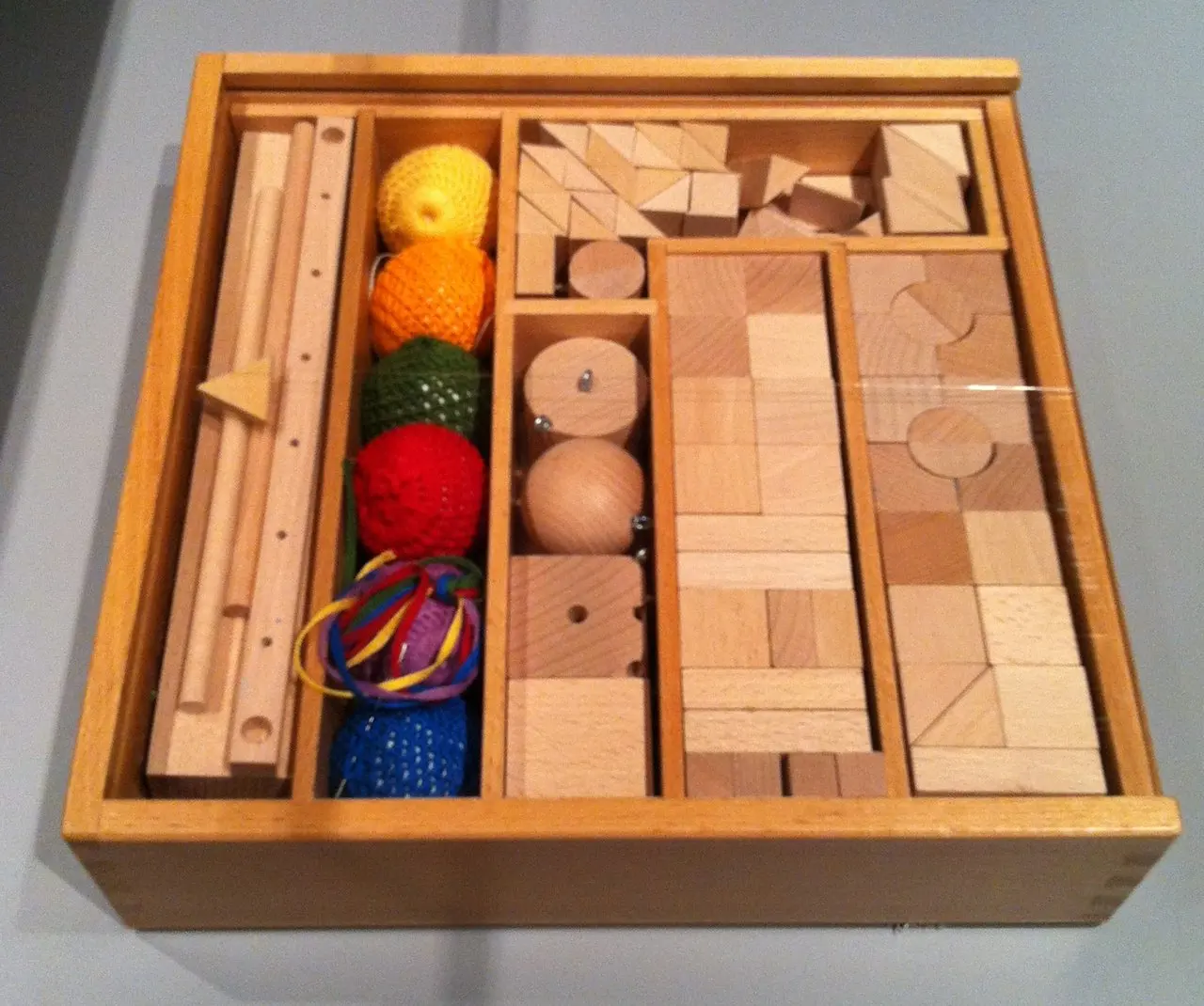
A boxed set that its file page describes as a facsimile, with the balls, the sphere, cylinder and cube, and the divided cubes side by side.
"Friedrich Fröbel: construction kit, facsimile" by Kippelboy — https://commons.wikimedia.org/wiki/File:Friedrich_Fr%C3%B6bel-_Construction_kit-_1782-1852-_SINA_Facsimil-dhub.jpg — CC BY-SA 3.0 (https://creativecommons.org/licenses/by-sa/3.0/); modified: resized from 1,785 x 1,492 to 1,280 x 1,070 px
The photograph shows how the first gifts can fit together in a single box. Six crocheted balls lie in a row, and a wooden sphere, cylinder and cube with small eyelets sit beside them, next to trays of cubes, bricks and triangular pieces. According to its file page, the set is a reproduction, not an object surviving from the 1890s.
The catalog's own illustrations survive as well. On page 4 it prints the tablets of the Seventh Gift at half size, a square, triangles, a circle and a half circle, “indicated by letters A, B, C, etc., for reference.” The letters label each shape, much as the item numbers label each box. The yo-yo is another plaything that, in the records read for it, went by older names before its present one.
Several things remain unknown here. The German collection of Froebel's essays that Jarvis translated was not read, so this page gives no date for when he settled on each gift. The book that the catalog cites for directions, Paradise of Childhood, was not read either, and neither was any record of how many sets Bradley sold or how other American makers numbered theirs. The dates of the translator, Josephine Jarvis, were not found.
Sources
- Bradley's Kindergarten Material and School Aids (Springfield, Mass.: Milton Bradley Co., 1896), Publishers' Note and pp. 3, 4, 12, 32. Public domain (EU: trade catalog with no individual author named, published 1896; US: published 1896). archive.org/details/bradleyskinderga00miltHow far it was read: page scan; the unnumbered Publishers' Note page and pp. 3, 4, 12 and 32; the year 1896 is from the library record of the scanned copy
- Friedrich Froebel, Friedrich Froebel's Pedagogics of the Kindergarten; or, His Ideas Concerning the Play and Playthings of the Child, translated by Josephine Jarvis (translator's name from other library catalog records of the same translation; New York: D. Appleton and Company, 1909 printing; the library record of the scanned copy reports an 1895 copyright notice), pp. 202-204, 238. Public domain in the US (published before 1931); Froebel d. 1852, per library catalog record, but the translator's year of death was not found, so the translation is quoted only in short single sentences. archive.org/details/richfroebelfried00frrichHow far it was read: page scan; pp. 202-204 and 238 of the 1909 printing
Cite this page
Who Decided the Inch. “Froebel Gifts: A Ball, a Cube, Then Blocks Cut Into Parts.” Published November 22, 2026. https://whodecidedtheinch.com/playthings/froebel-gifts/. Accessed on the day you read it.
- To the original: how sources are read
- Marked in the margin: every correction
- Report an error on this page (contact@whodecidedtheinch.com)
Related entries
Teddy Bear History: From a Cartoon Cub to 1907 Book Titles
Picture credit
"Drawing the Line in Mississippi, by Clifford K. Berryman, 1902" by Clifford K. Berryman — https://commons.wikimedia.org/wiki/File:Drawing_the_line_in_Mississippi_LCCN2008678324.jpg — Public domain (EU: Clifford K. Berryman died 1949 (per library catalog record, as given on the file page), more than 70 years ago (life plus 70 years); US: published before 1931 (1902); marked Public Domain Mark 1.0 on the file page)
Yo-Yo History: In the Records Read, the Toy Had Other Names
Picture credit
"A woman playing with an early form of the yo-yo, fashion plate, 1791" by Unknown artist — https://commons.wikimedia.org/wiki/File:1791-Yo-Yo-Bandalore.jpg — Public domain (EU: anonymous fashion plate, first published in 1791 (per the file page), more than 70 years ago (70 years from publication); US: published before 1931; marked Public Domain Mark 1.0 on the file page); modified: cropped: the bottom 37 pixels of the plate removed (full width kept, 492 x 806 from 492 x 843)
Jigsaw Puzzle History: A 1766 Map Cut Along Its Borders
Picture credit
"Europe divided into its kingdoms &c., by J. Spilsbury, 1766" by John Spilsbury, British Library — https://commons.wikimedia.org/wiki/File:Spilsbury_jigsaw_-_John_Spilsbury,_1766_-_BL.jpg — CC0 1.0 (https://creativecommons.org/publicdomain/zero/1.0/); modified: resized from 1,434 x 1,342 to 1,200 x 1,123 px