No. 3 Long read
Inch History: Three Barleycorns, in a Rule With No Date
Who Decided the Inch Published
Origin card
Short answer
The oldest English rule for the inch found for this page, printed in Latin in Cay's 1758 Statutes at Large, makes three dry, round barleycorns an inch and gives no year. The Weights and Measures Act 1824 turned it around, defining the inch as the twelfth part of a foot that is one third of the Imperial Standard Yard.
- Name
- Inch
- Category
- Old Measures
- Earliest known record
- Undated · Latin measuring rule, Compositio ulnarum et perticarum · printed in The Statutes at Large, vol. 1 (London, 1758), p. 201The earliest known record is not the same as the time or place of invention.
- Origin attribution
- Unknown: the rule names no author and no year; Cay's edition prints it under the running head of the reigns of Henry III, Edward I and Edward II.
- Key document
- Compositio ulnarum et perticarum, Cay 1758, vol. 1, p. 201 page scan; Weights and Measures Act 1824, s. I full text; Weights and Measures Act 1985, Sch. 1 full text; NIST Handbook 44 (2026), Appendix C full text
- Still in use?
- Yes, as of 2026: NIST Handbook 44 gives 1 inch as 2.54 centimeters exactly, and the current UK text of the 1985 Act sets the inch at 1/36 yard.
This card as data (CSV) source and license notes
Data: Cay, The Statutes at Large, vol. 1 (1758), p. 201; Weights and Measures Act 1824, s. I; Weights and Measures Act 1985, Sch. 1; NIST Handbook 44 (2026), Appendix C
An illustration of a folding rule with plain tick marks; the inch it divides was once counted as three barleycorns.
Illustration: Who Decided the Inch. Generated schematic image — not a photograph or historical record. No copyright is claimed in this generated illustration; if you reuse it, please keep this label.
Lay your thumb across a ruler and see where the knuckle lands. The numbered marks under it look as fixed as the alphabet, yet the oldest English rule for them found for this page counts grains of barley and names no year.
That rule is a single Latin sentence, Compositio ulnarum et perticarum, printed in Cay’s edition of The Statutes at Large (London, 1758), volume 1, page 201 page scan. It makes three dry, round barleycorns an inch, and Cay’s text gives it no date. The Weights and Measures Act 1824 full text came later and started from an object instead, a yard fixed on a brass rod. In that act a third of the yard is a foot, and a twelfth of the foot is an inch.
Where does the inch come from?

The Compositio ulnarum et perticarum as printed on page 201 of the first volume of Cay's 1758 Statutes at Large; the heading, the manuscript line and the rule carry no year.
“Compositio ulnarum et perticarum, The Statutes at Large, vol. 1 (London, 1758), p. 201”, John Cay (editor), The Statutes at Large, vol. 1 (London, 1758), page 201; public domain.
Full credit
"Compositio ulnarum et perticarum, The Statutes at Large, vol. 1 (London, 1758), p. 201" by John Cay (editor), The Statutes at Large, vol. 1 (London, 1758), page 201 — https://archive.org/details/bim_eighteenth-century_public-general-acts-12_cay-john_1758_1 — Public domain (EU: the editor John Cay died before 1758 (the volume's title calls him the late John Cay), more than 70 years ago (life plus 70 years); US: published before 1931 (London, 1758)); modified: cropped to the Compositio ulnarum et perticarum entry, converted to grayscale and resized to 1600 px wide
The earliest English rule for the inch found for this page sits in a collection of statutes. The Statutes at Large, edited by John Cay and printed in London in 1758, gathers English laws from Magna Carta onward. On page 201 of its first volume is a short entry headed Compositio ulnarum et perticarum. The heading is Latin for the make-up of ulnae and perches, two old lengths.
Just under the heading, Cay names a source. It is a handwritten book, the Cotton manuscript listed as Claudius D. 2. He prints the rule in Latin with no English version beside it, and the whole rule is a single sentence that opens “Ordinatum est quod tria grana ordei sicca & rotunda faciunt pollicem” (Cay, 1758, vol. 1, p. 201).
In this page’s own translation, the full sentence reads: “It is ordained that three grains of barley, dry and round, make an inch; twelve inches make a foot; three feet make an ulna; five and a half ulnae make a perch; and forty perches in length and four in breadth make an acre.” In Cay’s printing of the Compositio, an ulna is three feet, the length that later laws call a yard.
Is there a date for the barleycorn rule?
The printed text gives none. Nothing in the heading, the manuscript line or the Latin sentence names a year, a king or a parliament. The entry printed directly below it on the same page does carry a year of a king’s reign in its heading, “Anno 20 Edw. I.”
Cay’s edition does show where he filed the rule. The running head, the title line printed across the top of each page in that part of the book, reads “Temporibus Henrici III. Edwardique I. & II.” on page 201. In English that is “in the times of Henry III and of Edward I and II.”
So Cay’s 1758 edition places the Compositio among texts from those three reigns, and goes no further. That is a filing decision by an eighteenth-century editor, not a date in the rule. This page follows the printed text and gives the rule no year; if an older copy with a date turns up, the record here will change to match it.
Why three barleycorns?
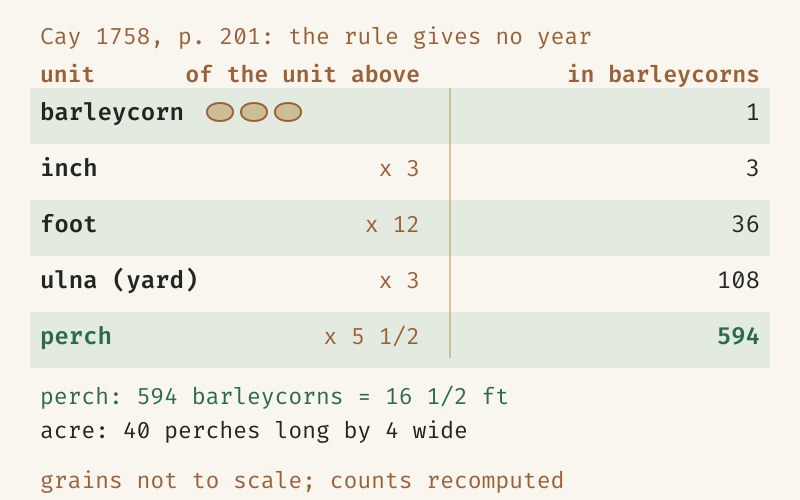
The chain in Cay's 1758 printing of the Compositio ulnarum et perticarum, counted in barleycorns; the grains are drawn as plain ovals, not to scale.
Drawn from Cay 1758, vol. 1, p. 201 (page scan); 3 × 12 × 3 × 5.5 recomputed to 594 barleycorns, or 16 1/2 feet.
This figure as text
the chain in Cay’s 1758 printing of the Compositio, smallest unit first.
- Barleycorn: one dry, round grain of barley.
- Inch: 3 barleycorns.
- Foot: 12 inches, or 36 barleycorns.
- Ulna (yard): 3 feet, or 108 barleycorns.
- Perch: 5 1/2 ulnae, or 594 barleycorns, which is 16 1/2 feet.
- Acre: 40 perches long by 4 perches wide.
"Three barleycorns to an inch: the chain in the Compositio ulnarum et perticarum" by Who Decided the Inch, https://whodecidedtheinch.com/old-measures/inch/, licensed under CC BY 4.0, https://creativecommons.org/licenses/by/4.0/
Data: Cay, The Statutes at Large, vol. 1 (London, 1758), p. 201
The rule builds upward from a seed. Each step names a number of the step below it, so every length in the sentence can be counted back down to grains: an inch is 3 barleycorns, a foot 36 and a yard 108.
The perch is the one step that is not a whole number of the unit below. Five and a half ulnae make it, so a perch holds 594 barleycorns. That is 16 1/2 feet, the same length NIST Handbook 44 still gives the rod, pole or perch.
The acre comes last, and it is the only unit in the rule given in two directions at once. Forty perches long and four perches wide make 160 square perches. The Weights and Measures Act 1824 gives the same count in its own words: an acre of “Four thousand eight hundred and forty such Square Yards, being One hundred and sixty Square Perches, Poles, or Rods.” (s. II, p. 638) The arithmetic agrees, since 160 square perches of 5 1/2 yards a side come to 4,840 square yards.
Does the rule say why barley was used?
No. The Latin names the grain and gives two conditions, sicca and rotunda, dry and round, and then it stops. Nothing on page 201 explains why barley was chosen over another grain, or why the rule settled on three grains rather than four.
No other text read for this page gives a reason either. The grains in the rule work as a starting count. No document read here presents them as a measured average of real barley.
How did the inch become part of the yard?
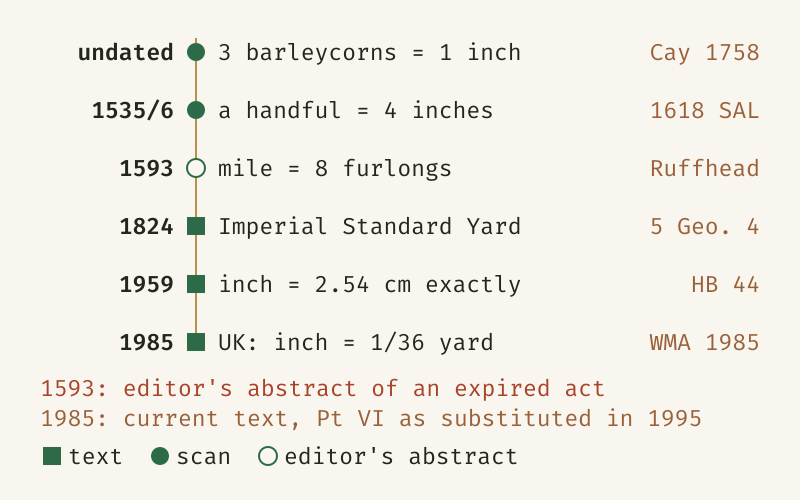
Six steps in the inch's paper trail, each marked by how far its source was read: as full text, as a page scan, or as an editor's abstract; the 1593 step is an editor's abstract of an expired act, and the 1985 step is the Act's current text, as substituted in 1995.
Drawn from Cay 1758, p. 201, the 1618 Statutes at Large, pp. 575 and 579 (page scans), Ruffhead 1770, p. 676 (editor's abstract), the 1824 and 1985 Acts and NIST Handbook 44 (full text); each row marked by how far it was read.
"The inch in dated records: a timeline with how each step was read" by Who Decided the Inch, https://whodecidedtheinch.com/old-measures/inch/, licensed under CC BY 4.0, https://creativecommons.org/licenses/by/4.0/
Data: Cay, The Statutes at Large, vol. 1 (1758), p. 201; The Statutes at Large (1618), pp. 575 and 579; Ruffhead, The Statutes at Large, vol. 2 (1770), p. 676 (editor's abstract); Weights and Measures Act 1824, s. I; NIST Handbook 44 (2026), Appendix C; Weights and Measures Act 1985, Sch. 1
| Date | Step | Source | How far it was read |
|---|---|---|---|
| undated | 3 barleycorns = 1 inch | Cay, Statutes at Large, vol. 1 (1758), p. 201 | page scan |
| 1535/6 | a handful = 4 inches | Statutes at Large (1618), pp. 575, 579: 27 Hen. 8 c. 6 | page scan |
| 1593 | mile = 8 furlongs | Ruffhead, Statutes at Large, vol. 2 (1770), p. 676: 35 Eliz. c. 6 | editor's abstract |
| 1824 | Imperial Standard Yard | Weights and Measures Act 1824, s. I | full text |
| 1959 | inch = 2.54 cm exactly | NIST Handbook 44 (2026), Appendix C | full text |
| 1985 | UK: inch = 1/36 yard | Weights and Measures Act 1985, Sch. 1 Pt VI (current text: Part VI as substituted from 1 Oct 1995) | full text |
The table as data (CSV, inch-0003-timeline.csv) (source and license notes) Data: Cay, The Statutes at Large, vol. 1 (1758), p. 201; The Statutes at Large (1618), pp. 575 and 579; Ruffhead, The Statutes at Large, vol. 2 (1770), p. 676 (editor's abstract); Weights and Measures Act 1824, s. I; NIST Handbook 44 (2026), Appendix C; Weights and Measures Act 1985, Sch. 1
For a long stretch the inch was the starting point, and other laws counted in it. An act from the twenty-seventh year of Henry VIII’s reign, printed in the 1618 Statutes at Large at page 579 page scan, measured breeding horses in handfuls.
The same book, at page 575, dates that session from 4 February to 14 April of the regnal year, which works out as 1535/6. The act ruled that “every handfull” should “containe foure inches of the Standard,” and page 579 sets the duty from the first day of May 1537.
A law of 1593 did the same for the mile, as abstracted in 1770. Owen Ruffhead’s edition of the statutes gives only an editor’s summary of that expired act at page 676 editor's abstract: “A Mile shall contain eight Furlongs, every Furlong forty Poles, and every Pole shall contain sixteen Foot and an half.” That pole of 16 1/2 feet matches the perch of 594 barleycorns in Cay’s Compositio, though the summary says nothing about barley.
Why did Parliament fix the yard in 1824?
The act says why in its opening lines, dated 17 June 1824. It recalls that “it is provided by the Great Charter, that there shall be but one Measure and one Weight throughout the Realm.” Yet, it goes on, “different Weights and Measures, some larger, and some less, are still in use in various Places.” Worse, “the true Measure of the present Standards is not verily known, which is the Cause of great Confusion and of manifest Frauds.”
Its first section answered with a single object that anyone could point to.
What did the 1824 Act change?
The Weights and Measures Act 1824 (5 Geo. 4 c. 74) turned the chain upside down. Instead of counting up from grains, it started from a brass rod kept by the Clerk of the House of Commons. The act’s first section set its start “from and after the First Day of May One thousand eight hundred and twenty-five.”
Its key words are these: “the Straight Line or Distance between the Centres of the Two Points in the Gold Studs in the Straight Brass Rod, now in the Custody of the Clerk of the House of Commons, whereon the Words and Figures ‘Standard Yard, 1760,’ are engraved, shall be and the same is hereby declared to be the original and genuine Standard of that Measure of Length or lineal Extension called a Yard.”
The same distance, “the Brass being at the Temperature of Sixty-two Degrees by Fahrenheit’s Thermometer,” is named the “Imperial Standard Yard.” (5 Geo. 4 c. 74, s. I, pp. 637–638)
A few lines later the act cuts the inch from that yard: “One-third Part of the said Standard Yard shall be a Foot, and the Twelfth Part of such Foot shall be an Inch.” The act does not count the inch in grains. Its inch was one thirty-sixth of a marked distance on a metal bar, measured when the brass stood at 62 degrees Fahrenheit.
The act also planned for losing the bar. Section III says that if the Imperial Standard Yard were “lost, or shall be in any Manner destroyed, defaced, or otherwise injured,” a new one could be made by reference to a pendulum swinging seconds in the latitude of London. The act puts that pendulum at “Thirty-nine Inches, and One thousand three hundred and ninety-three ten-thousandth Parts of an Inch” against the yard’s thirty-six.
The same question, who fixed a number and on what evidence, comes up with horsepower and with the letter order of the QWERTY keyboard.
What is an inch today?
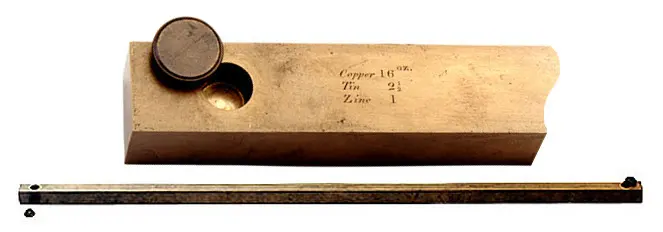
Bronze Yard No. 11, a bronze yard bar; according to its file page, the defining lines sit on gold plugs set into the bar's ends, and the bar is now in the NIST Museum.
"Bronze Yard No. 11" by Unknown author, National Institute of Standards and Technology — https://commons.wikimedia.org/wiki/File:Bronze_Yard_No._11.jpg — Public domain (US: work of an employee of the US National Institute of Standards and Technology, 17 U.S.C. §105, per the file page; EU: no separate basis traced (US federal work))
Today the inch is defined through the meter on both sides of the Atlantic, and both definitions still pass through the yard or the foot. In the United Kingdom, the current text of the Weights and Measures Act 1985 on legislation.gov.uk, read on 21 November 2026, lists in Schedule 1, Part VI: “YARD = 0.9144 metre,” “Foot = 1/3 yard” and “Inch = 1/36 yard” full text.
That part of the schedule is headed “Definitions of certain units which may not be used for trade except as supplementary indications.” The same page also lists a 2025 Act, 2025 c. 20, s. 11(3), that omits Schedule 1, marked as a change not yet applied to the text.
In the United States, NIST Handbook 44 (2026), Appendix C full text, lists 1 inch as 2.54 centimeters exactly and cites the Federal Register of 1 July 1959 for those exact relationships. The two routes land on the same length: one thirty-sixth of 0.9144 meter is 0.0254 meter, or 2.54 centimeters. For anyone converting, the factor is that single number, so 12 inches is 30.48 centimeters.
Is the old barleycorn inch the same length?
There is no way to say from the documents read here. Cay’s printing of the Compositio gives no measured length for its grains, only a count, and no conversion between barleycorns and the brass yard of 1824 appears in either text. A modern inch descends from the barleycorn inch by name and by the chain of twelves and threes, not by any recorded measurement.
What is still not known
The Compositio as printed by Cay has no author and no year, and his running head gives only a span of reigns. The Cotton manuscript that Cay names was not read for this page, so whether it adds a date is not known here.
No document read here gives a reason for barley, for three grains or for a foot of twelve inches. The bars and official orders that stood behind the yard between 1824 and the modern definitions were not read from a primary text for this page, so they are left out of the timeline rather than guessed.
Sources
- John Cay (ed.), The Statutes at Large, from Magna Charta, to the Thirtieth Year of King George the Second, vol. 1 (London, 1758), p. 201: Compositio ulnarum et perticarum. Public domain (EU and US: printed 1758). archive.org/details/bim_eighteenth-century_pu…How far it was read: page scan; p. 201, the Latin rule, its heading, the manuscript line and the running head
- Weights and Measures Act 1824 (5 Geo. 4 c. 74), 17 June 1824, ss. I-III, King's Printer copy on legislation.gov.uk. www.legislation.gov.uk/ukpga/Geo4/5/74/enactedHow far it was read: full text; ss. I-III, pp. 637-638 of the printed act
- The Statutes at Large (London, 1618), pp. 575, 578-579 and 699-700: 27 Hen. 8 c. 6, An Act for the increase and breede of Horses (pp. 575, 578-579); 32 Hen. 8 c. 42, An Act concerning Barbors and Surgeons to be of one Companie (pp. 699-700). Public domain (EU and US: printed 1618). archive.org/details/bim_early-english-books-1…How far it was read: page scan; pp. 575, 578-579 and 699-700
- Owen Ruffhead (ed.), The Statutes at Large, vol. 2, new edition (London, 1770), p. 676: 35 Eliz. c. 6 (editor's abstract of an expired act). Public domain (EU and US: printed 1770). archive.org/details/bim_eighteenth-century_pu…How far it was read: editor's abstract; Ruffhead's 1770 summary of the expired act, vol. 2 p. 676
- Weights and Measures Act 1985 (c. 72), Schedule 1, Part VI, current text on legislation.gov.uk. www.legislation.gov.uk/ukpga/1985/72/schedule/1How far it was read: full text; Schedule 1 as current on 21 November 2026Text license: Open Government Licence v3.0 (terms)
- NIST Handbook 44 (2026), Appendix C: General Tables of Units of Measurement. National Institute of Standards and Technology. U.S. Government work (17 U.S.C. §105). www.nist.gov/document/2026-nist-handbook-44-ap…How far it was read: full text; Appendix C, 2026 edition, tables and notes
Cite this page
Who Decided the Inch. “Inch History: Three Barleycorns, in a Rule With No Date.” Published November 22, 2026. https://whodecidedtheinch.com/old-measures/inch/. Accessed on the day you read it.
- To the original: how sources are read
- Marked in the margin: every correction
- Report an error on this page (contact@whodecidedtheinch.com)
Related entries
Why Is a Mile 5,280 Feet? 8 Furlongs, 40 Rods, 16.5 Feet
Picture credit
"175 miles to London" by Tim Green from Bradford — https://commons.wikimedia.org/wiki/File:175_miles_to_London_(16669202367).jpg — CC BY 2.0 (https://creativecommons.org/licenses/by/2.0/); modified: resized from 2,683 x 3,433 to 938 x 1,200 px, whole frame
Horsepower Definition: Farey Said Few Horses Could Match It
Picture credit
"Horse gin in use (detail), from The Illustrated Exhibitor, 1851" by Unknown engraver, The Illustrated Exhibitor (1851) — https://commons.wikimedia.org/wiki/File:Horse_Gin_in_use.jpg — Public domain (EU: anonymous engraving, published in The Illustrated Exhibitor in 1851, more than 70 years ago (70 years from publication); US: published before 1931; marked Public Domain Mark 1.0 on the file page); modified: cropped to the left part of the engraving (two horses and the gin arms)
Barleycorn Shoe Size: A 1912 Manual’s Third-of-an-Inch Step
Picture credit
"Shoemakers, from Das Ständebuch (The Book of Trades), 1568" by Jost Amman — https://commons.wikimedia.org/wiki/File:Shoemaker_Book_of_Trades.png — Public domain (EU: the file page's license tag gives the author's death as 1591 (PD-old-auto-expired), more than 70 years ago; US: published 1568, before 1931; marked Public Domain Mark 1.0 on the file page)