No. 3 Interactive page
Barleycorn Shoe Size: A 1912 Manual’s Third-of-an-Inch Step
Who Decided the Inch Published
Origin card
Short answer
Dooley's 1912 manual of shoemaking puts infant size 1 at 4 inches, at least originally, and adds one third of an inch per full size for sizes 1 to 5; adult sizes start again at 1 after child 13 1/2. The manual never mentions barleycorns; the match with the three-barleycorn inch printed in 1758 is arithmetic only.
- Name
- Shoe sizes on the barleycorn scale, whole sizes one third of an inch apart
- Category
- Old Measures
- Earliest known record
- 1912 · printed manual, A Manual of Shoemaking by William H. Dooley, chapter four, the earliest numbered size scale found for this page · BostonThe earliest known record is not the same as the time or place of invention.
- Origin attribution
- Unknown: Dooley (1912) writes that the measurements originated in England but names no maker, no town and no date; no earlier size scale was read for this page
- Key document
- Dooley 1912, A Manual of Shoemaking, chapter four full text; Cay 1758, The Statutes at Large, vol. 1, p. 201, the barleycorn rule for the inch page scan
- Still in use?
- Unknown from the sources read for this page, as of 2026: Dooley wrote in 1912 that the measurements were not now absolute; present-day British, American and other size systems are conventions not computed on this page
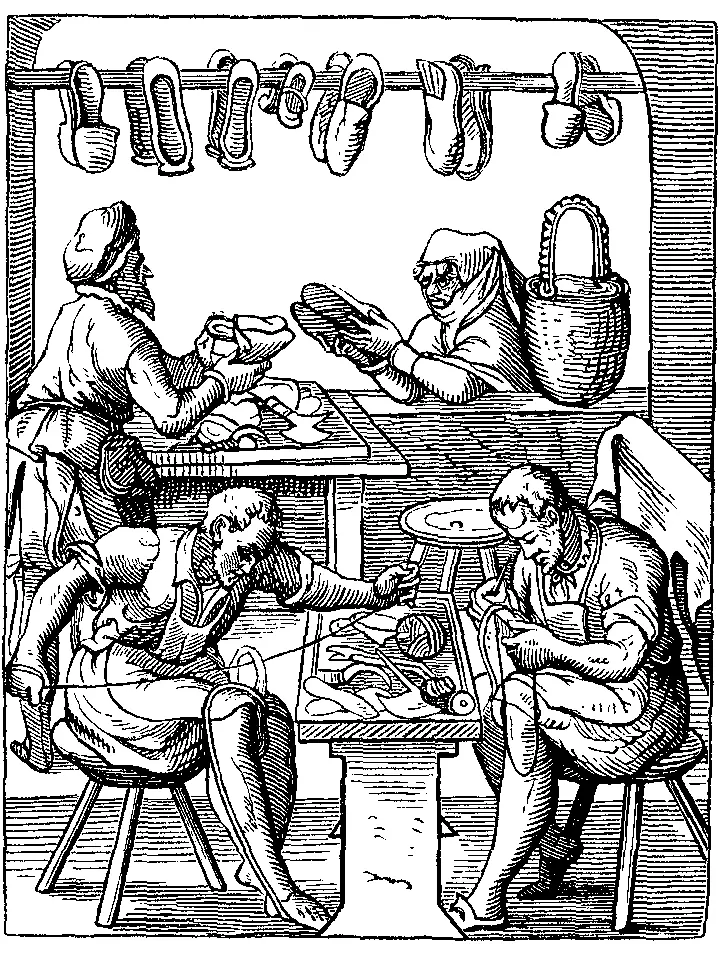
Shoemakers cut and stitch leather under a row of hanging shoes while a customer waits at the counter.
"Shoemakers, from Das Ständebuch (The Book of Trades), 1568" by Jost Amman — https://commons.wikimedia.org/wiki/File:Shoemaker_Book_of_Trades.png — Public domain (EU: the file page's license tag gives the author's death as 1591 (PD-old-auto-expired), more than 70 years ago; US: published 1568, before 1931; marked Public Domain Mark 1.0 on the file page)
Look inside the tongue of your shoe for the size printed there. On the English scale, that number once stood for a set length in inches, and a 1912 shoemaking manual already called the scale “not now absolute.”
The manual is W. H. Dooley's A Manual of Shoemaking (Boston, 1912) full text. In it, the smallest infant's shoe, size 1, “is, or was originally, four inches long,” and each full size above it is one third of an inch longer. Dooley states that step for “sizes 1 to 5.” A third of an inch is one barleycorn under an old English rule that three barleycorns make an inch.
How do barleycorn shoe sizes work?
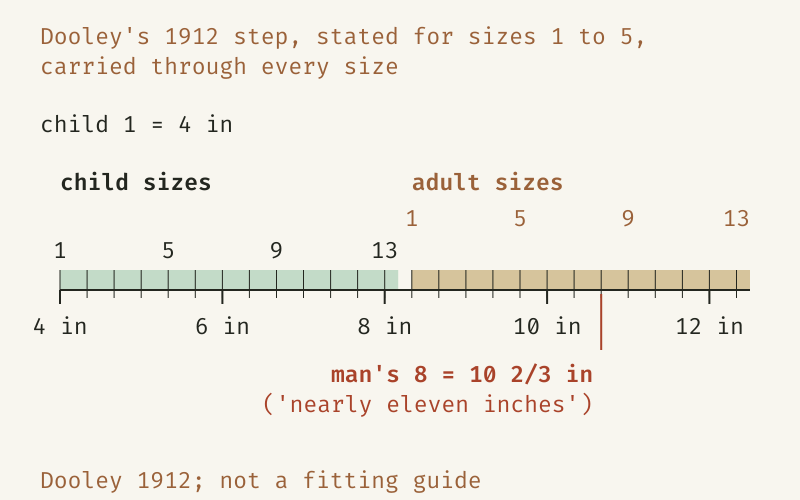
Dooley's scale drawn as a ruler, with his third-inch step carried through every size: child sizes from 4 inches, adult sizes starting again at 1, and a man's size 8 at 10 2/3 inches.
Drawn from Dooley 1912 (Project Gutenberg 55474), full text; child size 1 at 4 inches and a man's size 8 at 10 2/3 inches recomputed at one third of an inch per size.
"Shoe sizes on the barleycorn scale: each size one third of an inch" by Who Decided the Inch, https://whodecidedtheinch.com/old-measures/shoe-sizes/, licensed under CC BY 4.0, https://creativecommons.org/licenses/by/4.0/
Data: William H. Dooley, A Manual of Shoemaking (1912), chapter four
Dooley describes two runs of numbers. Infants' and children's sizes climb to 11, youths' and misses' sizes run on to 13 1/2, and then the count starts again at 1 and runs up through men's and women's sizes. On a third-inch step, adult size 1 comes one half size after child 13 1/2, at 8 1/3 inches.
Each whole size is a step of a third of an inch, which makes three sizes to the inch. Dooley states the step beside sizes 1 to 5 and gives one adult check: a man's No. 8 shoe, he writes, would be “nearly eleven inches long.” Carried through every size, the third-inch step puts a man's 8 at 10 2/3 inches, which matches that estimate.
Do US and UK sizes match?
Dooley writes that the measurements originated in England and are “not now absolute.” He adds that some makers of special lines varied the rate of sizes, and that a French system marked sizes in a cipher to keep the real size from the customer. Present-day British and American starting points, American women's sizes, the Paris point and Mondopoint are conventions, not computed on this page, because no usable source defining them was read.
Shoe size scale calculator
Type a foot length in inches or centimeters. The calculator takes 1 inch as exactly 2.54 centimeters, as NIST Handbook 44 full text states, and adds Dooley's allowance over the measured foot, “two to two and one half sizes.” It then rounds each result to the nearest half size on his scale and gives those sizes' shoe lengths. Dooley gives that allowance for men's shoes only, and the calculator applies it to every length for comparison. It is a history of the numbers, not a fitting or buying guide.
Scale reader · one 1912 manual
foot length shoe length after the allowance child sizes adult sizes. Size numbers above the band, inches below.
On the 1912 scale: a foot of 10.00 in (25.4 cm) plus Dooley’s allowance of 2 to 2 1/2 sizes gives adult 8 to adult 8 1/2, a shoe 10.67 to 10.83 in long.
This shows how one 1912 manual names shoe lengths: child size 1 is 4 inches, each size adds 1/3 inch (a step Dooley states for sizes 1 to 5; the calculator carries it through every size), and adult size 1 follows child 13 1/2. Dooley himself says these measurements “are not now absolute.” It is a history of the numbers, not a fitting or buying guide.
Not calculated here: today’s UK and US women’s starting points, the Paris point and Mondopoint (ISO 9407). No usable source for their definitions has been read yet.
| Foot, in | Foot, cm | Size, low | Size, high |
|---|---|---|---|
| 3.5 | 8.9 | child 1 1/2 | child 2 |
| 4.0 | 10.2 | child 3 | child 3 1/2 |
| 4.5 | 11.4 | child 4 1/2 | child 5 |
| 5.0 | 12.7 | child 6 | child 6 1/2 |
| 5.5 | 14.0 | child 7 1/2 | child 8 |
| 6.0 | 15.2 | child 9 | child 9 1/2 |
| 6.5 | 16.5 | child 10 1/2 | child 11 |
| 7.0 | 17.8 | child 12 | child 12 1/2 |
| 7.5 | 19.1 | child 13 1/2 | adult 1 |
| 8.0 | 20.3 | adult 2 | adult 2 1/2 |
| 8.5 | 21.6 | adult 3 1/2 | adult 4 |
| 9.0 | 22.9 | adult 5 | adult 5 1/2 |
| 9.5 | 24.1 | adult 6 1/2 | adult 7 |
| 10.0 | 25.4 | adult 8 | adult 8 1/2 |
| 10.5 | 26.7 | adult 9 1/2 | adult 10 |
| 11.0 | 27.9 | adult 11 | adult 11 1/2 |
| 11.5 | 29.2 | adult 12 1/2 | adult 13 |
Scale and allowance: W. H. Dooley, A Manual of Shoemaking (Boston, 1912). 1 in = 2.54 cm (NIST Handbook 44). The table as data (CSV) (source and license notes)
"Shoe sizes on Dooley's 1912 scale: worked values" by Who Decided the Inch, https://whodecidedtheinch.com/old-measures/shoe-sizes/, licensed under CC BY 4.0, https://creativecommons.org/licenses/by/4.0/ Data: William H. Dooley, A Manual of Shoemaking (1912), chapter four; NIST Handbook 44 (2026), Appendix C
The starting value, a 10-inch foot, comes out at adult 8 to adult 8 1/2 on Dooley's scale.
Where did the third-of-an-inch step come from?
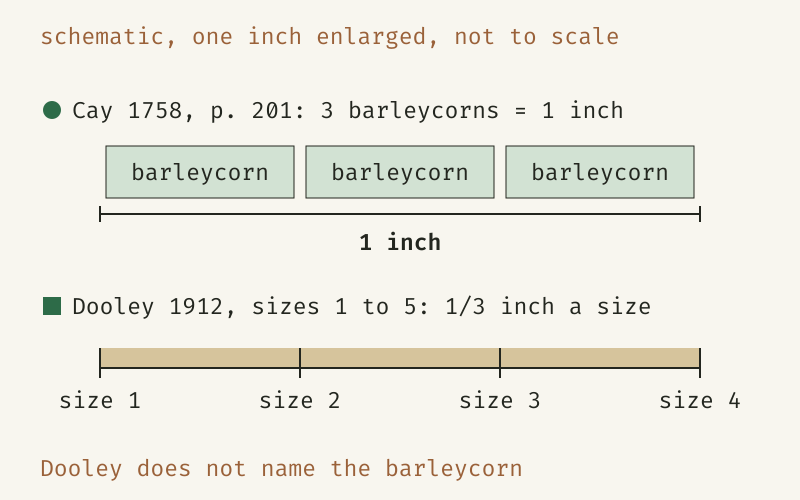
A schematic of one inch, enlarged: three barleycorns by the rule printed in Cay's 1758 statutes, and three shoe-size steps on Dooley's 1912 scale; not to scale.
Drawn from Cay 1758, p. 201 (page scan), and Dooley 1912 (full text); one size recomputed as 1/3 of an inch, the length of one of three barleycorns; a schematic.
This figure as text
the figure sets two sources side by side.
- Cay 1758, p. 201 page scan: three barleycorns make one inch.
- Dooley 1912 full text: each added full size adds one third of an inch, stated for sizes 1 to 5.
- Dooley does not use the word barleycorn.
"A third of an inch in two books: three barleycorns to the inch, one shoe size per third" by Who Decided the Inch, https://whodecidedtheinch.com/old-measures/shoe-sizes/, licensed under CC BY 4.0, https://creativecommons.org/licenses/by/4.0/
Data: John Cay (ed.), The Statutes at Large, vol. 1 (1758), p. 201; William H. Dooley, A Manual of Shoemaking (1912), chapter four
The barleycorn comes from a different book. A Latin rule on page 201 of John Cay's 1758 edition of The Statutes at Large page scan begins: “Ordinatum est quod tria grana ordei sicca & rotunda faciunt pollicem.” In this site's translation, it is ordained that three grains of barley, dry and round, make an inch. Cay prints the rule with no year, among statutes of Henry III and Edward I and II.
Dooley never uses the word barleycorn. The match is arithmetic. One shoe size and one barleycorn are both a third of an inch. Other everyday layouts and units are read from old documents too, from the letter order traced in the QWERTY keyboard entry to the hand used to measure horses.
J. Sparkes Hall's The Book of the Feet (New York, 1847) full text, a history of boots and shoes by a bootmaker to the Queen, describes taking a customer's measure and choosing lasts. It gives no numbered size scale. No source read for this page names who first numbered shoes in thirds of an inch, when that began, or why a third was chosen. Dooley's “or was originally” suggests that by 1912 the 4-inch start might no longer hold exactly, but he gives no date for any change.
Sources
- William H. Dooley, A Manual of Shoemaking and Leather and Rubber Products (Boston: Little, Brown, and Company, 1912), chapter four. Project Gutenberg ebook 55474. Public domain (EU: author d. 1944, per Project Gutenberg catalog record; US: published 1912). www.gutenberg.org/ebooks/55474How far it was read: full text; chapter four, the passages on shoe sizes and on measuring the foot
- NIST Handbook 44 (2026), Appendix C: General Tables of Units of Measurement. National Institute of Standards and Technology. U.S. Government work (17 U.S.C. §105). www.nist.gov/document/2026-nist-handbook-44-ap…How far it was read: full text; Appendix C, 2026 edition, tables and notes
- John Cay (ed.), The Statutes at Large, from Magna Charta, to the Thirtieth Year of King George the Second, vol. 1 (London, 1758), p. 201: Compositio ulnarum et perticarum. Public domain (EU and US: printed 1758). archive.org/details/bim_eighteenth-century_pu…How far it was read: page scan; p. 201, the Latin rule, its heading, the manuscript line and the running head
- J. Sparkes Hall, The Book of the Feet: A History of Boots and Shoes, from the second London edition (New York: William H. Graham; J. S. Redfield, 1847). Project Gutenberg ebook 56978. Public domain in the US (published 1847); the author's year of death was not found, so only facts and short quotations are used. www.gutenberg.org/ebooks/56978How far it was read: full text; whole text searched for sizes and measuring, the passage on bespoke work read
Cite this page
Who Decided the Inch. “Barleycorn Shoe Size: A 1912 Manual’s Third-of-an-Inch Step.” Published November 22, 2026. https://whodecidedtheinch.com/old-measures/shoe-sizes/. Accessed on the day you read it.
- To the original: how sources are read
- Marked in the margin: every correction
- Report an error on this page (contact@whodecidedtheinch.com)
Related entries
 Illustration
Inch History: Three Barleycorns, in a Rule With No Date
Illustration credit
Illustration: Who Decided the Inch. Generated schematic image — not a photograph or historical record. No copyright is claimed in this generated illustration; if you reuse it, please keep this label.
Why Is a Mile 5,280 Feet? 8 Furlongs, 40 Rods, 16.5 Feet
Picture credit
"175 miles to London" by Tim Green from Bradford — https://commons.wikimedia.org/wiki/File:175_miles_to_London_(16669202367).jpg — CC BY 2.0 (https://creativecommons.org/licenses/by/2.0/); modified: resized from 2,683 x 3,433 to 938 x 1,200 px, whole frame
Horsepower Definition: Farey Said Few Horses Could Match It
Picture credit
"Horse gin in use (detail), from The Illustrated Exhibitor, 1851" by Unknown engraver, The Illustrated Exhibitor (1851) — https://commons.wikimedia.org/wiki/File:Horse_Gin_in_use.jpg — Public domain (EU: anonymous engraving, published in The Illustrated Exhibitor in 1851, more than 70 years ago (70 years from publication); US: published before 1931; marked Public Domain Mark 1.0 on the file page); modified: cropped to the left part of the engraving (two horses and the gin arms)