No. 3 Table and data page
Hand Horse Measurement: Four Inches, Set by a Tudor Law
Who Decided the Inch Published
Origin card
Short answer
A hand is 4 inches. An act of the 1535/6 session, read in the 1618 Statutes at Large, measured breeding mares in four-inch handfuls from hoof to shoulder, and NIST Handbook 44 still lists the hand at 4 inches.
- Name
- Hand (the handful of the 1535/6 act), a unit for the height of horses
- Category
- Old Measures
- Earliest known record
- 1535/6 · act of Parliament, 27 Hen. 8 c. 6, from a session held at Westminster, the earliest record of the four-inch hand found for this page · printed in The Statutes at Large (London, 1618), pp. 578-579The earliest known record is not the same as the time or place of invention.
- Origin attribution
- Documented for the four-inch rule only: the act fixes every handful at four inches of the Standard. Who first measured horses in hands is unknown; the act does not call the handful new.
- Key document
- 27 Hen. 8 c. 6, The Statutes at Large (1618), pp. 575, 578-579 page scan; NIST Handbook 44 (2026), Appendix C full text
- Still in use?
- Still listed as of 2026: NIST Handbook 44 lists [1 hand] as 4 inches, in brackets that mark a unit not in general current use in the United States or believed to be based on custom and usage. How horse heights are taken today was not read for this page.
This card as data (CSV) source and license notes
Data: The Statutes at Large (1618), pp. 575, 578-579; NIST Handbook 44 (2026), Appendix C
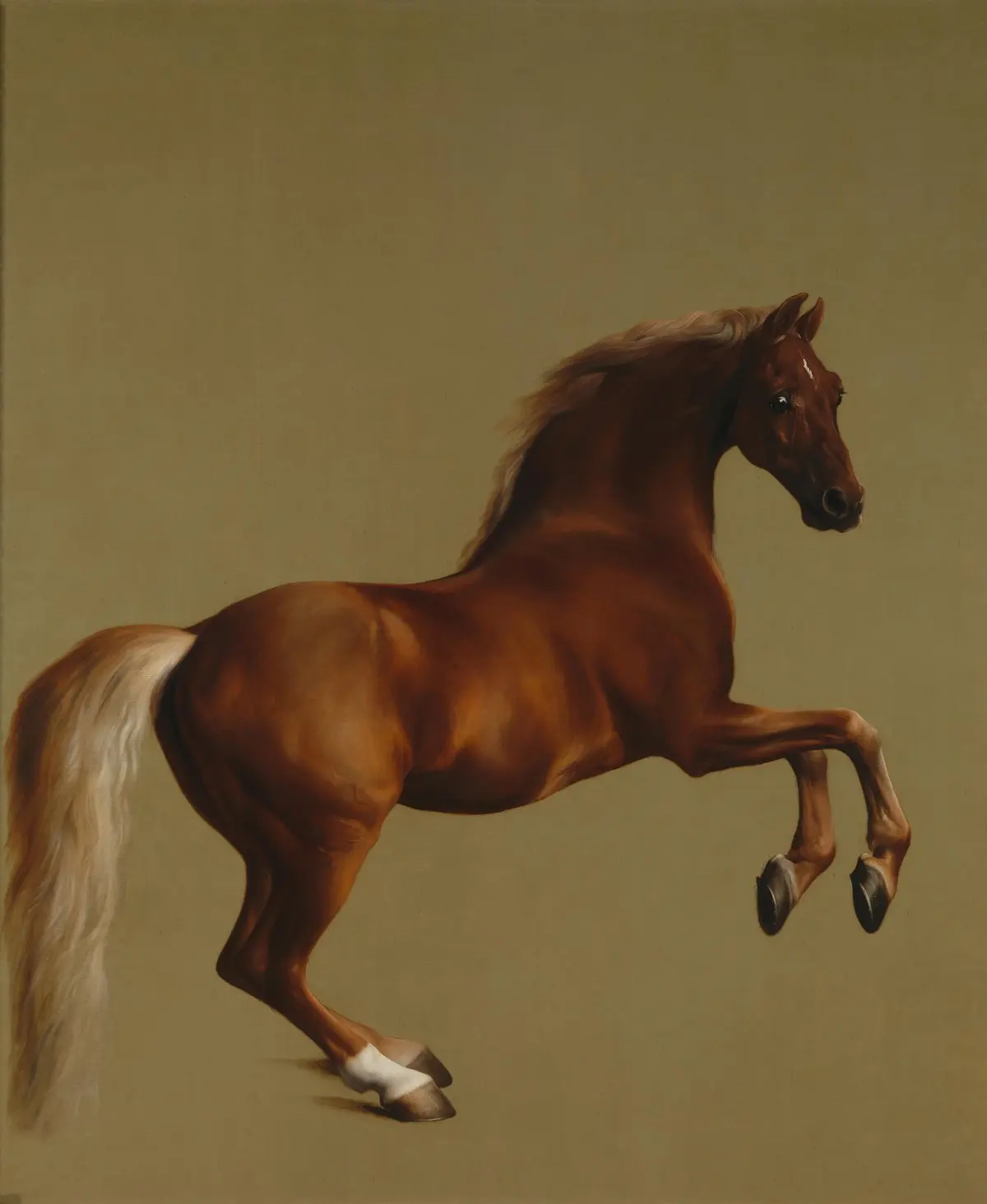
Whistlejacket, a chestnut horse rearing against a plain ground, painted in oil by George Stubbs; its file page dates the canvas to about 1762.
“Whistlejacket, by George Stubbs”, George Stubbs, National Gallery, London; Public Domain Mark.
Full credit
"Whistlejacket, by George Stubbs" by George Stubbs, National Gallery, London — https://commons.wikimedia.org/wiki/File:Whistlejacket_by_George_Stubbs.jpg — Public domain (Painting dated circa 1762 on the file page; the file page's PD-Art license marks the work public domain where the term is the author's life plus 100 years or fewer (EU: life plus 70) and in the US (published before 1931), and the photograph as a faithful reproduction of a two-dimensional public-domain work, with Public Domain Mark 1.0); modified: resized from 3,463 x 4,226 to 1,200 x 1,464 px
Lay your hand flat, fingers together, and look at how wide it is across the knuckles. Whatever that width is, the hand used for horses does not depend on it: that hand is a fixed four inches, the figure a Tudor law wrote down.
That law is 27 Hen. 8 c. 6, an act of the 1535/6 session of Parliament held in the twenty-seventh year of Henry VIII's reign. The 1618 Statutes at Large prints it at page 579 page scan, where it rules that “every handfull” should “containe foure inches of the Standard.” NIST Handbook 44 full text still lists the hand at 4 inches, in the brackets it uses for a unit not in general current use in the United States or one believed to be based on custom and usage.
How tall is a horse in hands?
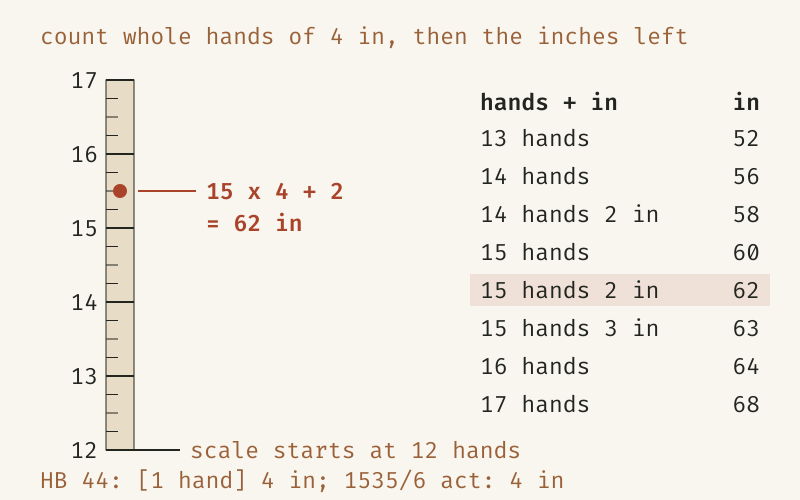
A measuring stick counted in hands of 4 inches, beside a table of heights from 13 to 17 hands; 62 inches works out to 15 hands and 2 inches.
Drawn from NIST Handbook 44 (2026), Appendix C, and the 1535/6 act as printed in 1618 (page scan); inches recomputed as hands × 4 plus the inches left over.
"Horse height in hands: a hand is 4 inches" by Who Decided the Inch, https://whodecidedtheinch.com/old-measures/horse-height-hands/, licensed under CC BY 4.0, https://creativecommons.org/licenses/by/4.0/
Data: NIST Handbook 44 (2026), Appendix C; The Statutes at Large (1618), p. 579
A height in hands counts the whole hands of 4 inches first and then adds whatever inches are left over. A horse that stands 62 inches tall is therefore 15 hands and 2 inches, because 15 hands make 60 inches. Counted in whole inches, the spare inches can only run from 0 to 3, since four more inches would make another whole hand.
One hand is a third of an ordinary 12-inch ruler. NIST Handbook 44 lists the inch as exactly 2.54 centimeters, so a single hand comes to 10.16 centimeters.
How are hands turned into inches?
Multiply the number of hands by 4 and then add the spare inches. The table below runs from 13 hands, the minimum height the 1535/6 act set for its mares, up to 17 hands, with centimeters calculated from the same inch.
| Height | Inches | Centimeters |
|---|---|---|
| 13 hands | 52 | 132.1 |
| 14 hands | 56 | 142.2 |
| 14 hands 2 in | 58 | 147.3 |
| 15 hands | 60 | 152.4 |
| 15 hands 2 in | 62 | 157.5 |
| 15 hands 3 in | 63 | 160.0 |
| 16 hands | 64 | 162.6 |
| 17 hands | 68 | 172.7 |
The table as data (CSV, hands-0022.csv) (source and license notes) Data: NIST Handbook 44 (2026), Appendix C; The Statutes at Large (1618), p. 579
Where did the hand come from?
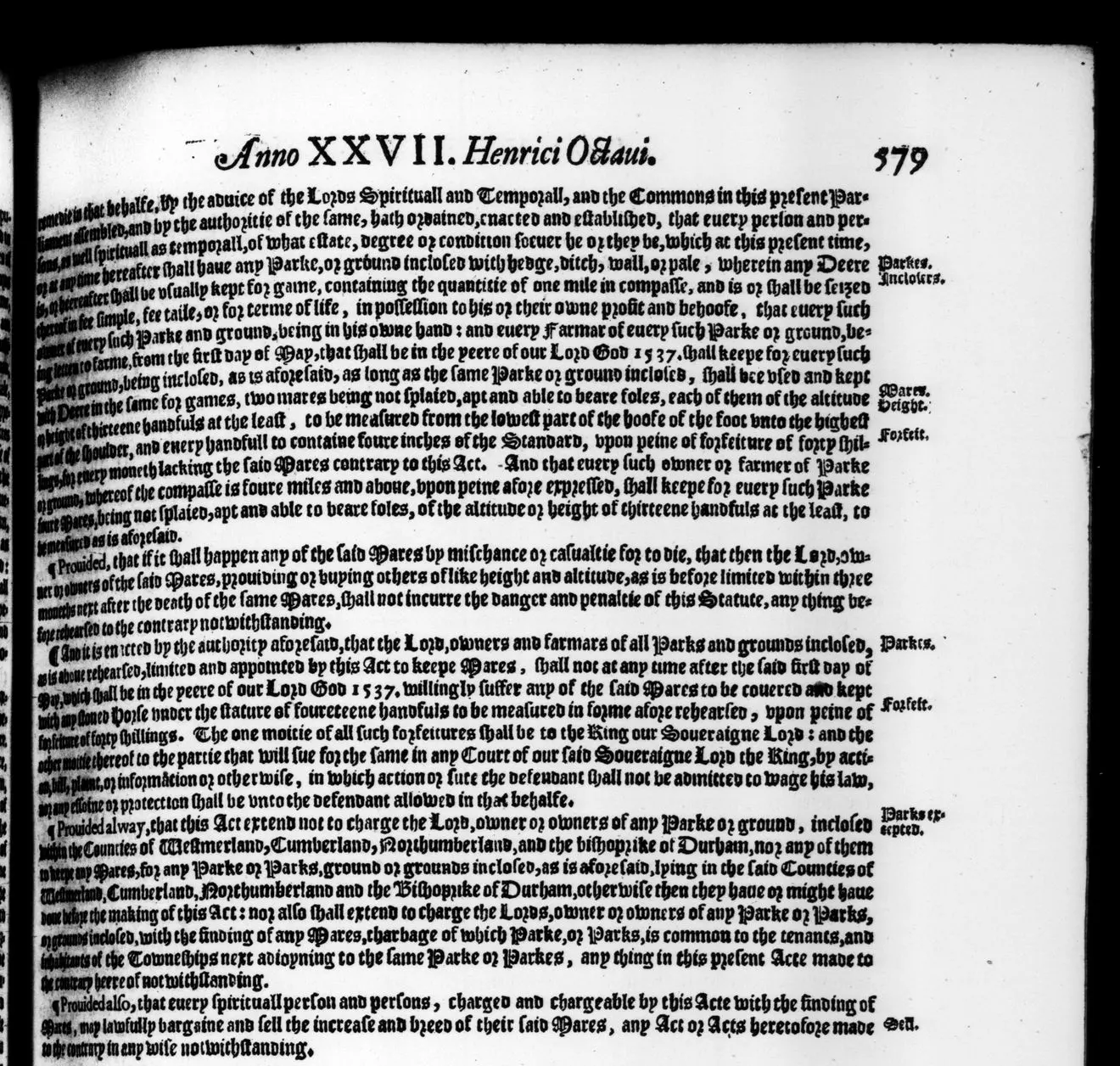
Page 579 of The Statutes at Large (London, 1618): the part of the horse-breeding act that sets the mares' height, the four-inch handful and the 14-handful minimum for stallions allowed to cover those mares.
“The Statutes at Large (London, 1618), p. 579: 27 Hen. 8 c. 6”, England, The Statutes at Large (London, 1618), page 579; public domain.
Full credit
"The Statutes at Large (London, 1618), p. 579: 27 Hen. 8 c. 6" by England, The Statutes at Large (London, 1618), page 579 — https://archive.org/details/bim_early-english-books-1475-1640_the-statutes-at-large-_england-statutes-i_1618 — Public domain (EU: statute printed in London in 1618 with no individual author named, more than 70 years ago (70 years from publication); US: published before 1931); modified: cropped to the top 54.5 percent of the page (the end of 27 Hen. 8 c. 6 and the page head; the next act left out), converted to grayscale and resized to 1,320 px wide
The earliest record of the four-inch hand found for this page is a Tudor act about breeding horses. The 1618 Statutes at Large prints it on pages 578 and 579 as chapter 6 of Henry VIII's twenty-seventh year, under the title “An Act for the increase and breede of Horses” page scan. On page 575, the same printing places that session at Westminster, from “the fourth of February” until “the 14. day of Aprill.”
That page gives the king's year and the months, not a year of the Lord. The year is worked out from them. February to April of Henry VIII's twenty-seventh year is what modern reckoning records as 1535/6.
The act opens with its reason. In many places, it complains, “little Horses, and Nags of small stature and value” were allowed to graze and “to cover Mares and Fillies of very small stature,” so that the breed of “good and strong Horses” was “lately diminished, altered and decayed.”
What did the act require?
Its answer, on page 579, was a height rule for the mares kept in deer parks.
The quotation that follows keeps the 1618 spelling, with the long s and the u used for v put in modern form.
The 1618 text requires “two mares being not splaied, apt and able to beare foles, each of them of the altitude or height of thirteene handfuls at the least, to be measured from the lowest part of the hoofe of the foot unto the highest part of the shoulder, and every handfull to containe foure inches of the Standard, upon peine of forfeiture of forty shillings, for every moneth lacking the said Mares contrary to this Act.”
In modern words, every enclosed deer park one mile around had to keep two mares that were able to bear foals. Each mare had to be at least 13 handfuls high, measured from the bottom of the hoof to the top of the shoulder, and each handful was four inches of the official standard. Lacking the mares cost the keeper forty shillings for every month, unless a mare that died by mischance was replaced within three months. Parks four miles around or more had to keep four such mares.
A second clause turned to stallions. After “the said first day of May,” which the page places in 1537, owners were not to let those mares be covered by any “stoned Horse,” meaning an uncut stallion, “under the stature of foureteene handfuls.” The rules therefore applied from 1 May 1537, about a year after the 1535/6 session ended, and they did not reach parks in Westmorland, Cumberland, Northumberland or the bishopric of Durham.
Why hands and not inches?
The act does not say. It uses the handful as a word its readers already knew and then pins it to “foure inches of the Standard,” so the legal handful is counted in inches rather than taken from anyone's actual hand. No source read for this page tells when horse keepers began counting in hands. A later edition of the Statutes at Large also holds the furlong and the mile, and shoe sizes are another count tied to the body, kept in barleycorns.
Where on a horse is height measured?
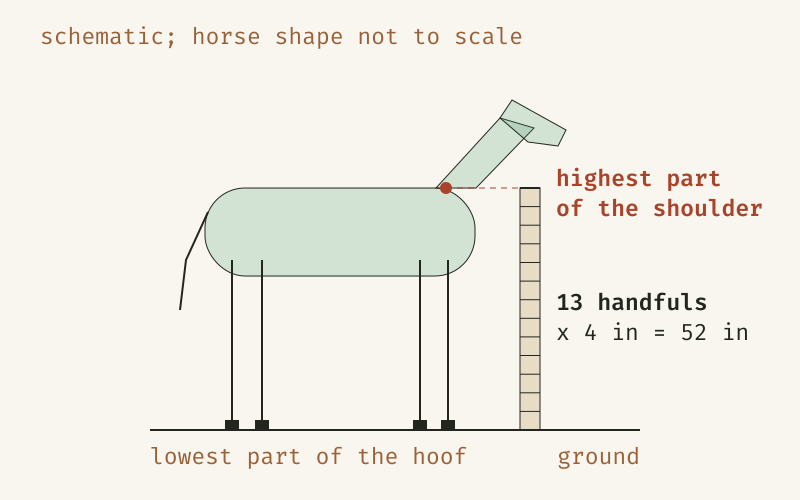
A schematic of the act's rule: 13 handfuls of 4 inches, 52 inches in all, from the lowest part of the hoof to the highest part of the shoulder; the horse shape is not to scale.
Drawn from The Statutes at Large (1618), p. 579 (page scan); 13 × 4 recomputed to 52 inches; a schematic, not a copy of any drawing.
"Where the 1535/6 act measured a horse: from the hoof to the highest part of the shoulder" by Who Decided the Inch, https://whodecidedtheinch.com/old-measures/horse-height-hands/, licensed under CC BY 4.0, https://creativecommons.org/licenses/by/4.0/
Data: The Statutes at Large (1618), p. 579
The 1535/6 act named both ends of the measurement. It ran “from the lowest part of the hoofe of the foot unto the highest part of the shoulder,” which leaves the head and neck out of the count. By that rule, a mare of 13 handfuls stood at least 52 inches at the shoulder, or 4 feet 4 inches, while a stallion allowed to cover her had to reach 14 handfuls, which is 56 inches.
Some things are still open. The act shows the four-inch hand written into law by 1537, but not where the handful began or who first used it. No open breed or show rulebook was read for this page, so how horse heights are written down and taken today is not set out here.
Sources
- The Statutes at Large (London, 1618), pp. 575, 578-579 and 699-700: 27 Hen. 8 c. 6, An Act for the increase and breede of Horses (pp. 575, 578-579); 32 Hen. 8 c. 42, An Act concerning Barbors and Surgeons to be of one Companie (pp. 699-700). Public domain (EU and US: printed 1618). archive.org/details/bim_early-english-books-1…How far it was read: page scan; pp. 575, 578-579 and 699-700
- NIST Handbook 44 (2026), Appendix C: General Tables of Units of Measurement. National Institute of Standards and Technology. U.S. Government work (17 U.S.C. §105). www.nist.gov/document/2026-nist-handbook-44-ap…How far it was read: full text; Appendix C, 2026 edition, tables and notes
Cite this page
Who Decided the Inch. “Hand Horse Measurement: Four Inches, Set by a Tudor Law.” Published November 22, 2026. https://whodecidedtheinch.com/old-measures/horse-height-hands/. Accessed on the day you read it.
- To the original: how sources are read
- Marked in the margin: every correction
- Report an error on this page (contact@whodecidedtheinch.com)
Related entries
 Illustration
Inch History: Three Barleycorns, in a Rule With No Date
Illustration credit
Illustration: Who Decided the Inch. Generated schematic image — not a photograph or historical record. No copyright is claimed in this generated illustration; if you reuse it, please keep this label.
Why Is a Mile 5,280 Feet? 8 Furlongs, 40 Rods, 16.5 Feet
Picture credit
"175 miles to London" by Tim Green from Bradford — https://commons.wikimedia.org/wiki/File:175_miles_to_London_(16669202367).jpg — CC BY 2.0 (https://creativecommons.org/licenses/by/2.0/); modified: resized from 2,683 x 3,433 to 938 x 1,200 px, whole frame
Horsepower Definition: Farey Said Few Horses Could Match It
Picture credit
"Horse gin in use (detail), from The Illustrated Exhibitor, 1851" by Unknown engraver, The Illustrated Exhibitor (1851) — https://commons.wikimedia.org/wiki/File:Horse_Gin_in_use.jpg — Public domain (EU: anonymous engraving, published in The Illustrated Exhibitor in 1851, more than 70 years ago (70 years from publication); US: published before 1931; marked Public Domain Mark 1.0 on the file page); modified: cropped to the left part of the engraving (two horses and the gin arms)