No. 1 Origin entry
Who Invented the Traffic Light? London Had a Signal by 1869
Who Decided the Inch Published
Origin card
Short answer
Credit is split in the records read for this page: The Builder of 19 December 1868 gave the idea for a gas-lit semaphore signal near the Houses of Parliament to Knight, a South-Eastern Railway superintendent, and the building to Saxby & Farmer. Garrett Morgan's American traffic signal patent came later, in 1923.
- Name
- Traffic light
- Category
- Objects
- Earliest known record
- 1868 · report of a semaphore signal-post in The Builder, 19 December, the earliest record of a street signal found for this page · Westminster, LondonThe earliest known record is not the same as the time or place of invention.
- Origin attribution
- Documented for the London signal: The Builder credits the idea to Mr. Knight and the building to Saxby & Farmer; no single inventor of the traffic light is named in the records read
- Key document
- The Builder, 19 December 1868, p. 926 page scan; The Builder, 9 January 1869, p. 28 page scan; Hansard, House of Commons, 11 March 1869 full text; U.S. Patent 1,475,024, Garrett A. Morgan, 1923 page scan; the 1866 select committee record, not yet read
- Still in use?
- Yes, signals still hold and release traffic at street crossings, as of 2026
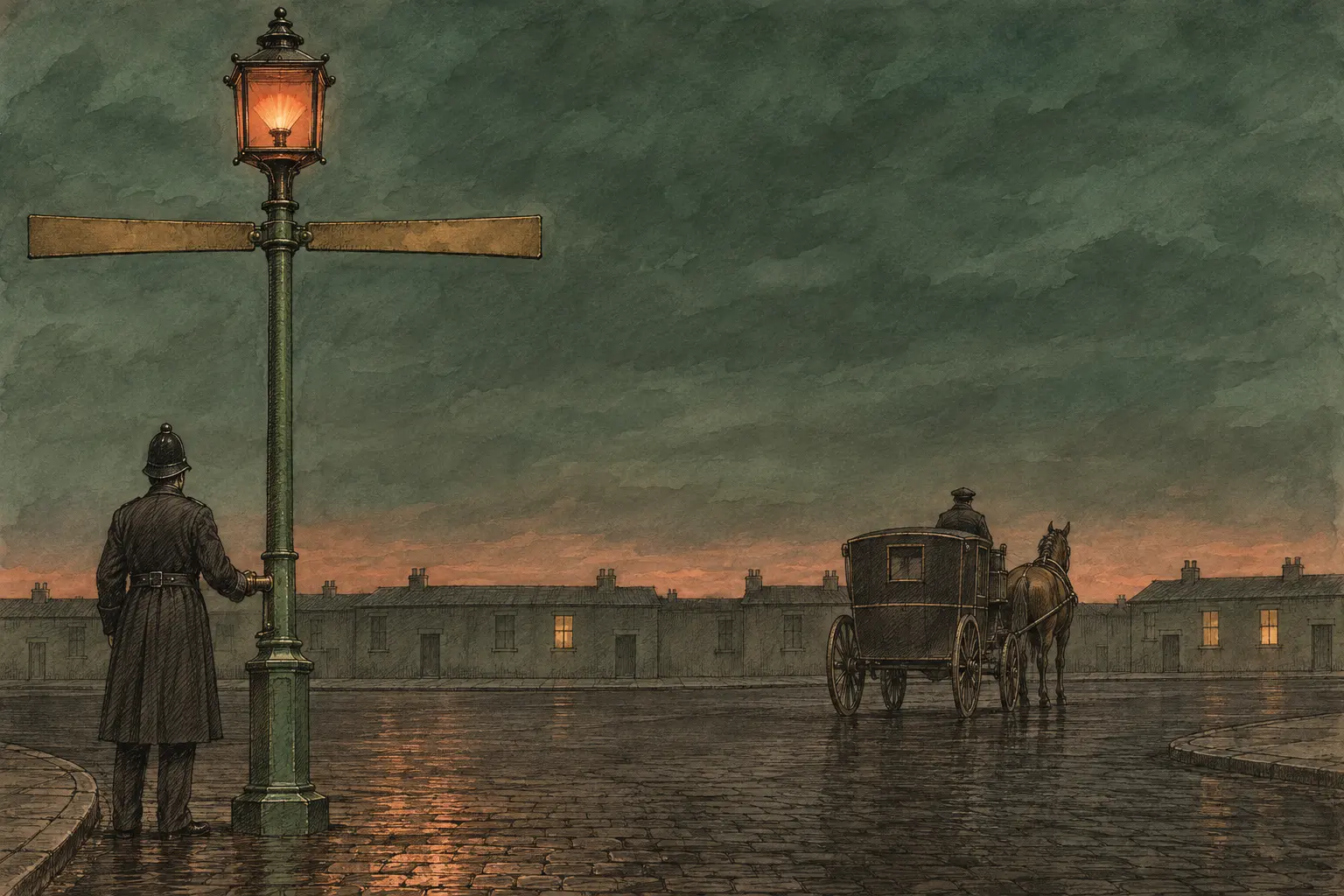
An illustration of an early street signal: flat arms held level for stop, with a gas lamp above them.
Illustration: Who Decided the Inch. Generated schematic image — not a photograph or historical record. No copyright is claimed in this generated illustration; if you reuse it, please keep this label.
Wait at a red light, and a box on a pole decides when a whole street moves. Signals like that did not start as boxes of lamps; one early street signal stood beside the Houses of Parliament in London, with swinging arms like a railway signal and gas lights near the top.
A London weekly, The Builder, described that cast-iron “semaphore signal-post” on 19 December 1868 page scan, and it credited the idea to a railway man, Mr. Knight. On 11 March 1869, the House of Commons was told the signal had been “partially successful” full text. No document read for this page names one inventor of the traffic light, and Garrett A. Morgan's U.S. patent for a traffic signal came decades later, in 1923.
Where did London's 1868 street signal stand?
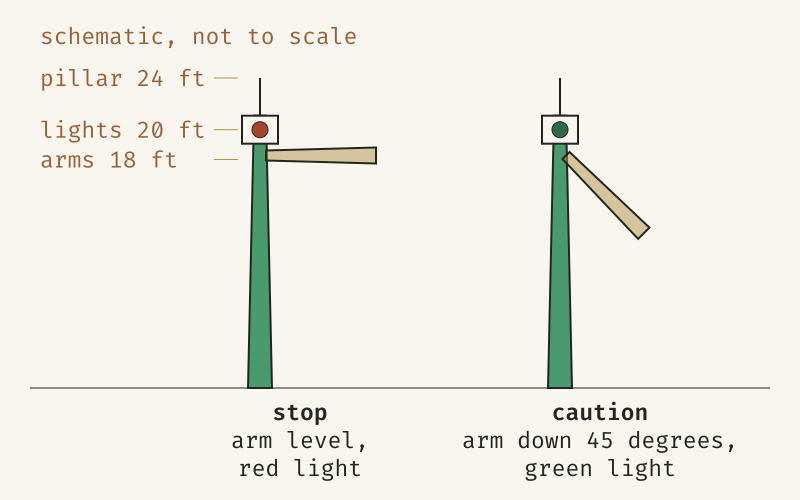
A schematic, not to scale, of the two positions The Builder described in December 1868: arm level with a red light for stop, arm dropped to 45 degrees with a green light for caution.
Drawn from The Builder, 19 December 1868, p. 926, read from the page scan; heights and arm positions as printed there; a schematic, not a copy of any picture of the signal.
"Two positions of the Westminster semaphore signal described in The Builder, 19 December 1868" by Who Decided the Inch, https://whodecidedtheinch.com/objects/traffic-light/, licensed under CC BY 4.0, https://creativecommons.org/licenses/by/4.0/
Data: The Builder, 19 December 1868, p. 926
The earliest record of a street signal found for this page is a short report headed “Semaphore Street Signals,” on page 926 of The Builder for 19 December 1868 page scan. A semaphore is a signal that speaks through the angle of a raised arm, as railway signals did. The report describes a post “erected by Messrs. Saxby & Farmer, railway-signal engineers, to the order of Sir Richard Mayne,” at “the south end of Parliament-street, Westminster.”
The pillar was cast iron and hollow, 24 ft high, with the rods, cranks and gas pipe hidden inside. Its arms were 4 ft long and stood 18 ft above the street, with the lights at 20 ft. A level arm meant stop and an arm dropped to 45 degrees meant caution: “red for stop, and green for caution or walking pace.” At night the same movement showed a red or a green light.
That height was the point. The report says the signals could be seen from Birdcage Walk, Westminster Bridge, the end of Whitehall and Old Palace Yard, “a great advantage as contrasted with the uplifted hand of the policeman, not seen until the crossing is reached.” This experimental pillar had three arms, not four, because it was not meant to stop traffic in one of the four streets.
The barber pole is another street sign with a story attached.
Who designed it, and did it explode?
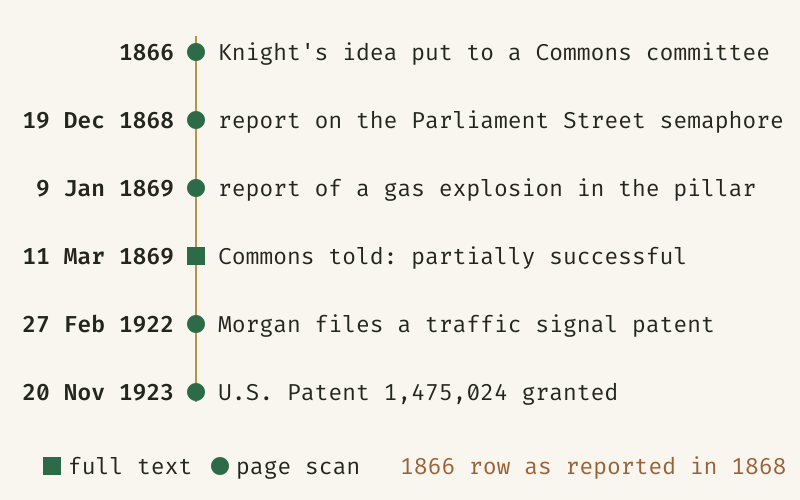
Six dated records, from Mr. Knight's proposal as reported in 1868 to Morgan's patent of 1923, each marked by how far it was read.
Drawn from The Builder, 19 December 1868 and 9 January 1869 (page scans), Hansard for 11 March 1869 (full text) and U.S. Patent 1,475,024 (page scan); the six records in date order.
"From a street semaphore in Westminster to Garrett A. Morgan's 1923 patent" by Who Decided the Inch, https://whodecidedtheinch.com/objects/traffic-light/, licensed under CC BY 4.0, https://creativecommons.org/licenses/by/4.0/
Data: The Builder, 19 December 1868, p. 926; The Builder, 9 January 1869, p. 28; Hansard, HC Deb 11 March 1869; U.S. Patent 1,475,024 (Garrett A. Morgan, 1923)
The Builder gives the idea to one man and the building to a firm. “The idea of applying the semaphore and coloured light system of signalling, as commonly employed on railways, to the regulation of street traffic, originated with Mr. Knight, superintendent of the South-Eastern Railway,” the December report says. It adds that he made the recommendation to a select committee of the House of Commons in 1866. That committee's own record was not read for this page, so the 1866 date rests on the journal's word.
Three weeks later the same journal reported trouble. On page 28 of its issue for 9 January 1869 page scan, it said the pillar had suffered “two accidents from gas explosions, for which its designers, or makers, are in no way chargeable.” Gas leaking from mains near the pillar had seeped into the hollow pillar and caused “a violent explosion on Saturday night, when the constable opened the small door with the intention of turning off the gas from the signal lights.”
The report does not say whether the constable was hurt, but it does say that “the police report favourably of the working” of the signal, and that the road around its base was being loosened so leaking gas could escape into the air. This second report places the pillar “at the corner of New Palace-yard,” while the December report named the south end of Parliament Street.
| Date | Record | Read |
|---|---|---|
| 1866 | Mr. Knight recommends street semaphores to a Commons select committee, as reported in 1868 | page scan |
| 19 December 1868 | The Builder describes the semaphore signal-post at Parliament Street | page scan |
| 9 January 1869 | The Builder reports a gas explosion inside the pillar | page scan |
| 11 March 1869 | The House of Commons is told the signal was partially successful | full text |
| 27 February 1922 | Garrett A. Morgan files his traffic signal application | page scan |
| 20 November 1923 | U.S. Patent 1,475,024 is granted | page scan |
The table as data (CSV, traffic-light-timeline.csv) (source and license notes) Data: The Builder, 19 December 1868 and 9 January 1869; Hansard, HC Deb 11 March 1869; U.S. Patent 1,475,024 (Garrett A. Morgan, 1923)
What did Parliament hear in 1869?
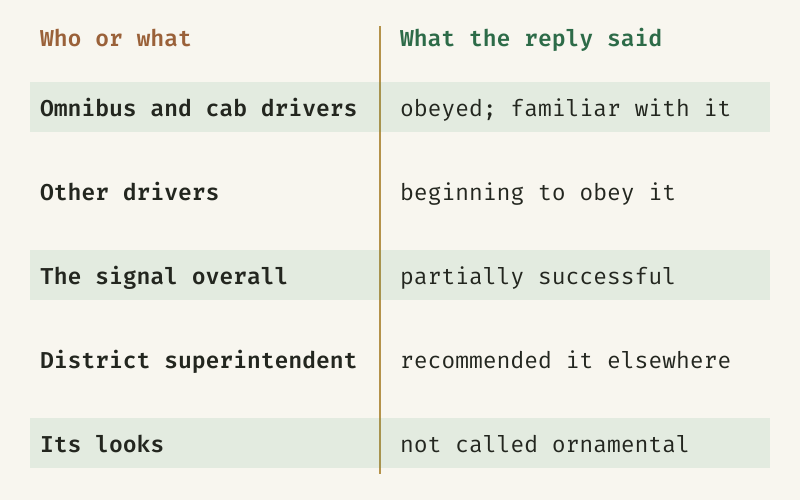
Five points from the reply given in Parliament on 11 March 1869.
Drawn from Hansard, HC Deb 11 March 1869, vol. 194, cols. 1088–1089, full text.
This figure as text
the five points in the reply.
- Drivers of omnibuses and cabs obeyed the signal and were familiar with it.
- Drivers of other vehicles were beginning to obey it.
- The signal had been partially successful, though not completely.
- The district superintendent recommended it for other districts.
- The speaker could not say it was ornamental.
"What the House of Commons heard about the Westminster semaphore on 11 March 1869" by Who Decided the Inch, https://whodecidedtheinch.com/objects/traffic-light/, licensed under CC BY 4.0, https://creativecommons.org/licenses/by/4.0/
Data: Hansard, HC Deb 11 March 1869 vol 194 cc1088-9
On 11 March 1869, Captain Dawson-Damer asked the Home Secretary whether “that structure called a semaphore, on the crossing near the Houses of Parliament, is conducive to the safety of the public,” and if not, whether it would be removed full text. Hansard, the printed record of debates, gives the answer from Mr. Bruce, who began with why the signal was there.
Policemen at the main crossings, he said, had tried “at very great risk to themselves, to stop the great mass of vehicles.” Then he gave the toll: “During the last Session a policeman died of the injuries he received at one of those crossings, and two Members of Parliament were knocked down.” The signal was meant to give drivers “better notice” than “the out-stretched arms of a single policeman.”
His verdict was mixed. The signal “had been partially successful. The signal was obeyed by the drivers of omnibuses and cabs, who were familiar with it,” and other drivers were starting to follow it. The district superintendent recommended it for other districts, and Mr. Bruce hoped it would turn out to be useful, “for he could not venture to assert that it was ornamental.”
What did Garrett Morgan patent?
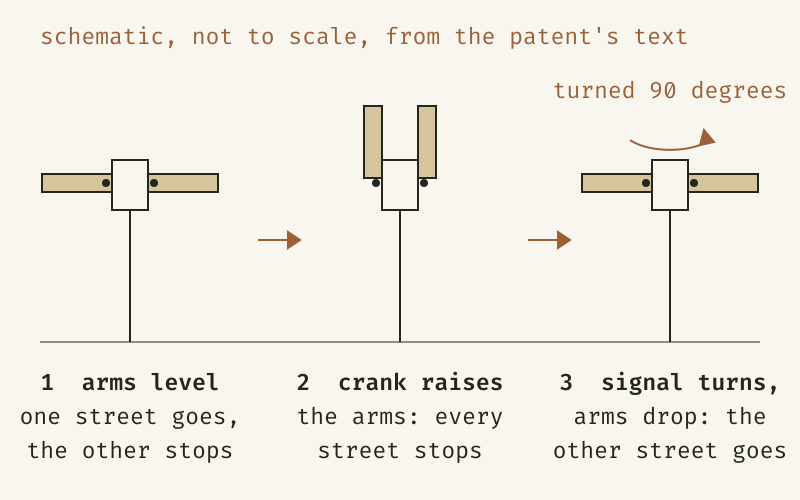
A schematic, not to scale, of the three steps in Morgan's 1923 patent: arms level, arms raised to stop every street, then the signal turned and the arms dropped for the other street, drawn as seen from that street.
Drawn from the specification of U.S. Patent 1,475,024, read from the page scan; a schematic, not a copy of the patent drawing.
"Garrett A. Morgan's 1923 traffic signal in three steps, from the patent's specification" by Who Decided the Inch, https://whodecidedtheinch.com/objects/traffic-light/, licensed under CC BY 4.0, https://creativecommons.org/licenses/by/4.0/
Data: U.S. Patent 1,475,024 (Garrett A. Morgan, 1923), specification
U.S. Patent 1,475,024, “Traffic Signal,” was granted to Garrett A. Morgan of Cleveland, Ohio, on November 20, 1923, from an application filed February 27, 1922 page scan. The specification describes a signal set where two or more streets meet and “manually operable for directing the flow of traffic” (p. 1). It calls the device a “semaphore signal,” the same word used in Westminster 55 years earlier.
Its main idea is a pause. One object, the patent says, is “a visible indicator which is useful in stopping traffic in all directions before the signal to proceed in any one direction is given.” That gives vehicles already partly across time to clear, “thus avoiding accidents which frequently occur by reason of the over-anxiety of the waiting drivers, to start as soon as the signal to proceed is given” (p. 1).
The mechanism runs on a crank. Turning it raises the arms upright, which stops every street; while they are up, the signal turns 90 degrees, and then the arms are released and fall level by their own weight, giving the right of way to the other street. A dashpot, a piston in an air cylinder, softens the fall, and for night use the patent places “two electric lamps” inside the signal (p. 2).
The patent's drawings are not shown here; the figure above is drawn from its words. A patent records what an inventor asked to protect, not whether the signal was built or used. The zipper is another object whose paper trail runs through more than one patent.
How does the patent compare with the story?
The U.S. Patent and Trademark Office tells Morgan's story in its Journeys of Innovation feature “Of courage and caution” full text. The paper trail adds some context to two of its points.
The good story
The caution or “yellow” light is “the most significant part of Morgan's invention,” in the USPTO feature “Of courage and caution.”
The paper trail
The two specification pages read for this page describe the in-between step, as the feature itself also does, as raised arms that stop traffic in all directions; they name no yellow light. page scan
The good story
“Morgan intended for his traffic signal to be more visible than the police officer typically present at busy intersections,” says a caption in the same feature.
The paper trail
The Builder made that case for the Westminster semaphore in 1868, which could be seen from far off, unlike “the uplifted hand of the policeman.” page scan
The 1868 signal had a caution signal of its own, though a different one: its normal position, the arm at 45 degrees with a green light, meant caution or walking pace, not a stop in every direction.
Several things remain unknown. The 1866 select committee record, which might hold Mr. Knight's own proposal, was not read for this page, and neither report in The Builder gives the day the Westminster post went up. No dated record of the first electric street signal was read either; the USPTO feature says only that electric traffic signals “soon replaced mechanical ones.” The page on To the original explains how patents and old journals are read for entries like this one.
Sources
- “Semaphore Street Signals,” The Builder, vol. 26, no. 1350 (London, 19 December 1868), p. 926. Unsigned report. Public domain (EU: anonymous, published 1868; US: published 1868). archive.org/details/sim_building-uk_1868-12-1…How far it was read: page scan; p. 926, the whole report; printed page number and date checked on the page image
- Hansard, House of Commons, Metropolis: Semaphore near Palace Yard, Question, HC Deb 11 March 1869 vol 194 cc1088-9 (Captain Dawson-Damer; Mr. Bruce). Contains Parliamentary information licensed under the Open Parliament Licence v3.0. api.parliament.uk/historic-hansard/commons/1869/mar…How far it was read: full text; the question and the reply, columns 1088-1089
- “The Street Signals in Westminster,” The Builder, vol. 27, no. 1353 (London, 9 January 1869), p. 28. Unsigned report. Public domain (EU: anonymous, published 1869; US: published 1869). archive.org/details/sim_building-uk_1869-01-0…How far it was read: page scan; p. 28, the whole report; printed page number and date checked on the page image
- Garrett A. Morgan, Traffic Signal, U.S. Patent 1,475,024, application filed February 27, 1922, serial no. 539,403, patented November 20, 1923 (United States Patent Office). U.S. patent, published 1923; USPTO: patent text and drawings typically not subject to copyright; drawings not reproduced on this page. image-ppubs.uspto.gov/dirsearch-public/print/downloadPd…How far it was read: page scan; specification pages 1 and 2; the drawing sheets were not reproduced and the claims page was not read
- Rebekah Oakes, “Of courage and caution,” Journeys of Innovation, United States Patent and Trademark Office (web feature, published November 1, 2023, last updated January 14, 2025, as stated on the page). www.uspto.gov/learning-and-resources/journeys-i…How far it was read: full text; the whole feature
Cite this page
Who Decided the Inch. “Who Invented the Traffic Light? London Had a Signal by 1869.” Published November 22, 2026. https://whodecidedtheinch.com/objects/traffic-light/. Accessed on the day you read it.
- To the original: how sources are read
- Marked in the margin: every correction
- Report an error on this page (contact@whodecidedtheinch.com)
Related entries
QWERTY Keyboard: In the 1878 Patent, a Drawing, Not a Claim
Picture credit
"Remington No. 1 typewriter, Wisconsin Historical Museum (DSC02806)" by Daderot — https://commons.wikimedia.org/wiki/File:Remington_No._1_typewriter,_made_by_Remington_%26_Songs,_Ilion,_NY,_1873-1878,_the_first_Sholes_%26_Glidden_model_typewriter_made_by_Remington_-_Wisconsin_Historical_Museum_-_DSC02806.JPG — CC0 1.0 (https://creativecommons.org/publicdomain/zero/1.0/); modified: resized
Barber Pole: An 1813 Book Reads the White Stripe as Bandage
Picture credit
"Barber's pole (AM 615460)" by Auckland Museum — https://commons.wikimedia.org/wiki/File:Barber%27s_pole_(AM_615460).jpg — CC BY 4.0 (https://creativecommons.org/licenses/by/4.0/); modified: resized
 Illustration
Paper Clip: Vaaler’s 1901 U.S. Patent Drew a Different Shape
Illustration credit
Illustration: Who Decided the Inch. Generated schematic image — not a photograph or historical record. No copyright is claimed in this generated illustration; if you reuse it, please keep this label.