No. 2 Long read
Lamplighter: The Job Is Older Than Gas Street Lighting
Who Decided the Inch Published
Origin card
Short answer
A lamplighter lit street lamps by hand, working from a ladder with a light of his own. A woodcut that the Rijksmuseum dates to 1635-1694 shows one walking past lamps on posts; Friedrich Accum reported gas lamps in London's streets in 1815.
- Name
- Lamplighter
- Category
- Lost Trades
- Earliest known record
- 1635-1694 · woodcut by Dirck de Bray, dated by the Rijksmuseum as given on its Wikimedia Commons file page, the earliest record of the job found for this page · Rijksmuseum, AmsterdamThe earliest known record is not the same as the time or place of invention.
- Origin attribution
- Unknown. A trade, not an invention: no record read for this page names who first lit street lamps for pay.
- Key document
- Dirck de Bray, Lantaarnopsteker, woodcut editor's abstract; Friedrich Accum, A Practical Treatise on Gas-light, 1815 full text; Henry Mayhew, London Labour and the London Poor, vol. 1 full text
- Still in use?
- Not settled for this page (checked 2026): no official current record of the trade could be read under its terms.
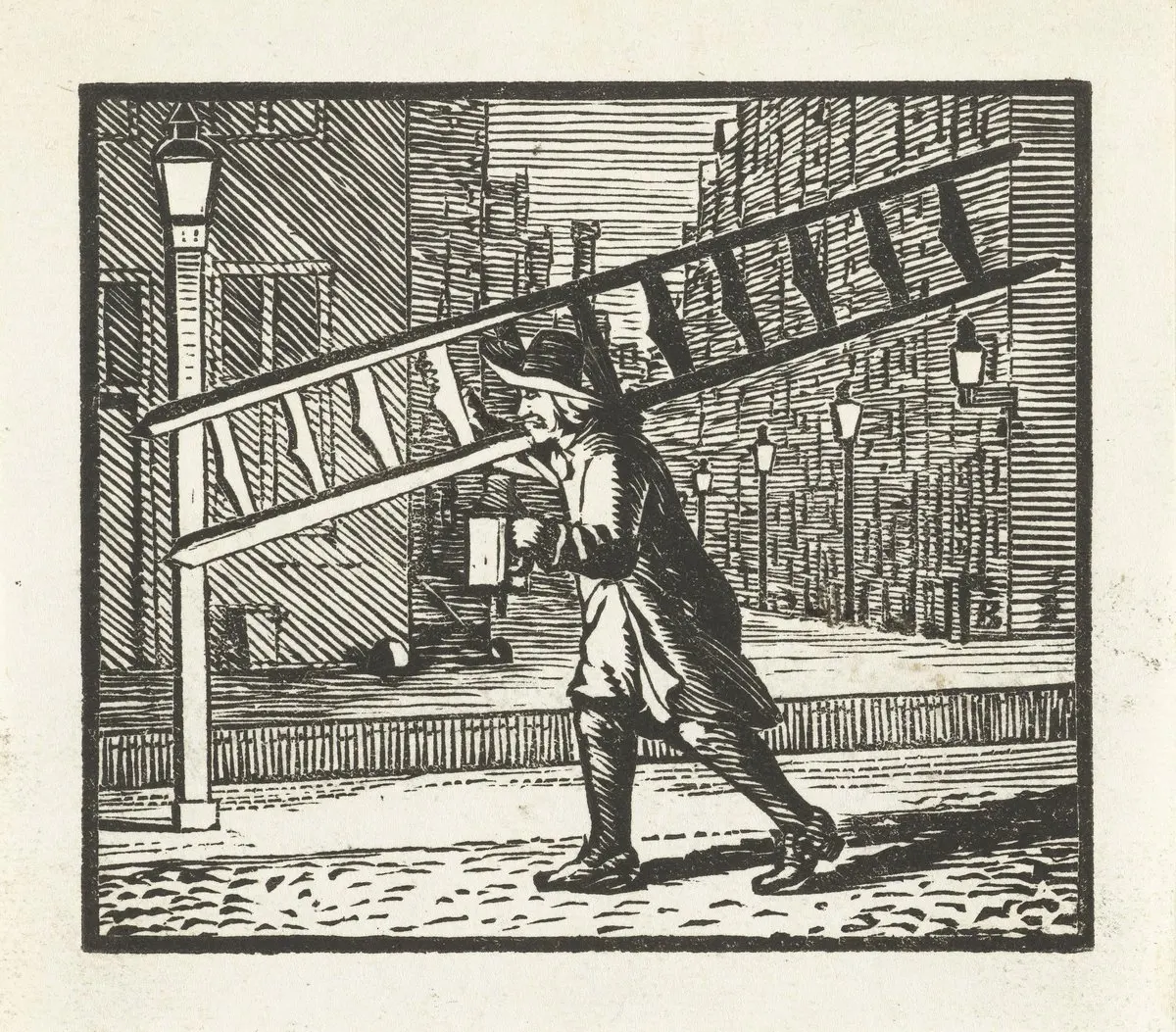
A lamplighter walks a street of lamps on posts, with a ladder on his shoulder and a lantern in his hand, in a woodcut by Dirck de Bray that the Rijksmuseum dates to 1635–1694.
"Lantaarnopsteker (lamplighter), woodcut by Dirck de Bray" by Dirck de Bray, Rijksmuseum — https://commons.wikimedia.org/wiki/File:Lantaarnopsteker,_RP-P-OB-30.866.jpg — CC0 1.0 (https://creativecommons.org/publicdomain/zero/1.0/); modified: the Commons current version is cropped 8% horizontally and 6% vertically from the earlier upload, as stated in the file history, resized from 4,234 x 3,715 to 1,200 x 1,053 px
Flip the switch by your door, and every lamp in the room comes on at once. Street lamps did not always work that way. In a small Dutch woodcut by Dirck de Bray, a man walks past a row of lamps on posts with a ladder over his shoulder and a lantern in his hand. He is a lamplighter, and the Rijksmuseum dates the print to 1635–1694, more than a century before Friedrich Accum reported gas lamps in London’s streets in 1815.
That print is the earliest record of the job found for this page, which is not the same as the beginning of the job. The dated records that could be read are lined up below, from that woodcut to a London estimate of the 1860s and a table of one English town’s street lamps.
Each record carries a mark for how far it was read. Where the records stop, the page says so and leaves the gap open, rather than filling it with a likely-sounding date.
What did a lamplighter do?
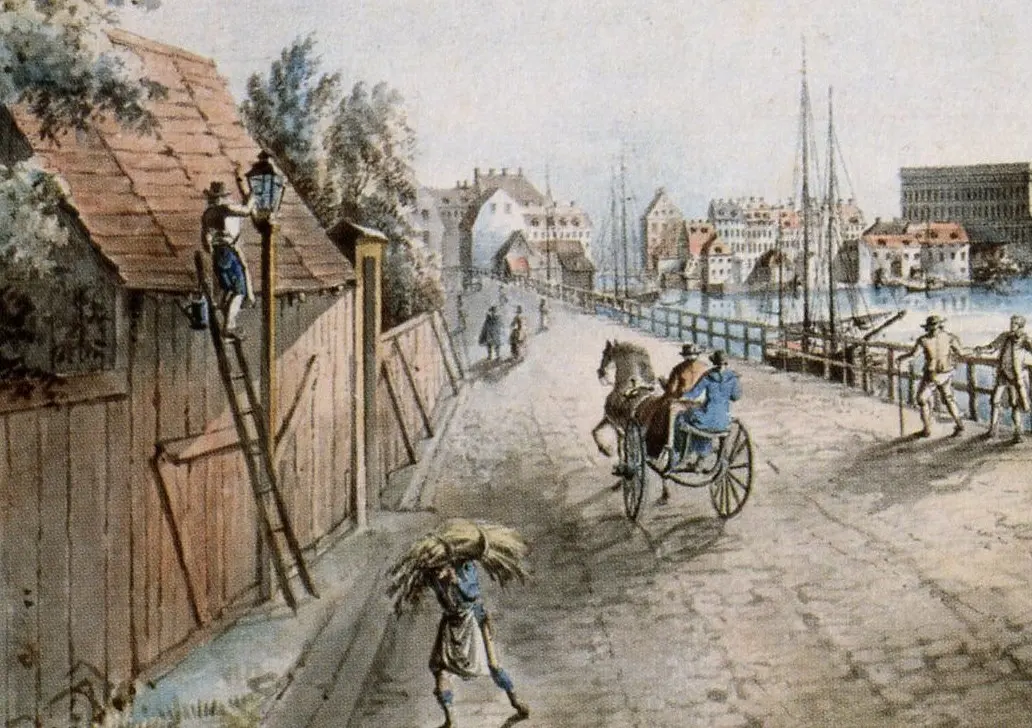
A man on a ladder reaches the lantern on a post beside a Stockholm street, in a colored view by Johan Fredric Martin that its file page dates to 1790 and titles as a lamplighter.
“Lykttändare (lamplighter), view from Kungsholmen, Stockholm”, Johan Fredric Martin, Nationalmuseum; Public Domain Mark.
Full credit
"Lykttändare (lamplighter), view from Kungsholmen, Stockholm" by Johan Fredric Martin, Nationalmuseum — https://commons.wikimedia.org/wiki/File:Lyktt%C3%A4ndare_1790.jpg — Public domain (EU: the file page's license tag marks the work public domain where the term is the author's life plus 100 years or fewer; US: made 1790, published before 1931; marked Public Domain Mark 1.0 on the file page); modified: cropped before upload, as stated on the file page
A lamplighter lit street lamps by hand, one at a time. In the pictures read for this page, the lamps sit on posts above head height, so the work began with a climb. Johan Fredric Martin’s colored view of Stockholm, dated 1790 on its file page, shows it plainly: the Swedish description there begins “En lykttändare,” a lamplighter editor's abstract, and the man in the picture stands on a ladder and reaches up to the lantern on a wooden post.
The Rijksmuseum’s description of the de Bray woodcut, as given on the Wikimedia Commons file page, reads the scene the same way editor's abstract. In this site’s translation from the Dutch, the description says that a lamplighter walks through the streets with a ladder on his shoulder and a lantern in his hand. The museum’s subject terms for the print include street lighting and the oil lamp.
Robert Louis Stevenson wrote the job into a poem for children, “The Lamplighter,” in A Child’s Garden of Verses full text. In the poem, a child at a window watches for a man named Leerie, who comes every night at teatime “with lantern and with ladder.” One line sums up the whole routine: “Leerie stops to light it as he lights so many more.”
Where did Mayhew place the job?
Henry Mayhew put the job into his survey of working London. In London Labour and the London Poor, he sorts the people who earned a living in the streets into divisions and classes full text. Among what he calls the “STREET-LABOURERS,” the second class is “The Lighters and Waterers--or the turncocks and the lamplighters.”
That heading pairs the lamplighter with the turncock. In Mayhew’s classification, the lamplighter is a street worker of the same general kind as the scavenger, the sweeper and the bill-sticker, rather than a seller or a performer.
The job also turns up in the words of the people Mayhew interviewed. In the second volume, “a youth casually employed as a sweeper” describes carrying soot for chimney sweeps on the mornings they hire him full text. Talking about what he would like to be, he says, “something like a lamp-lighter, I think,” and later he repeats it: “I’d rather be a lamp-lighter.”
What did a lamplighter carry?
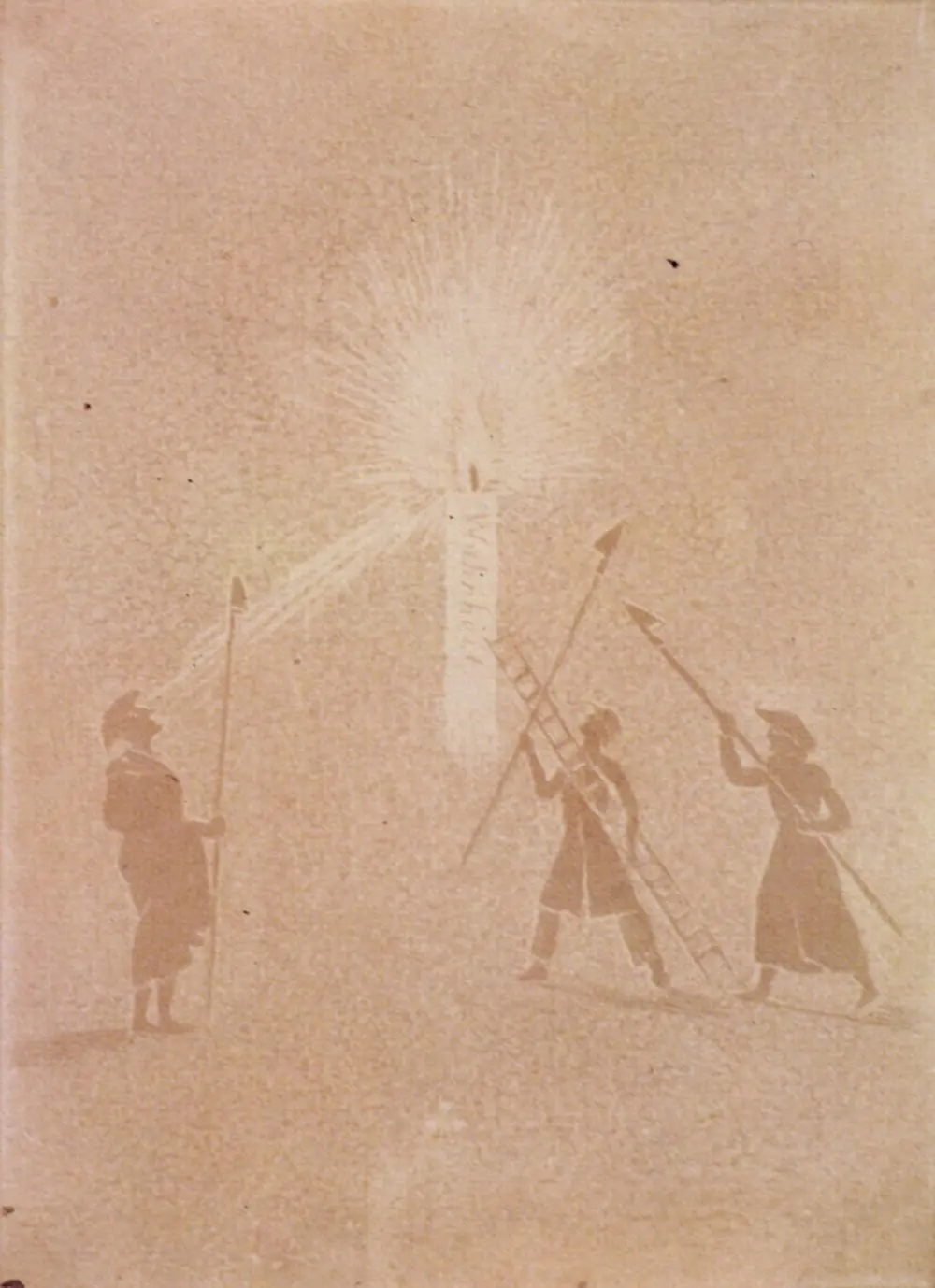
In Johann Carl Enslen’s Drei Laternenmänner, Dresden (three lantern men), dated 1839 on its file page, three figures with poles and a ladder face a giant candle; the file page notes the word Wahrheit, truth, on it.
"Drei Laternenmänner, Dresden, by Johann Carl Enslen" by Johann Carl Enslen, Zeno.org — https://commons.wikimedia.org/wiki/File:Enslen,_Johann_Carl_-_Drei_Laternenm%C3%A4nner,_Dresden_(Zeno_Fotografie).jpg — Public domain (EU: the file page's license tag (PD-old-100-expired) marks the work public domain where the term is the author's life plus 100 years or fewer; US: dated 1839 on the file page, published before 1931; marked Public Domain Mark 1.0 on the file page)
Two tools appear again and again, a ladder and a light. De Bray’s lamplighter carries both, and Stevenson’s Leerie hurries by “with ladder and with light.” Even Enslen’s image of 1839, built around a candle marked with the word for truth rather than around a street, gives one of its three lantern men a ladder editor's abstract.
The lamplighters’ own lamps could smoke badly. Friedrich Accum, writing in 1815 about the new gas lighting, complained that “in lamps, with very large wicks, such as are often suspended before butchers’ shops, or with those of the lamp-lighters, the smoke is very offensive, and in great measure eclipses the light of the flame” full text.
None of the records read for this page lists the full kit. They show the ladder and the light, and Accum adds his complaint that the lamplighters’ own lamps smoked.
How old is the job?
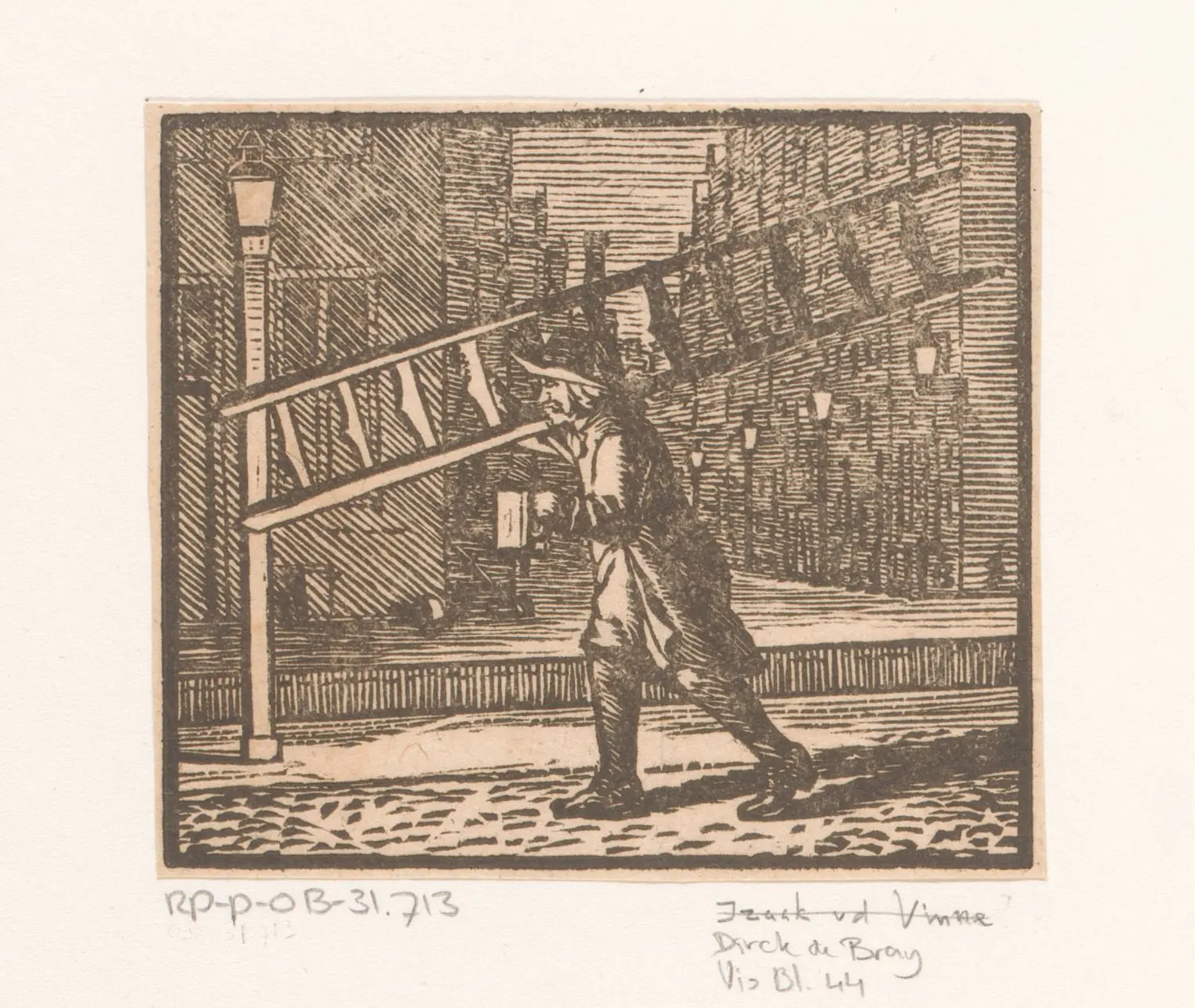
A second impression of de Bray’s lamplighter woodcut in the Rijksmuseum; the mount carries the museum number and the name Dirck de Bray in pencil.
"Lantaarnopsteker (lamplighter), second impression, woodcut by Dirck de Bray" by Dirck de Bray, Rijksmuseum — https://commons.wikimedia.org/wiki/File:Lantaarnopsteker,_RP-P-OB-31.713.jpg — CC0 1.0 (https://creativecommons.org/publicdomain/zero/1.0/)
The job is older than gas street lighting, as the de Bray woodcut and Accum’s 1815 book show together. The Rijksmuseum dates it to 1635–1694, a range rather than a single year, and the inscriptions listed on the file page include no date editor's abstract. The museum holds at least two impressions from the same design, and both file pages give the same catalog reference and the same date range.
The lamps in the print are oil lamps, according to the museum’s subject terms, and that matters for the timing. Accum’s 1815 book compares the new gas lamps with “the parish oil lamps” of London, so oil was what London’s parishes had been using before gas arrived full text.
The job, then, did not arrive with gas. When gas came, the lamps changed. The people who lit them stayed in the record, and the next section sets out the dates that could be read for that change.
How far back the job goes is not settled here. The woodcut is the earliest record found for this page, not evidence of when the first street lamp was lit for pay. Older records may exist in archives that this page could not read under their published terms.
How did gas change the work?
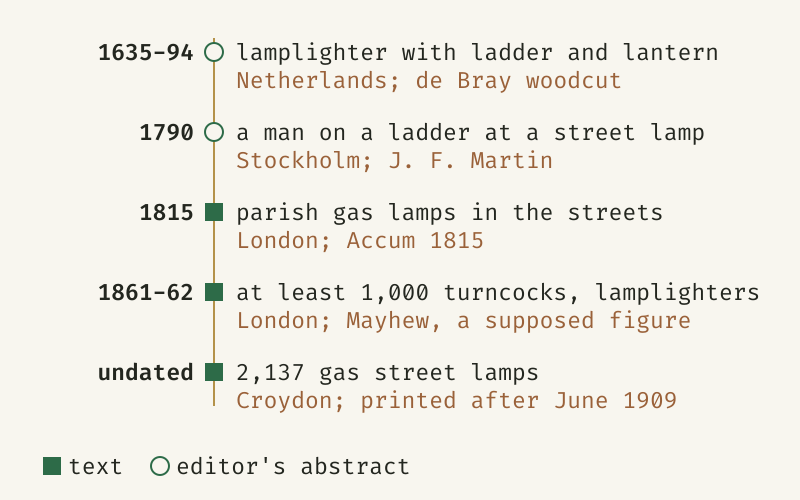
Five dated records about lamplighters and street lamps, each marked by how far it was read: full text or a museum or file-page description.
Drawn from the de Bray and Martin file pages (editor's abstract), Accum 1815, Mayhew’s survey of the London poor and the Britannica’s eleventh edition (full text); the same five records as the table below, in date order.
"Lamplighters and street lamps in the records read for this page" by Who Decided the Inch, https://whodecidedtheinch.com/lost-trades/lamplighter/, licensed under CC BY 4.0, https://creativecommons.org/licenses/by/4.0/
Data: Rijksmuseum and Nationalmuseum descriptions on Wikimedia Commons file pages; Friedrich Accum, A Practical Treatise on Gas-light (1815); Henry Mayhew, London Labour and the London Poor, vol. 1; Encyclopaedia Britannica, 11th edition, vol. 16, Lighting
London’s streets already had gas by 1815. Accum’s treatise, printed in London that year, says the parish gas-light lamps were “now exhibited in the streets of this metropolis” full text. He names “the avenues to the House of Lords and House of Commons, Westminster-hall, Westminster-bridge” among places that had “adopted this species of illumination,” and he traces the gas company’s mains “along the line from Pall Mall to Temple-bar.”
Gas did not remove the lamplighter from the record. Mayhew’s survey, in the text of its enlarged edition of 1861–62, treats lamplighters as one class of London street worker. His rough estimate appears in a long list of street trades that opens with “There are supposed to be at the least” and includes “another thousand chimney-sweeps, and the same number of turncocks and lamp-lighters” full text.
Mayhew does not count turncocks and lamplighters separately. The thousand is the least number he supposes for the two trades together. His estimate was published decades after Accum’s gas lamps.
| Date | Place | What the record shows | Source | Read |
|---|---|---|---|---|
| 1635–1694 | Netherlands | A lamplighter carrying a ladder and a lantern past lamps on posts | Dirck de Bray woodcut, Rijksmuseum (museum dating) | editor's abstract |
| 1790 | Stockholm | A man on a ladder at a street lamp, in a picture titled as a lamplighter | Johan Fredric Martin, Nationalmuseum | editor's abstract |
| 1815 | London | Parish gas-light lamps “now exhibited in the streets” | Accum, A Practical Treatise on Gas-light | full text |
| 1861–62 | London | Turncocks and lamplighters supposed to number at least a thousand | Mayhew, London Labour and the London Poor, vol. 1 | full text |
| undated (printed after June 1909) | Croydon | 2,137 incandescent gas street lamps, in a table the article does not date | Britannica, 11th edition, vol. 16 | full text |
The table as data (CSV, lamplighter-timeline.csv) (source and license notes) Data: Rijksmuseum and Nationalmuseum descriptions on Wikimedia Commons file pages; Friedrich Accum, A Practical Treatise on Gas-light (1815); Henry Mayhew, London Labour and the London Poor, vol. 1; Encyclopaedia Britannica, 11th edition, vol. 16, Lighting
The records do not show how the work itself changed with gas: the hours, the pay, or the difference between lighting a gas lamp and an oil one. None of the sources read for this page describes that, so the page leaves it open. Other street occupations leave similar gaps, among them the town crier, another street job done by voice and bell.
When did the job end?
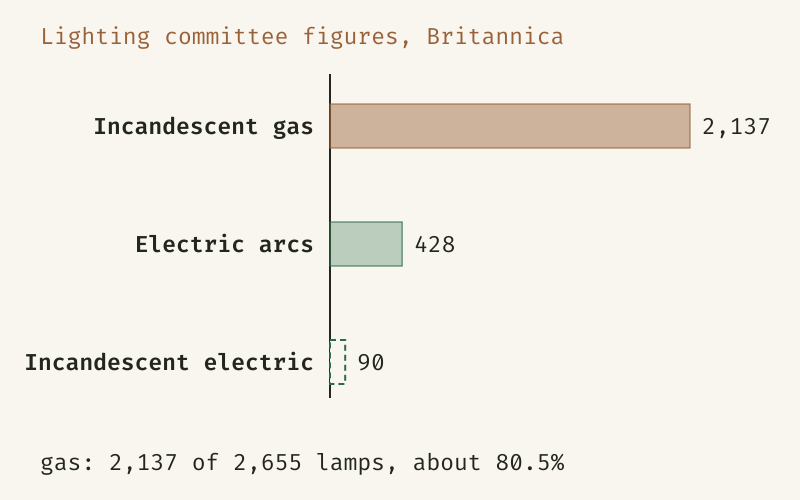
Croydon’s street lamps by type, from the lighting committee’s figures as printed in the Britannica’s eleventh edition; gas makes up about 80.5 percent.
Drawn from the Croydon lighting committee table in the Britannica’s eleventh edition, vol. 16 (full text); 2,137 of 2,655 recomputed to about 80.5 percent.
This figure as text
Croydon’s street lamps by type, as listed in the table.
- Incandescent gas: 2,137 lamps
- Electric arcs: 428 lamps
- Incandescent electric: 90 lamps
"Croydon's street lamps by type" by Who Decided the Inch, https://whodecidedtheinch.com/lost-trades/lamplighter/, licensed under CC BY 4.0, https://creativecommons.org/licenses/by/4.0/
Data: Encyclopaedia Britannica, 11th edition, vol. 16, Lighting: Croydon lighting committee table
The records read for this page do not give an end date. They do show that electric light and gas lamps shared one town’s streets for a period. The eleventh edition of the Encyclopaedia Britannica prints a table issued by the lighting committee of Croydon full text. It counts 2,137 incandescent gas street lamps, 428 electric arc lamps and 90 incandescent electric lamps.
That makes gas 2,137 of 2,655 lamps, or about 80.5 percent, by this page’s arithmetic. The article does not date the table, and although the same volume prints lighthouse returns from June 1909, the year of the Croydon figures themselves is not given.
What did the lamps cost?
The same article shows gas being improved rather than abandoned. It describes two gas lamps, the Lucas and the Scott-Snell, that drew in extra air to burn more brightly, and it reports that “Both these systems are widely used for public lighting in many large towns of the United Kingdom and the continent of Europe” full text.
Cost is the article’s argument for the newer light. It reports tests by Frank Bailey on old and new street lamps in the City of London, expressed as yearly cost per candle-power in pence and without a date. A double-burner low-pressure incandescent gas lamp came to 11.1d. and a flame arc lamp to 5d., and the article states that “The cost of electricity, light for light, is very much less than that of gas.”
The Croydon table counts lamps, not people. It says nothing about who lit Croydon’s gas lamps, or whether a clock or a person did it, so it cannot show how long the job lasted there. It shows something narrower. In this one town, electric lamps had arrived while gas lamps still made up most of the count.
A national count would help, and the 1910 census of the United States includes a volume on occupations, but its tables could not be read for this page. A city council page about central London’s gas lamps could not be used either, because its terms allow copying for personal use only.
So the most important part of the story is still missing here. This page has no readable record of the last year anyone was paid to light street lamps by hand in any city, and no official current record of the trade. The page on ice harvesting follows another trade that winter and machines decided.
Sources
- Dirck de Bray, Lantaarnopsteker (lamplighter), woodcut, Rijksmuseum RP-P-OB-30.866, dated by the museum 1635–1694; the museum's description as given on its Wikimedia Commons file page. Image released by the Rijksmuseum under CC0 1.0. commons.wikimedia.org/wiki/File:Lantaarnopsteker,_RP-P-…How far it was read: editor's abstract; the Rijksmuseum's description and dating as given on the file page, with the print itself
- Friedrich Accum, A Practical Treatise on Gas-light (London: R. Ackermann, 1815). Project Gutenberg ebook 44567. Public domain (EU: author d. 1838, per Project Gutenberg catalog record; US: published 1815). www.gutenberg.org/ebooks/44567How far it was read: full text; the 1815 edition
- Johan Fredric Martin, Lykttändare (lamplighter), view from Kungsholmen over Stockholm, 1790, Nationalmuseum (medium not stated on the file page); as described on its Wikimedia Commons file page. Public domain (EU: the file page's license tag gives the term as life plus 100 years or fewer; US: made 1790; Public Domain Mark on the file page). commons.wikimedia.org/wiki/File:Lyktt%C3%A4ndare_1790.jpgHow far it was read: editor's abstract; the file page's title, date and description, with the image itself
- Robert Louis Stevenson, A Child's Garden of Verses, poem XXX, The Lamplighter. Project Gutenberg ebook 136. Public domain (EU: author d. 1894, per Project Gutenberg catalog record; US: published before 1931). www.gutenberg.org/ebooks/136How far it was read: full text; poem XXX
- Henry Mayhew, London Labour and the London Poor, vol. 1 (London: first edition 1851; enlarged edition 1861–62). Project Gutenberg ebook 55998. Public domain (EU: author d. 1887, per Project Gutenberg catalog record; US: published before 1931). www.gutenberg.org/ebooks/55998How far it was read: full text; the enlarged edition's text: the classes of street-folk and the number of street-folk
- Henry Mayhew, London Labour and the London Poor, vol. 2. Project Gutenberg ebook 60440. Public domain (EU: author d. 1887, per Project Gutenberg catalog record; US: published before 1931). www.gutenberg.org/ebooks/60440How far it was read: full text; the account of a youth casually employed as a sweeper
- Johann Carl Enslen, Drei Laternenmänner, Dresden, 1839; reproduction from Zeno.org; as described on its Wikimedia Commons file page. Public domain (EU and US: the file page gives the artist as dead more than 100 years; made 1839). commons.wikimedia.org/wiki/File:Enslen,_Johann_Carl_-_D…How far it was read: editor's abstract; the file page's title, date and annotation, with the image itself
- Dirck de Bray, Lantaarnopsteker (lamplighter), woodcut, second impression, Rijksmuseum RP-P-OB-31.713, dated by the museum 1635–1694; as described on its Wikimedia Commons file page. Image released by the Rijksmuseum under CC0 1.0. commons.wikimedia.org/wiki/File:Lantaarnopsteker,_RP-P-…How far it was read: editor's abstract; the file page's description, with the image itself
- Encyclopaedia Britannica, 11th edition, vol. 16, slice 6, article Lighting (Croydon lighting committee table). Project Gutenberg ebook 41472. Public domain in the US (published before 1931); the article's author is not named in this slice, so only facts and short quotations are used. www.gutenberg.org/ebooks/41472How far it was read: full text; the Lighting article, section on electric street lighting


Cite this page
Who Decided the Inch. “Lamplighter: The Job Is Older Than Gas Street Lighting.” Published November 22, 2026. https://whodecidedtheinch.com/lost-trades/lamplighter/. Accessed on the day you read it.
- To the original: how sources are read
- Marked in the margin: every correction
- Report an error on this page (contact@whodecidedtheinch.com)
Related entries
 Illustration
Knocker-Upper: In the Records Read, No End Date for the Job
Illustration credit
Illustration: Who Decided the Inch. Generated schematic image — not a photograph or historical record. No copyright is claimed in this generated illustration; if you reuse it, please keep this label.
Switchboard Operator: British Dial Exchanges Took Decades
Picture credit
"Signal Corps telephone operators at switchboard, Toul, 1919 (SC-49623)" by Lt. Fox, United States Army Signal Corps (Army Signal Corps Photo SC-49623) — https://commons.wikimedia.org/wiki/File:SC-49623_Signal_Corps_telephone_operators_at_switchboard.jpg — Public domain (US: work of a U.S. Army Signal Corps photographer made in official duties, 17 U.S.C. §105, per the file page; EU: no separate basis traced (US federal work)); modified: resized from 2,729 x 2,012 to 1,200 x 885 px and saved in grayscale
 Illustration
Town Crier: The Crier’s Oyez Survives in a Courtroom
Illustration credit
Illustration: Who Decided the Inch. Generated schematic image — not a photograph or historical record. No copyright is claimed in this generated illustration; if you reuse it, please keep this label.