No. 2 Origin entry
Switchboard Operator: British Dial Exchanges Took Decades
Who Decided the Inch Published
Origin card
Short answer
A switchboard operator connected callers at a telephone exchange's central station, the work Strowger's 1891 patent set out to do without an operator. In Britain, Hansard records 1 1/2 million telephones still on manual exchanges in 1954, and in 1978 an MP said the Isle of Wight would lose its last manual exchange, at Ryde.
- Name
- Switchboard operator
- Category
- Lost Trades
- Earliest known record
- 1889 · patent application filed March 12, 1889, as printed in the patent dated 1891, which names the operator at the central station; the earliest record found for this page · Kansas City, Missouri, Strowger's stated residenceThe earliest known record is not the same as the time or place of invention.
- Origin attribution
- Unknown. A trade, not an invention: no record read for this page names who began the work of connecting calls.
- Key document
- U.S. Patent 447,918, Almon B. Strowger, 1891 page scan; Hansard, Commons debates of 1914, 1954, 1967 and 1978 full text; Signal Corps photo SC-49623, 1919 editor's abstract
- Still in use?
- Not settled for this page as of 2026: the latest record read, a 1978 Commons debate, still mentions a manual exchange; no current record of the job was read.
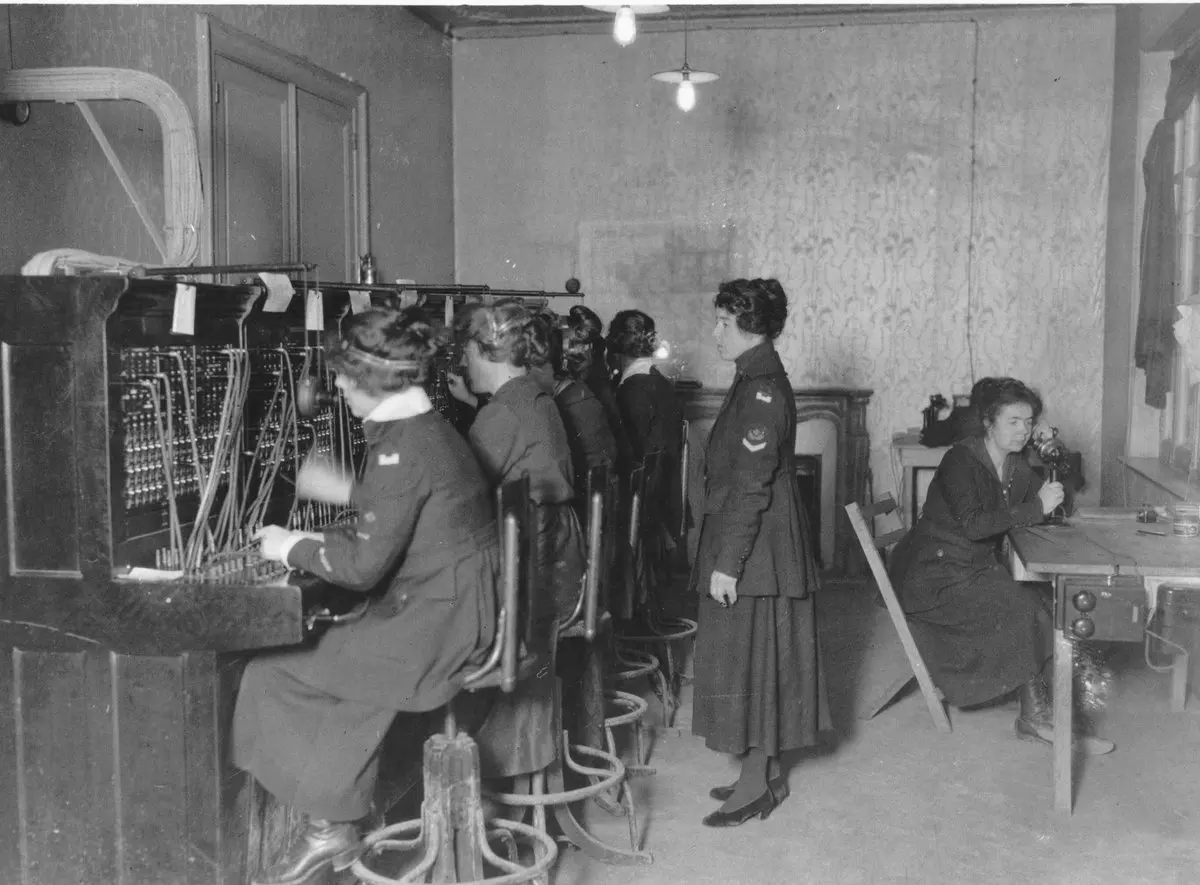
U.S. Army Signal Corps telephone operators at a switchboard in Toul, France, in a photograph dated 14 January 1919 on its file page.
“Signal Corps telephone operators at switchboard, Toul, 1919 (SC-49623)”, Lt. Fox, United States Army Signal Corps (Army Signal Corps Photo SC-49623); public domain.
Full credit
"Signal Corps telephone operators at switchboard, Toul, 1919 (SC-49623)" by Lt. Fox, United States Army Signal Corps (Army Signal Corps Photo SC-49623) — https://commons.wikimedia.org/wiki/File:SC-49623_Signal_Corps_telephone_operators_at_switchboard.jpg — Public domain (US: work of a U.S. Army Signal Corps photographer made in official duties, 17 U.S.C. §105, per the file page; EU: no separate basis traced (US federal work)); modified: resized from 2,729 x 2,012 to 1,200 x 885 px and saved in grayscale
Tap a name in your phone, and the call goes through with no operator joining the lines. Calls were once placed another way. A Kansas City man, Almon B. Strowger, applied in 1889 for a patent on an “automatic telephone-exchange.” Its stated aim was to let one caller reach another “without the assistance of an operator at the central station” page scan.
This page follows that operator, the person working at the central station. The patent was granted in 1891, but a patent is not the end of a job. In Britain, the House of Commons was still hearing about manual exchanges in 1954, 1967 and 1978 full text. The records read for this page show the change arriving one exchange at a time, across decades.
What did a switchboard operator do?
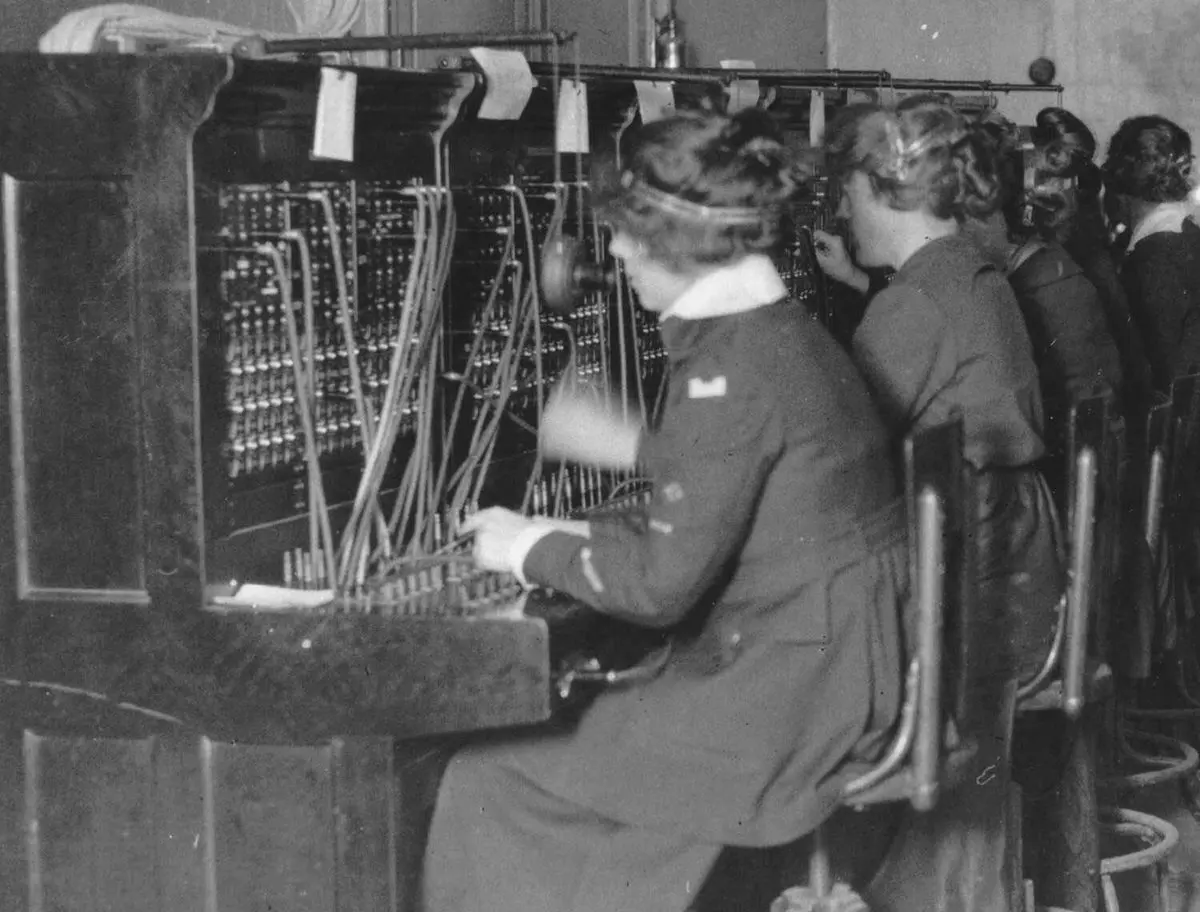
Detail of the 1919 Signal Corps photograph: cords run from a shelf of plugs up to rows of sockets on the board.
“Signal Corps telephone operators at switchboard, Toul, 1919 (SC-49623), detail of the board”, Lt. Fox, United States Army Signal Corps (Army Signal Corps Photo SC-49623); public domain.
Full credit
"Signal Corps telephone operators at switchboard, Toul, 1919 (SC-49623), detail of the board" by Lt. Fox, United States Army Signal Corps (Army Signal Corps Photo SC-49623) — https://commons.wikimedia.org/wiki/File:SC-49623_Signal_Corps_telephone_operators_at_switchboard.jpg — Public domain (US: work of a U.S. Army Signal Corps photographer made in official duties, 17 U.S.C. §105, per the file page; EU: no separate basis traced (US federal work)); modified: cropped to the switchboard (box 0,560 to 1,500,1,700 of 2,729 x 2,012), resized to 1,200 x 912 px and saved in grayscale
A switchboard operator sat at the central station of a telephone system and joined one caller's line to another's. Strowger's patent describes the systems “now in use” when he applied (specification p. 1) page scan. Each had “a principal or central station, (central office,)” and a number of sub-stations. The sub-stations were connected “with each other at the central office” by line-wires.
The patent's purpose shows where the operator stood. Its first stated object is a connection made without the operator at the central station. That person was the part of the system the inventor set out to replace.
The 1919 photograph shows that work at one Army exchange. Its file page gives the title “Signal Corps telephone operators at switchboard,” places it in Toul, France, and names five of the operators from left to right editor's abstract. In the picture, operators in headsets sit before a tall board of sockets, with cords running down to a shelf of plugs.
An American count shows who did the work. The 1917 census of telephones counted 138,971 operators on September 29 of that year, in systems with annual incomes of $5,000 or more; 137,292 were women and 1,679 were men (Table 35, p. 45) page scan. The same table gives 94,360 women among 96,332 operators in 1912. The table and its notes give the numbers but not the reasons.
In the patent, the operator at the central station appears only as the help the machine would do without. The knocker-upper is another lost trade on this site that has to be traced mostly through other people's writing.
What did Strowger's 1891 patent change?
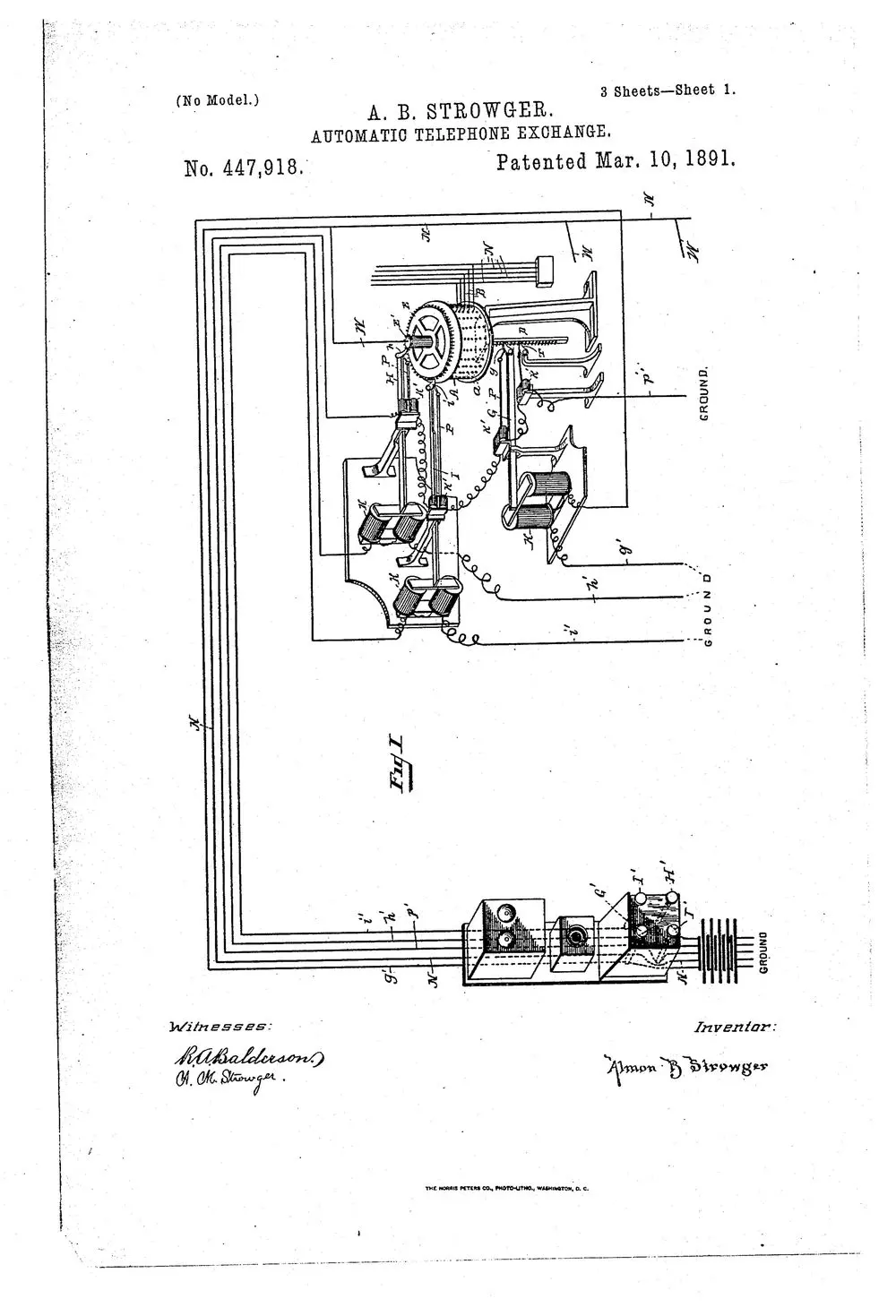
Sheet 1 of U.S. Patent 447,918, dated March 10, 1891; Fig. I shows a distant sub-station's telephone and its exchange device at the central office.
“A. B. Strowger, Automatic Telephone Exchange, U.S. Patent 447,918 (1891), sheet 1”, A. B. Strowger, Automatic Telephone Exchange, U.S. Patent 447,918 (1891), sheet 1; United States Patent and Trademark Office; public domain.
Full credit
"A. B. Strowger, Automatic Telephone Exchange, U.S. Patent 447,918 (1891), sheet 1" by A. B. Strowger, Automatic Telephone Exchange, U.S. Patent 447,918 (1891), sheet 1; United States Patent and Trademark Office — https://image-ppubs.uspto.gov/dirsearch-public/print/downloadPdf/0447918 — Public domain (EU: the draughtsman is not named on the sheet and the drawing was published in 1891, more than 70 years ago (70 years from publication); the inventor's death year was not traced to a source read for this page; US: U.S. patent drawing published 1891, before 1931; patent text and drawings are typically not subject to copyright); modified: page image of the USPTO PDF at 150 dpi resized to 1,000 x 1,469 px and saved as grayscale JPEG; whole sheet shown
U.S. Patent 447,918 is dated March 10, 1891, two days short of two years after the March 12, 1889 filing page scan. In place of a person, it puts a machine at the central office. The wires to the other stations end inside a hollow cylinder, in numbered rows. A needle inside the cylinder moves from row to row and from wire to wire until it touches the right one.
The caller moves that needle from the sub-station with keys. In the patent's own example (specification p. 2), telephone 288 wants to reach telephone 315, so the caller presses “the key marked G' three times, then the key marked H' once, and then the key marked I' five times.” Three, one and five give the number 315, one digit at a time. A fourth key, marked P', sends the needle back to where it started.
The patent even calls the caller the operator. Each push of the button at the sub-station is “made at the will of the operator” (p. 2), and that operator is the person at the sub-station. The text describes keys, not a dial. Its five claims each cover a combination of parts: wires ending in a cylinder or curved surface, a contact-needle, levers, pawls and magnets.
A patent shows what was claimed, not what was built or how widely it was used. Equipment of Strowger's type did reach Britain. In March 1914, the Commons was told that “experimental exchanges equipped with automatic telephone plant of the Strowger type” had opened at Epsom and at the General Post Office, London, in May and July 1913 full text. Ten more places, from Accrington to Stockport, were to get automatic exchanges so that the results of “replacing manual by automatic equipment” could be tested.
How long did manual switchboards last?
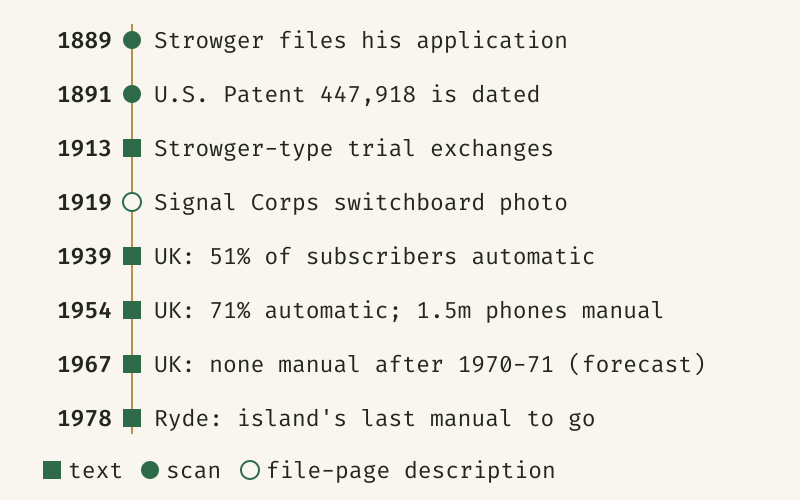
Eight dated records about the operator's job and the automatic exchanges that followed, each marked by how far it was read.
Drawn from U.S. Patent 447,918 (page scan), the Signal Corps file page (editor's abstract) and Commons debates of 1914, 1954, 1967 and 1978 (full text); dates sorted, with the same eight rows as the table below.
"Strowger's patent and the slow end of Britain's manual telephone exchanges" by Who Decided the Inch, https://whodecidedtheinch.com/lost-trades/switchboard-operator/, licensed under CC BY 4.0, https://creativecommons.org/licenses/by/4.0/
Data: U.S. Patent 447,918 (1891); Hansard, House of Commons, 1914, 1954, 1967 and 1978; Signal Corps photo SC-49623, Wikimedia Commons file page
In the British records read for this page, the change took decades. In a Commons debate of May 1954, the Assistant Postmaster-General, David Gammans, gave the figures full text. When war broke out, he said, 51 percent of subscribers were on an automatic exchange, and “The figure today is 71 per cent.” He added that 1 1/2 million telephones were “still connected to a manual exchange,” against 4 1/2 million on automatic ones.
That is one telephone in four still on a manual exchange in 1954, by this page's arithmetic. In the same speech, Gammans compared the two kinds of exchange. On a manual exchange, the speed of answer had been 10 seconds in 1946 and was down to seven. On automatic exchanges it had fallen from about 10 seconds to about five.
In March 1967, the Postmaster-General, Edward Short, set a finish line full text. By the end of that year, he said, “fewer than 3 per cent, of subscribers will be connected to manual exchanges, and there will be none at all after 1970–71.” That was a forecast, not a record of closures. Short also said subscribers on S.T.D. exchanges could dial “on average only about 80 per cent. of their calls; the rest have to go via the operator.”
| Date | Place | What the record shows | Source | Read |
|---|---|---|---|---|
| 12 March 1889 | Kansas City, Missouri (his stated residence) | Strowger files his application for an automatic telephone exchange | U.S. Patent 447,918 | page scan |
| 10 March 1891 | United States | Patent 447,918 is dated; its aim is a connection without an operator at the central station | U.S. Patent 447,918 | page scan |
| May and July 1913 | Epsom and London | Experimental exchanges with automatic plant of the Strowger type open | Hansard, 24 March 1914 | full text |
| 14 January 1919 | Toul, France | Signal Corps photograph of telephone operators at a switchboard | Commons file page, SC-49623 | editor's abstract |
| 1939 | United Kingdom | 51 percent of subscribers on automatic exchanges when war broke out | Hansard, 14 May 1954 | full text |
| 1954 | United Kingdom | 71 percent automatic; 1 1/2 million telephones still on manual exchanges | Hansard, 14 May 1954 | full text |
| 1967 | United Kingdom | Forecast: fewer than 3 percent on manual exchanges by year end, none after 1970–71 | Hansard, 15 March 1967 | full text |
| 1978 | Ryde, Isle of Wight | An MP says the island will lose its last manually operated exchange | Hansard, 10 February 1978 | full text |
The table as data (CSV, switchboard-timeline.csv) (source and license notes) Data: U.S. Patent 447,918 (1891); Hansard, House of Commons, 1914, 1954, 1967 and 1978; Signal Corps photo SC-49623, Wikimedia Commons file page
When did the last manual exchanges close?
The records read here do not show whether that forecast was met. In February 1978, Stephen Ross, the MP for the Isle of Wight, told the Commons that the island would lose its “last manually operated telephone exchange in Ryde,” with 50 to 60 jobs at stake full text. The minister who replied said the Post Office regarded the Ryde exchange as “reaching the end of its useful life.” The debate does not say whether Ryde was the kind of local manual exchange the 1967 forecast covered.
From the Strowger-type trials of 1913 to that 1978 debate is 65 years. Over that span, the British records show manual and automatic exchanges working side by side, with operators still answering calls on the manual ones.
Much of this slice of telephone operator history remains open here. The date Ryde actually closed was not found, and no record read for this page names the last manual exchange anywhere. Nor does any record read for this page give a closing year for manual working in the United States. The page on ice harvesting follows another lost trade with no single closing date.
Sources
- Almon B. Strowger, Automatic Telephone-Exchange, U.S. Patent 447,918, dated March 10, 1891; application filed March 12, 1889, serial no. 303,027. Three drawing sheets and three pages of specification. U.S. patent, published 1891; USPTO: patent text and drawings typically not subject to copyright. image-ppubs.uspto.gov/dirsearch-public/print/downloadPd…How far it was read: page scan; drawing sheet 1 and all three specification pages, with the five claims
- U.S. Army Signal Corps, photo SC-49623, Signal Corps telephone operators at switchboard, Toul, Meurthe et Moselle, France, 14 January 1919, by Lt. Fox; as described on its Wikimedia Commons file page. U.S. Government work (17 U.S.C. §105). commons.wikimedia.org/wiki/File:SC-49623_Signal_Corps_t…How far it was read: editor's abstract; the file page's description, date, author and source line, with the photograph itself
- Hansard, House of Commons, Telephone Service (Automatic Exchanges), HC Deb 24 March 1914 vol 60 c188 (Captain Norton). Contains Parliamentary information licensed under the Open Parliament Licence v3.0. api.parliament.uk/historic-hansard/commons/1914/mar…How far it was read: full text; the written question and answer, column 188
- Hansard, House of Commons, Telephone Service, HC Deb 14 May 1954 vol 527 cc1610 and 1612 (the Assistant Postmaster-General, Mr. David Gammans). Contains Parliamentary information licensed under the Open Parliament Licence v3.0. api.parliament.uk/historic-hansard/commons/1954/may…How far it was read: full text; the debate page, columns 1610 and 1612
- Hansard, House of Commons, Post Office, HC Deb 15 March 1967 vol 743 c435 (the Postmaster-General, Mr. Edward Short). Contains Parliamentary information licensed under the Open Parliament Licence v3.0. api.parliament.uk/historic-hansard/commons/1967/mar…How far it was read: full text; the debate page, column 435
- Hansard, House of Commons, Post Office Services (Isle of Wight), HC Deb 10 February 1978 vol 943 cc1930 and 1936 (Mr. Stephen Ross; the Under-Secretary of State for Industry, Mr. Les Huckfield). Contains Parliamentary information licensed under the Open Parliament Licence v3.0. api.parliament.uk/historic-hansard/commons/1978/feb…How far it was read: full text; the debate page, columns 1930 and 1936
- Bureau of the Census, Census of Electrical Industries, 1917: Telephones (Washington: Government Printing Office, 1920), Table 35, p. 45. U.S. Government work (17 U.S.C. §105), published 1920. archive.org/details/censusofelectric00censHow far it was read: page scan; page 45 with Table 35 and the notes under it, read on the page image

Cite this page
Who Decided the Inch. “Switchboard Operator: British Dial Exchanges Took Decades.” Published November 22, 2026. https://whodecidedtheinch.com/lost-trades/switchboard-operator/. Accessed on the day you read it.
- To the original: how sources are read
- Marked in the margin: every correction
- Report an error on this page (contact@whodecidedtheinch.com)
Related entries
 Illustration
Knocker-Upper: In the Records Read, No End Date for the Job
Illustration credit
Illustration: Who Decided the Inch. Generated schematic image — not a photograph or historical record. No copyright is claimed in this generated illustration; if you reuse it, please keep this label.
Lamplighter: The Job Is Older Than Gas Street Lighting
Picture credit
"Lantaarnopsteker (lamplighter), woodcut by Dirck de Bray" by Dirck de Bray, Rijksmuseum — https://commons.wikimedia.org/wiki/File:Lantaarnopsteker,_RP-P-OB-30.866.jpg — CC0 1.0 (https://creativecommons.org/publicdomain/zero/1.0/); modified: the Commons current version is cropped 8% horizontally and 6% vertically from the earlier upload, as stated in the file history, resized from 4,234 x 3,715 to 1,200 x 1,053 px
 Illustration
Town Crier: The Crier’s Oyez Survives in a Courtroom
Illustration credit
Illustration: Who Decided the Inch. Generated schematic image — not a photograph or historical record. No copyright is claimed in this generated illustration; if you reuse it, please keep this label.