No. 2 Origin entry
Ice Harvesting: Pond Ice Was Cut by Hand, Then by Horse
Who Decided the Inch Published
Origin card
Short answer
Ice harvesting cut pond and river ice in winter for summer sale, and by Hiles's 1893 account Boston cargoes went to the West Indies from 1806 and later as far as Calcutta. He says ice machines then took over the tropical demand, while the home harvest was still large when he wrote.
- Name
- Ice harvesting
- Category
- Lost Trades
- Earliest known record
- 1805–6 · winter supply cut for shipping, as reported in an 1893 handbook · Boston, MassachusettsThe earliest known record is not the same as the time or place of invention.
- Origin attribution
- Unknown. A trade, not an invention: Hiles credits Frederick Tudor with the first cargo to the West Indies in 1806, and no second source read for this page confirms it.
- Key document
- Theron L. Hiles, The Ice Crop, 1893 full text; Henry David Thoreau, Walden, The Pond in Winter full text; Ice Cutting, print and note, Gleason's Pictorial Drawing-Room Companion, 1852, vol. 2, p. 37 page scan
- Still in use?
- Not settled for this page, as of 2026: Hiles says ice imports to tropical ports soon ceased once machines supplied them; no record read for this page dates the end of the home harvest.
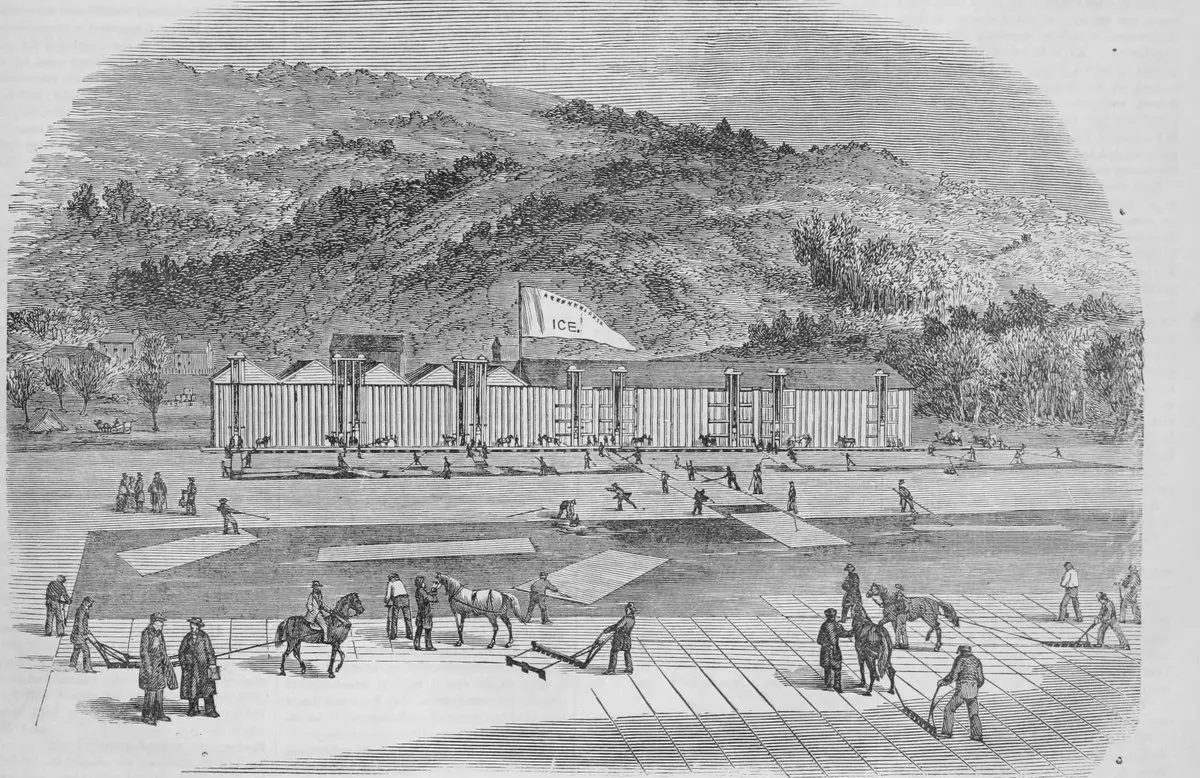
Ice cutting at Rockland Lake, New York: men and horses work on ice scored into squares in front of a long row of ice houses, in Gleason's Pictorial Drawing-Room Companion, 1852, vol. 2, p. 37.
“Ice Cutting at Rockland Lake, New York (Gleason's Pictorial Drawing-Room Companion, vol. 2, 1852, p. 37)”, Unknown engraver, Gleason's Pictorial Drawing-Room Companion (Boston, 1852); public domain.
Full credit
"Ice Cutting at Rockland Lake, New York (Gleason's Pictorial Drawing-Room Companion, vol. 2, 1852, p. 37)" by Unknown engraver, Gleason's Pictorial Drawing-Room Companion (Boston, 1852) — https://archive.org/details/gleasonspictoria02glea — Public domain (US: published 1852; EU: anonymous periodical engraving, more than 70 years from publication (1852)); modified: cropped to the engraving (box 75,1290 to 1,660,2318 of the 1,733 x 2,434 page image), leaving out the text columns, running head and printed title; resized to 1,200 x 778 px and saved in grayscale
Crack an ice cube out of the tray in your freezer. Summer ice was not always made in a kitchen freezer. In Henry David Thoreau's Walden, a “prudent landlord” goes to the frozen pond in January “to get ice to cool his summer drink” full text.
Ice harvesting was the trade behind that drink, cutting pond and river ice in winter, storing it in ice houses, and selling it in hot weather. Thoreau claimed a much longer reach for his pond. He wrote, “Thus it appears that the sweltering inhabitants of Charleston and New Orleans, of Madras and Bombay and Calcutta, drink at my well.” That sentence is a literary figure of speech, not a shipping record, and this page treats it that way.
The plainer documentary account comes from an 1893 handbook for the industry, Theron L. Hiles's The Ice Crop full text. Hiles writes that a cargo of Boston ice was shipped to the West Indies in 1806. Decades later, he says, “ice and refrigerator machines” took over the demand in tropical countries.
How was pond ice cut?
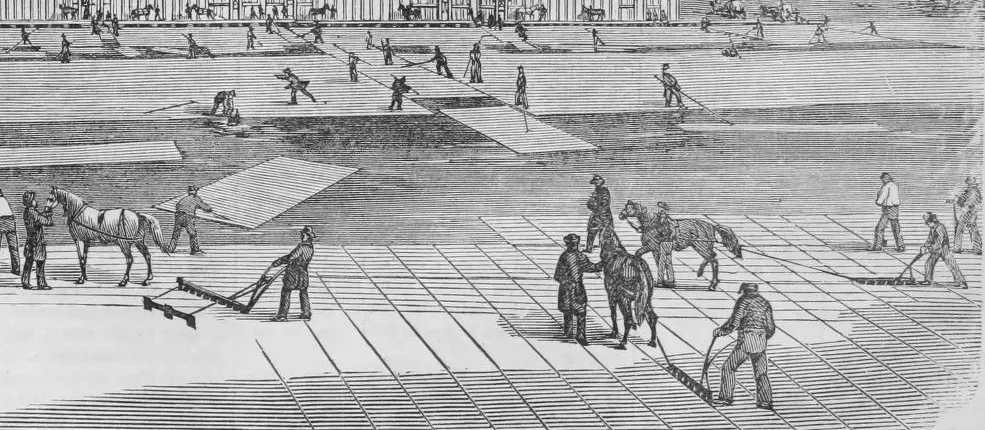
Detail of the same print: men with hand plows and horses work across ice scored into squares, and men with long poles stand at open water among floating sheets of ice.
“Ice Cutting at Rockland Lake, New York (Gleason's Pictorial Drawing-Room Companion, vol. 2, 1852, p. 37), detail of the field”, Unknown engraver, Gleason's Pictorial Drawing-Room Companion (Boston, 1852); public domain.
Full credit
"Ice Cutting at Rockland Lake, New York (Gleason's Pictorial Drawing-Room Companion, vol. 2, 1852, p. 37), detail of the field" by Unknown engraver, Gleason's Pictorial Drawing-Room Companion (Boston, 1852) — https://archive.org/details/gleasonspictoria02glea — Public domain (US: published 1852; EU: anonymous periodical engraving, more than 70 years from publication (1852)); modified: cropped to the right half of the engraving's foreground (box 600,1860 to 1,585,2290 of the 1,733 x 2,434 page image) and saved in grayscale
Hiles's chapter on cutting takes the harvesting season in order full text. First came the snow, which scrapers removed as soon as the field “will bear the weight of a horse.” An ice auger and a measure gave the thickness. The figure Hiles sets as the goal is “an average thickness of fourteen inches,” a little more than the length of a standard school ruler.
Next came the lines. A cord stretched between two stakes set a base line, a hand plow scored it, and a horse-drawn marker followed, cutting “a groove three inches deep,” with a guide riding in the previous groove so that every new line ran parallel.
Heavier plows then deepened the grooves until they reached “about two-thirds through the ice,” leaving “not less than four inches of solid ice” underneath. A second marking at right angles produced the checkerboard pattern visible in the print at the top of this page.
Saws cut through the ends of a section, and iron bars separated a “float” containing “one hundred to one thousand or more cakes,” which workers guided along a channel toward the ice house, splitting it into individual cakes on the way. Dangerously thin ice, Hiles adds, was marked with brush planted in bored holes, “to give warning of the danger of venturing upon it.” Originally, he writes, “axes and saws comprised the dealers' outfit.”
Thoreau watched a harvest of this kind at Walden during the winter of 1846–47. He wrote that “a hundred Irishmen, with Yankee overseers, came from Cambridge every day to get out the ice,” and that the cakes were lifted onto an enormous stack “by grappling irons and block and tackle, worked by horses.” The workers told him that “in a good day they could get out a thousand tons, which was the yield of about one acre.”
Where did the ice go?
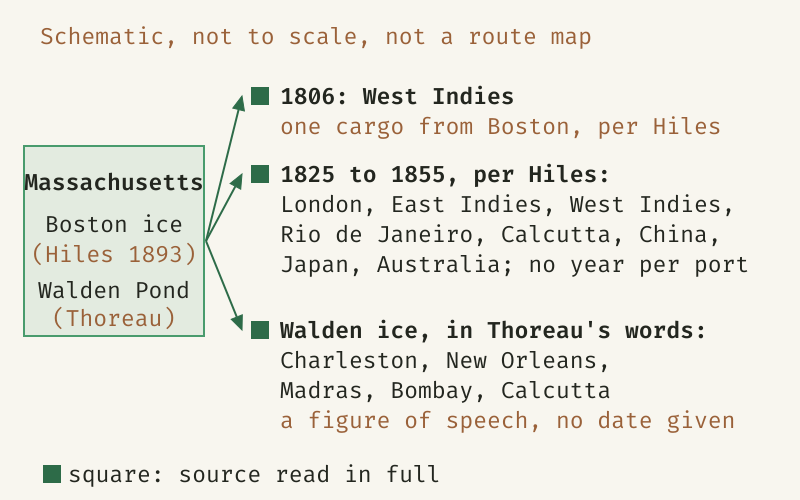
A schematic of where Boston and Walden ice was said to go, not to scale and not a route map: one dated cargo, a list of ports with no years, and Thoreau's figure of speech.
Drawn from the first chapter of Hiles 1893 and the chapter The Pond in Winter in Thoreau's Walden (full text); a schematic, with ports and years only as each source gives them.
"Where Boston and Walden ice was said to go" by Who Decided the Inch, https://whodecidedtheinch.com/lost-trades/ice-harvesting/, licensed under CC BY 4.0, https://creativecommons.org/licenses/by/4.0/
Data: Theron L. Hiles, The Ice Crop (1893), chapter I; Henry David Thoreau, Walden, The Pond in Winter
Hiles opens his historical sketch with a flat statement. “Prior to 1805, there was no regularly conducted traffic in ice, in this country.” In the winter of 1805–6, he continues, a supply was secured at Boston, and the following summer a cargo traveled to the West Indies, “where yellow fever was then raging.”
He names Frederick Tudor of Boston as the merchant who “shipped the first cargo to the West Indies in 1806” and became known as the “Ice King.” His book appeared 87 years after that voyage. No independent second source read for this page confirms who dispatched the first cargo.
Hiles says the business grew slowly at first, with all the ice consumed and exported in 1825 amounting to “probably less than fifty thousand tons.” During the thirty years that followed, cargoes were consigned to London, the East Indies, the West Indies, Rio de Janeiro, Calcutta, China, Japan and Australia, though he gives no year for any single port. In 1852, Gleason's Pictorial Drawing-Room Companion said ice was shipped “in heavy quantities to the West Indies, the East Indies and other climes” page scan.
| Date | From | To | Quantity | Source | Read |
|---|---|---|---|---|---|
| 1806 | Boston | West Indies | one cargo | Hiles 1893, first chapter | full text |
| 1825 | United States | home use and export | probably under fifty thousand tons | Hiles 1893, first chapter | full text |
| 1825 to 1855 | Boston | London, East Indies, West Indies, Rio de Janeiro, Calcutta, China, Japan, Australia | not given | Hiles 1893, first chapter | full text |
| winter 1846–47 | Walden Pond | a stack on the shore | a thousand tons on a good day; the heap about ten thousand | Thoreau, Walden | full text |
| not given | Walden Pond | Charleston, New Orleans, Madras, Bombay, Calcutta | none; a figure of speech | Thoreau, Walden | full text |
| 1855 | United States | storage | about two million tons, “a liberal estimate” | Hiles 1893, first chapter | full text |
The table as data (CSV, ice-trade.csv) (source and license notes) Data: Theron L. Hiles, The Ice Crop (1893), chapter I; Henry David Thoreau, Walden, The Pond in Winter
Calcutta is the only port on both lists, yet most of the Walden heap from that winter did not make the journey. The cutters themselves, Thoreau reports, calculated that “not twenty-five per cent of this would reach its destination.” The heap was “estimated to contain ten thousand tons,” and the greater part of it never got to market; after part was carried off the following July, the rest stood in the sun and “was not quite melted till September 1848.”
How did ice survive a ship voyage?
Hiles's chapter on marketing explains how a vessel was packed. Cakes were stowed tightly in the hold and trimmed to fit, with “Six or eight inches of sawdust” along the sides of the vessel and “perhaps, ten inches of short shavings on top.” After loading, “Hatches are thoroughly caulked, and the hold is not opened until the end of the trip.” On land, he adds, heavy ice stored during freezing weather in a well-built house could remain usable “for two or three seasons.”
What ended the ice trade?
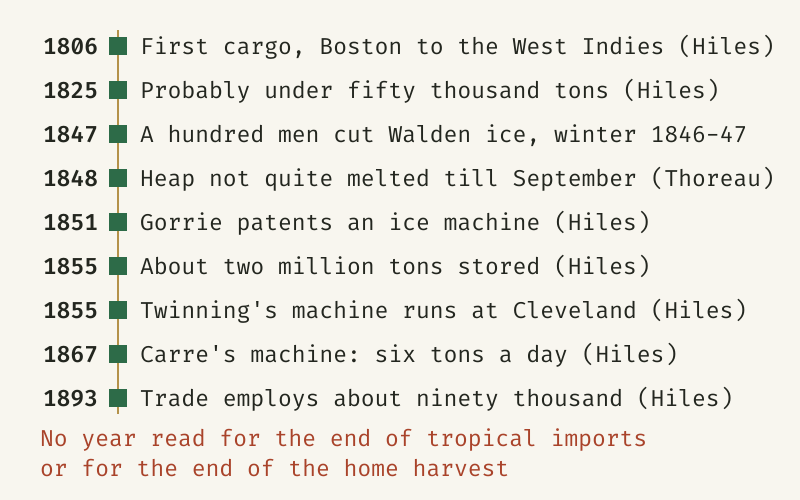
Nine dated records about the ice trade and early ice machines, all read in full; no year was found for the end of the trade.
Drawn from the first and seventh chapters of Hiles 1893 and the chapter The Pond in Winter in Thoreau's Walden (full text); one row per dated record, in year order.
This figure as text
- 1806: the first cargo from Boston to the West Indies, as Hiles reports it.
- 1825: probably under fifty thousand tons used and exported, by Hiles's estimate.
- Winter 1846–47: about a hundred men cut Walden ice for sixteen days, as Thoreau reports.
- September 1848: the last of the Walden heap melts, as Thoreau reports.
- 1851: John Gorrie of New Orleans patents an ice machine, as Hiles lists it.
- 1855: about two million tons of ice stored in the United States, by Hiles's “liberal estimate.”
- 1855: Professor Twinning's machine (Hiles's spelling) runs at Cleveland, making 1,600 pounds of ice in twenty-four hours, by Hiles's account.
- 1867: Ferdinand Carré's machine makes six tons of ice a day at the French exposition, by Hiles's account.
- 1893: the trade employs about ninety thousand people and twenty-five thousand horses, by Hiles's figure.
"Ice harvesting and early ice machines" by Who Decided the Inch, https://whodecidedtheinch.com/lost-trades/ice-harvesting/, licensed under CC BY 4.0, https://creativecommons.org/licenses/by/4.0/
Data: Theron L. Hiles, The Ice Crop (1893), chapters I and VII; Henry David Thoreau, Walden, The Pond in Winter
For the export trade, The Ice Crop gives a direct answer. The export business, Hiles writes, “reached its height about this time,” meaning the years leading up to 1855. He continues, “Not many years after this, ice and refrigerator machines began to supply the demand for ice in tropical climes, and the importations of the natural product soon ceased.” His chapter on artificial ice lists Gorrie's 1851 patent, Twinning's 1853 American patent, and the Cleveland machine operating two years later.
Did the harvest at home end too?
On the domestic side, the same book shows no ending at all. Hiles estimated the ice trade's workforce at “about ninety thousand persons and twenty-five thousand horses,” and he also recorded sanitary rules of his own day. Some boards of health prohibited cutting on “specified polluted waters” for anything except cooling, and in New York, household ice taken from canal water had to be labeled.
The switchboard operator is another job that machines took over in steps. For the export side of this trade, the same handbook describes a similar handover. The town crier is a street job that left a word behind.
Much remains unknown. No record read for this page dates the end of the domestic harvest. A federal census report on the ice industry could not be located in a readable copy, and period journals that might document ice arriving in Calcutta were not read either. Tudor's first cargo rests on Hiles alone.
Sources
- “Ice Cutting,” and the engraving “Ice Cutting at Rockland Lake, New York,” Gleason's Pictorial Drawing-Room Companion (Boston: F. Gleason), vol. 2, 1852, p. 37. Unsigned note and engraving. Public domain (EU: anonymous, published 1852; US: published 1852). archive.org/details/gleasonspictoria02gleaHow far it was read: page scan; p. 37, the short note Ice Cutting and the engraving below it with its printed title; printed page number and running title checked on the page image
- Henry David Thoreau, Walden, chapter "The Pond in Winter". Project Gutenberg ebook 205 (Walden, and On The Duty Of Civil Disobedience). Public domain (EU: author d. 1862, per Project Gutenberg catalog record; US: published before 1931). www.gutenberg.org/ebooks/205How far it was read: full text; the chapter "The Pond in Winter"
- Theron L. Hiles, The Ice Crop: How to Harvest, Store, Ship and Use Ice (New York: Orange Judd Company, 1893; copyright 1892), chapters I, II, III, V and VII. Project Gutenberg ebook 65269. Public domain in the US (published 1893); the author's year of death was not found, so only facts and short quotations are used and no illustration from the book is reproduced. www.gutenberg.org/ebooks/65269How far it was read: full text; chapters I (pp. 7-11), II (pp. 11-14), III (pp. 14-42), V (pp. 56-62) and VII (pp. 84-91), page ranges from the book's table of contents
Cite this page
Who Decided the Inch. “Ice Harvesting: Pond Ice Was Cut by Hand, Then by Horse.” Published November 22, 2026. https://whodecidedtheinch.com/lost-trades/ice-harvesting/. Accessed on the day you read it.
- To the original: how sources are read
- Marked in the margin: every correction
- Report an error on this page (contact@whodecidedtheinch.com)
Related entries
 Illustration
Knocker-Upper: In the Records Read, No End Date for the Job
Illustration credit
Illustration: Who Decided the Inch. Generated schematic image — not a photograph or historical record. No copyright is claimed in this generated illustration; if you reuse it, please keep this label.
Lamplighter: The Job Is Older Than Gas Street Lighting
Picture credit
"Lantaarnopsteker (lamplighter), woodcut by Dirck de Bray" by Dirck de Bray, Rijksmuseum — https://commons.wikimedia.org/wiki/File:Lantaarnopsteker,_RP-P-OB-30.866.jpg — CC0 1.0 (https://creativecommons.org/publicdomain/zero/1.0/); modified: the Commons current version is cropped 8% horizontally and 6% vertically from the earlier upload, as stated in the file history, resized from 4,234 x 3,715 to 1,200 x 1,053 px
Switchboard Operator: British Dial Exchanges Took Decades
Picture credit
"Signal Corps telephone operators at switchboard, Toul, 1919 (SC-49623)" by Lt. Fox, United States Army Signal Corps (Army Signal Corps Photo SC-49623) — https://commons.wikimedia.org/wiki/File:SC-49623_Signal_Corps_telephone_operators_at_switchboard.jpg — Public domain (US: work of a U.S. Army Signal Corps photographer made in official duties, 17 U.S.C. §105, per the file page; EU: no separate basis traced (US federal work)); modified: resized from 2,729 x 2,012 to 1,200 x 885 px and saved in grayscale