No. 2 Origin entry
Town Crier: The Crier’s Oyez Survives in a Courtroom
Who Decided the Inch Published
Origin card
Short answer
A town crier, or bellman, cried street notices; an 1874 history lists objects lost or found, sales, weddings, christenings and funerals among a country crier's duties, and finds London's posts near sinecures. This page classes the trade as declining; its call, Oyez, is still cried by the Marshal of the United States Supreme Court as of November 2026.
- Name
- Town crier (bellman)
- Category
- Lost Trades
- Earliest known record
- 1564 · sale cried by an out-cryer and bellman, as reported in 1839 · London, in a book on its street tradesThe earliest known record is not the same as the time or place of invention.
- Origin attribution
- Unknown: the records read show criers already at work; none names a first crier or a place where the trade began
- Key document
- Henry Sampson, A History of Advertising (1874), pp. 58-59 full text; Walter W. Skeat, A Concise Etymological Dictionary of the English Language, p. 364 page scan; Supreme Court of the United States, procedures page full text
- Still in use?
- Declining: Sampson found bellmen still used in most country towns of the United Kingdom in 1874, and the crier's call Oyez is still cried at the U.S. Supreme Court (as of 2026)
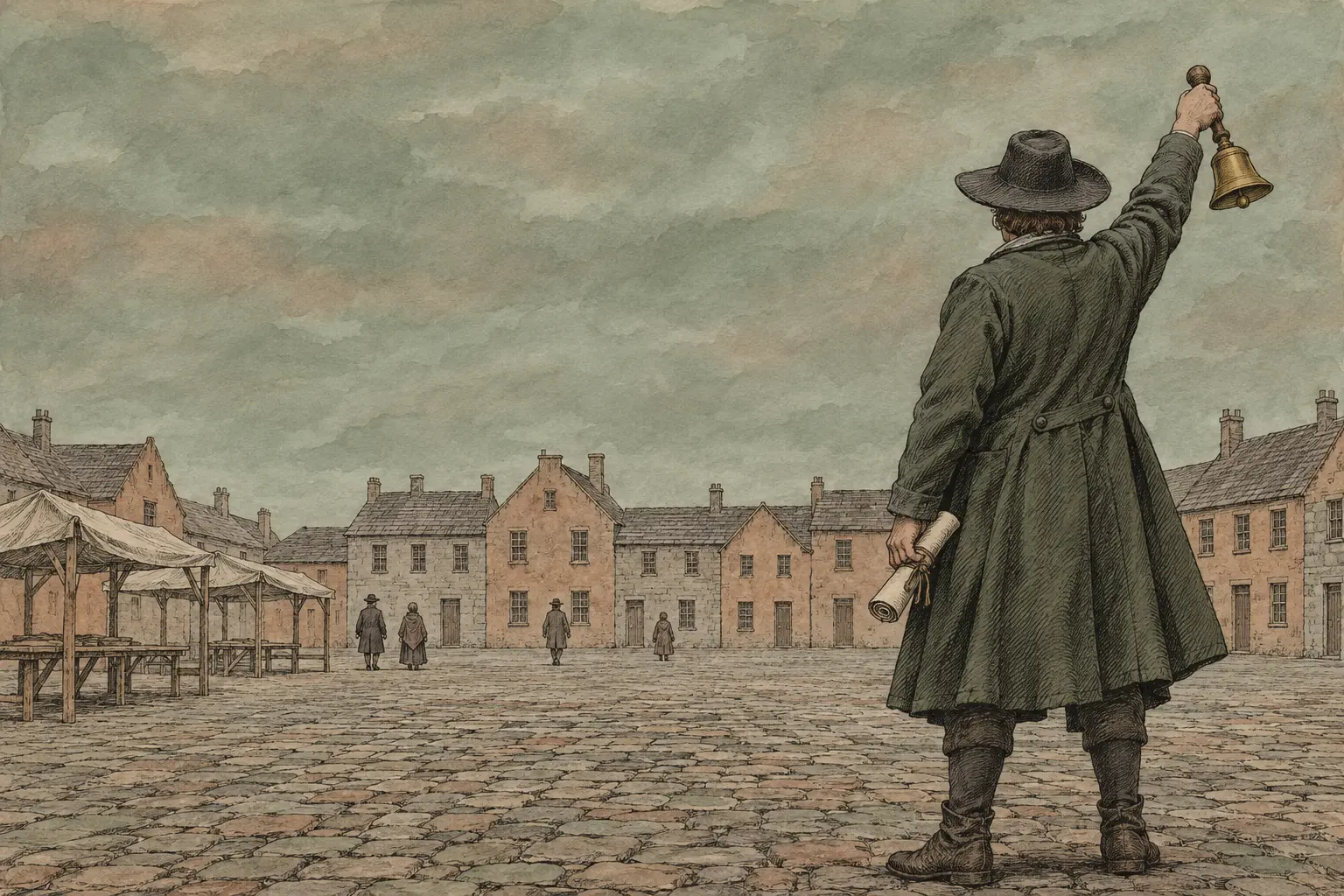
An illustration of a town crier, or bellman, raising his bell to call out notices across a square.
Illustration: Who Decided the Inch. Generated schematic image — not a photograph or historical record. No copyright is claimed in this generated illustration; if you reuse it, please keep this label.
When a train runs late, a recorded voice tells the whole platform at the same moment. Announcing news to a crowd was once a paid job for one person, who walked the street with a bell.
Its paper trail starts with a London bellman’s night round, which Strype’s 1756 edition of Stow tentatively dates to 1556. It runs to Henry Sampson’s A History of Advertising (1874), which found such bellmen still at work in most country towns, though London’s posts already looked like sinecures. This page classes the trade as declining, yet, as of November 2026, the crier’s opening call is still heard whenever the Supreme Court of the United States sits. The Court’s Marshal cries “Oyez! Oyez! Oyez!”
What did a town crier do?
Sampson’s history, read in full text, gives the fullest description of the work found for this page full text. “The provincial crier’s duties are of the most various description,” he writes, “and relate to objects lost or found, sales by public auction or private contract, weddings, christenings, and funerals.”
His example comes from the Scottish burgh of Lanark, “not much more than a century ago” in his day, when the burgh supported only one butcher, who dared not kill a sheep until every part had been ordered beforehand. When customers were slow to commit, the bellman, locally called the “skelligman,” walked the streets reciting a rhyme that began, “Bell-ell-ell! There’s a fat sheep to kill!” The verse went on to name the provost and the priest as buyers of a leg each.
London employed bellmen of a different kind. John Thomas Smith’s The Cries of London (1839) quotes John Strype’s 1756 edition of Stow, which describes a bellman assigned to each city ward full text. During the long nights he walked the streets and lanes “ringing a bell,” greeted householders with seasonal rhymes, and reminded them to “look to their lights,” and Strype writes that the custom “seems to be” from January 1556.
Smith also gives a rate of pay, dated 1564, in his book on London’s street trades. Leases of houses and household furniture, he writes, were sold “by an out-cryer and bellman for the day, who retained one farthing in the shilling for his pains.” That is a cut of the sale rather than a wage, given here in Smith’s terms and not converted to today’s money. Smith identifies no source for that statement, so the 1564 date and rate rest on his word alone.
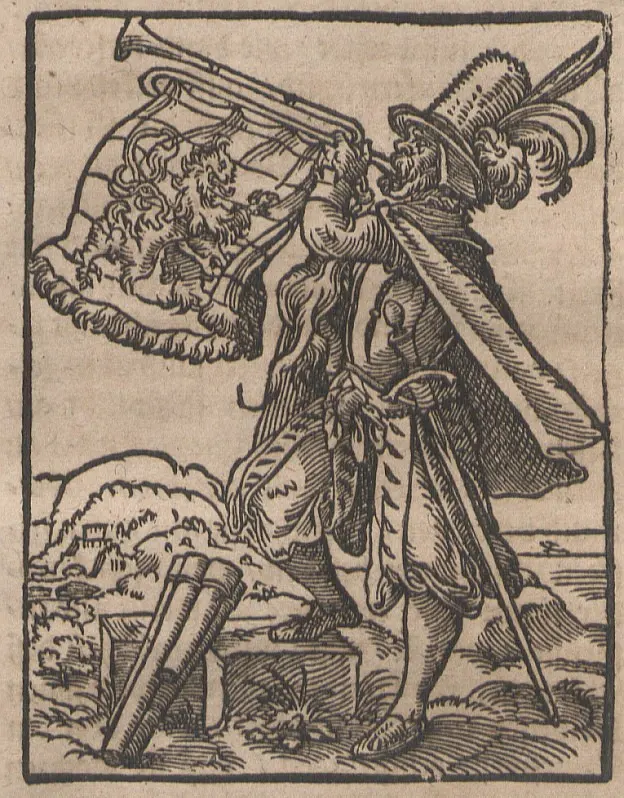
A trumpeter from the 1641 Frankfurt edition of Tommaso Garzoni’s Piazza Universale, cropped below the frame to remove a later source line; according to its file page, the woodcut sits in the book’s chapter on criers and trumpeters.
“Trompeter, woodcut from Garzoni’s Piazza Universale (Frankfurt, 1641)”, Unknown artist, in Tommaso Garzoni, Piazza Universale (Frankfurt, 1641); Deutsche Fotothek; Public Domain Mark.
Full credit
"Trompeter, woodcut from Garzoni’s Piazza Universale (Frankfurt, 1641)" by Unknown artist, in Tommaso Garzoni, Piazza Universale (Frankfurt, 1641); Deutsche Fotothek — https://commons.wikimedia.org/wiki/File:Fotothek_df_tg_0007253_St%C3%A4ndebuch_%5E_Beruf_%5E_Ausrufer.jpg — Public domain (EU: anonymous woodcut printed in Frankfurt in 1641, more than 70 years ago (70 years from publication); US: published before 1931; marked Public Domain Mark 1.0 on the file page); modified: cropped: the bottom 22 pixels below the printed frame removed, taking off the archive's added source line (full width kept, 624 x 798 from 624 x 820)
Why did the job fade?
No record consulted for this page identifies a cause for the decline, or a date when the occupation ended. For his own generation, Sampson’s account points the other way. “Notwithstanding the immense development of advertising since the spread of newspapers,” he writes, “the services of the bellman are still used in most of the country towns of the United Kingdom.”
In London, he adds, there were “still bellmen and parish criers, though their offices would appear to be sinecures.” A sinecure is a salaried post that requires little or no actual work. In his account, newspapers and bellmen worked side by side in 1874, and he does not claim that the newspapers eliminated the bellmen. No present-day count of working town criers was found, which is why this page classifies the occupation as declining rather than gone.
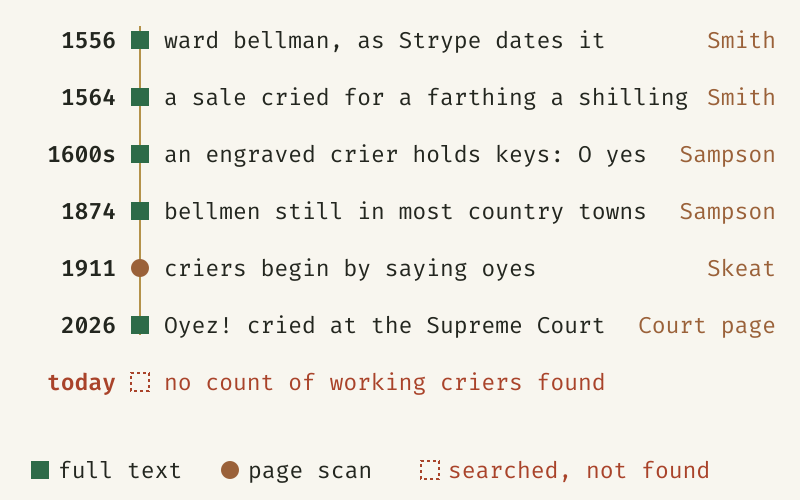
Every dated record of bellmen and criers read for this page, from a London ward bellman’s night round that Strype dates to 1556 to the Supreme Court’s cry; the dictionary year is the date in the scanned copy’s library record.
Drawn from Smith 1839 (with Strype 1756 as he quotes it), Sampson 1874 and the Supreme Court’s procedures page (full text), and Skeat’s dictionary (page scan); rows sorted by date.
This figure as text
| Date | What the record says | Source | How far it was read |
|---|---|---|---|
| January 1556, as Strype dates it | A bellman for each London ward rings a bell through the streets at night; Strype writes that the custom seems to begin in 1556 | Strype’s 1756 edition of Stow, quoted in Smith, The Cries of London (1839) | full text (as quoted) |
| 1564 | Leases and household goods are sold by an out-cryer and bellman, who keeps one farthing in the shilling | Smith, The Cries of London (1839), p. 16; no source named | full text |
| early 1600s | An engraved bellman or town crier holds keys, over a notice that opens O yes | Sampson, A History of Advertising (1874), p. 58 | full text |
| 1874 | Bellmen are still used in most country towns of the United Kingdom; London’s look like sinecures | Sampson, A History of Advertising (1874), p. 59 | full text |
| copy dated 1911, per its library record | A dictionary entry: public criers begin by saying oyes | Skeat, A Concise Etymological Dictionary, p. 364 | page scan |
| as of 2026 | The Marshal’s opening cry includes Oyez! Oyez! Oyez! | Supreme Court of the United States, procedures page | full text |
| today | No count of town criers at work today was found | none | searched, not found |
"Town crier timeline: only the dates read for this page" by Who Decided the Inch, https://whodecidedtheinch.com/lost-trades/town-crier/, licensed under CC BY 4.0, https://creativecommons.org/licenses/by/4.0/
Data: John Thomas Smith, The Cries of London (1839), with Strype (1756) as quoted; Henry Sampson, A History of Advertising (1874); Walter W. Skeat, A Concise Etymological Dictionary, p. 364; Supreme Court of the United States, procedures page
Other street jobs on this site are traced the same way, record by record, such as the knocker-upper, a trade paid to wake the street, and the switchboard operator, whose operators connected voices by hand.
Where does oyez survive?
The Court’s own procedures page, as read in November 2026, describes the opening ceremony full text. At 10 a.m. the Marshal announces the entrance of the Justices, and everyone present remains standing through “the traditional cry.” In the middle of that cry comes “Oyez! Oyez! Oyez!” Then everyone with business before the Court is told to come forward and attend, because the Court is in session.
The word itself connects the courtroom to the street. Walter W. Skeat’s A Concise Etymological Dictionary of the English Language, read from the page scan of page 364, defines “oyez, oyes” as “hear ye!” and adds, “Public criers begin by saying oyes, now corrupted into o yes!” page scan. Skeat traces the word to “A. F. oyez, 2 p. pl. imperative of oyer, to hear,” a command form addressed to several listeners at once. His neighboring entry carries oyer back to the Latin audire, “to hear.”
Sampson points to the same call in an engraving. What he calls one of the earliest collections of “Cries of London,” engraved early in the 1600s, shows the bellman holding a bunch of keys above a humorous notice that opens “O yes.”
A word like this is what this site calls a job fossil: a trace that a past trade or working technique has left in everyday language. Every example carries the current state of its trade. In this case the occupation is declining rather than gone. Sampson found bellmen still employed in most country towns in 1874, and the crier’s call is still spoken at the Court as of November 2026.
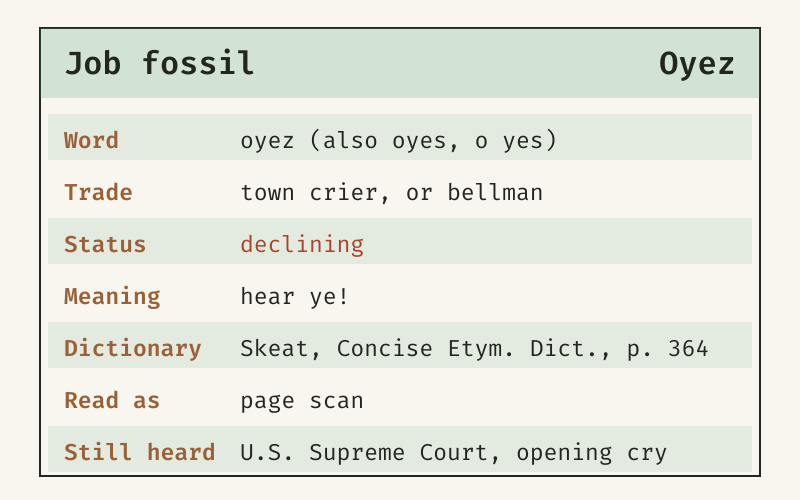
A record card for one job fossil, oyez: its trade, the state of that trade, its meaning and dictionary page, and where it is still heard.
Drawn from Skeat, A Concise Etymological Dictionary, p. 364 (page scan), and the Supreme Court’s procedures page (full text), with the trade’s state from Sampson 1874 (full text); the table below gives the evidence for each spelling.
"Job fossil: oyez, the town crier’s call" by Who Decided the Inch, https://whodecidedtheinch.com/lost-trades/town-crier/, licensed under CC BY 4.0, https://creativecommons.org/licenses/by/4.0/
Data: Walter W. Skeat, A Concise Etymological Dictionary, p. 364; Supreme Court of the United States, procedures page; Henry Sampson, A History of Advertising (1874)
| Word | Trade | Status | Evidence for the word | How far it was read |
|---|---|---|---|---|
| oyez | town crier | declining | Skeat, p. 364: “hear ye!”; from A. F. oyez, a plural command of oyer, to hear | page scan |
| oyes | town crier | declining | Skeat, p. 364: public criers begin by saying oyes | page scan |
| o yes | town crier | declining | Skeat, p. 364: oyes, now corrupted into o yes | page scan |
| Oyez | town crier | declining | Supreme Court procedures page: the Marshal’s cry, Oyez! Oyez! Oyez! | full text |
The job fossil table, one claim per row (CSV) (source and license notes) Data: Walter W. Skeat, A Concise Etymological Dictionary, p. 364; Supreme Court of the United States, procedures page; Henry Sampson, A History of Advertising (1874)
Several things remain unknown. The records read do not name a first crier or a place where the trade began. They do not say when the Supreme Court took up the call, which its page calls only “traditional,” or how many town criers work today. The abbreviation A. F. is left as Skeat prints it, because the key to his abbreviations was not read for this page.
Sources
- Henry Sampson, A History of Advertising from the Earliest Times (London: Chatto and Windus, 1874), pp. 58–59. Project Gutenberg ebook 54149. Public domain (EU: author d. 1891, per Project Gutenberg catalog record; US: published 1874). www.gutenberg.org/ebooks/54149How far it was read: full text; pp. 58–59 of the 1874 edition, in the Project Gutenberg text
- Supreme Court of the United States, “The Court and Its Procedures,” supremecourt.gov. U.S. Government work (17 U.S.C. §105). www.supremecourt.gov/about/procedures.aspxHow far it was read: full text; the whole page, as of 2026-11-21
- John Thomas Smith, The Cries of London (London: J. B. Nichols and Son, 1839), p. 16. Project Gutenberg ebook 37817. Public domain (EU: author d. 1833, as the book's memoir records; US: published 1839). www.gutenberg.org/ebooks/37817How far it was read: full text; p. 16, including Smith's quotation from Strype's 1756 edition of Stow
- Trompeter, woodcut in Tommaso Garzoni, Piazza Universale (Frankfurt am Main: Merian and Hoffmann, 1641); as described on its Wikimedia Commons file page (image from the Deutsche Fotothek, SLUB Dresden). Public domain (EU and US: printed 1641; Public Domain Mark on the file page). commons.wikimedia.org/wiki/File:Fotothek_df_tg_0007253_…How far it was read: editor's abstract; the file page's title, date and the chapter it names, with the image itself
- Walter W. Skeat, A Concise Etymological Dictionary of the English Language (Oxford: Clarendon Press; the scanned copy is dated 1911 in its library record), p. 364, entries “Oyer” and “oyez, oyes.” Public domain (EU: author d. 1912, per library catalog record; US: dated 1911 in the library record). archive.org/details/conciseetymologi00skeaHow far it was read: page scan; p. 364, read from the page image

Cite this page
Who Decided the Inch. “Town Crier: The Crier’s Oyez Survives in a Courtroom.” Published November 22, 2026. https://whodecidedtheinch.com/lost-trades/town-crier/. Accessed on the day you read it.
- To the original: how sources are read
- Marked in the margin: every correction
- Report an error on this page (contact@whodecidedtheinch.com)
Related entries
 Illustration
Knocker-Upper: In the Records Read, No End Date for the Job
Illustration credit
Illustration: Who Decided the Inch. Generated schematic image — not a photograph or historical record. No copyright is claimed in this generated illustration; if you reuse it, please keep this label.
Lamplighter: The Job Is Older Than Gas Street Lighting
Picture credit
"Lantaarnopsteker (lamplighter), woodcut by Dirck de Bray" by Dirck de Bray, Rijksmuseum — https://commons.wikimedia.org/wiki/File:Lantaarnopsteker,_RP-P-OB-30.866.jpg — CC0 1.0 (https://creativecommons.org/publicdomain/zero/1.0/); modified: the Commons current version is cropped 8% horizontally and 6% vertically from the earlier upload, as stated in the file history, resized from 4,234 x 3,715 to 1,200 x 1,053 px
Switchboard Operator: British Dial Exchanges Took Decades
Picture credit
"Signal Corps telephone operators at switchboard, Toul, 1919 (SC-49623)" by Lt. Fox, United States Army Signal Corps (Army Signal Corps Photo SC-49623) — https://commons.wikimedia.org/wiki/File:SC-49623_Signal_Corps_telephone_operators_at_switchboard.jpg — Public domain (US: work of a U.S. Army Signal Corps photographer made in official duties, 17 U.S.C. §105, per the file page; EU: no separate basis traced (US federal work)); modified: resized from 2,729 x 2,012 to 1,200 x 885 px and saved in grayscale