No. 2 Origin entry
Knocker-Upper: In the Records Read, No End Date for the Job
Who Decided the Inch Published
Origin card
Short answer
Edwin Waugh's Lancashire Sketches (1869 edition, Manchester) and an 1877 magazine account describe knockers-up hired to wake early workers with taps of a long rod. No record read for this page gives a date for the end of the trade.
- Name
- Knocker-up
- Category
- Lost Trades
- Earliest known record
- 1869 · book of sketches, third edition, the earliest dated record read for this page · ManchesterThe earliest known record is not the same as the time or place of invention.
- Origin attribution
- Unknown: no record read for this page names a first knocker-up or a place where the trade began; in an 1877 magazine account one knocker-up says she was near the first, and no second source read for this page confirms it
- Key document
- Edwin Waugh, Lancashire Sketches, third edition (1869), The Knocker-Up full text; Experiences of a Knocker-up, Chambers's Journal, 17 November 1877 full text
- Still in use?
- Not shown either way: the latest record read for this page, a House of Lords speech of 1994, speaks of the knocker-up as belonging to days gone by (as of 2026)
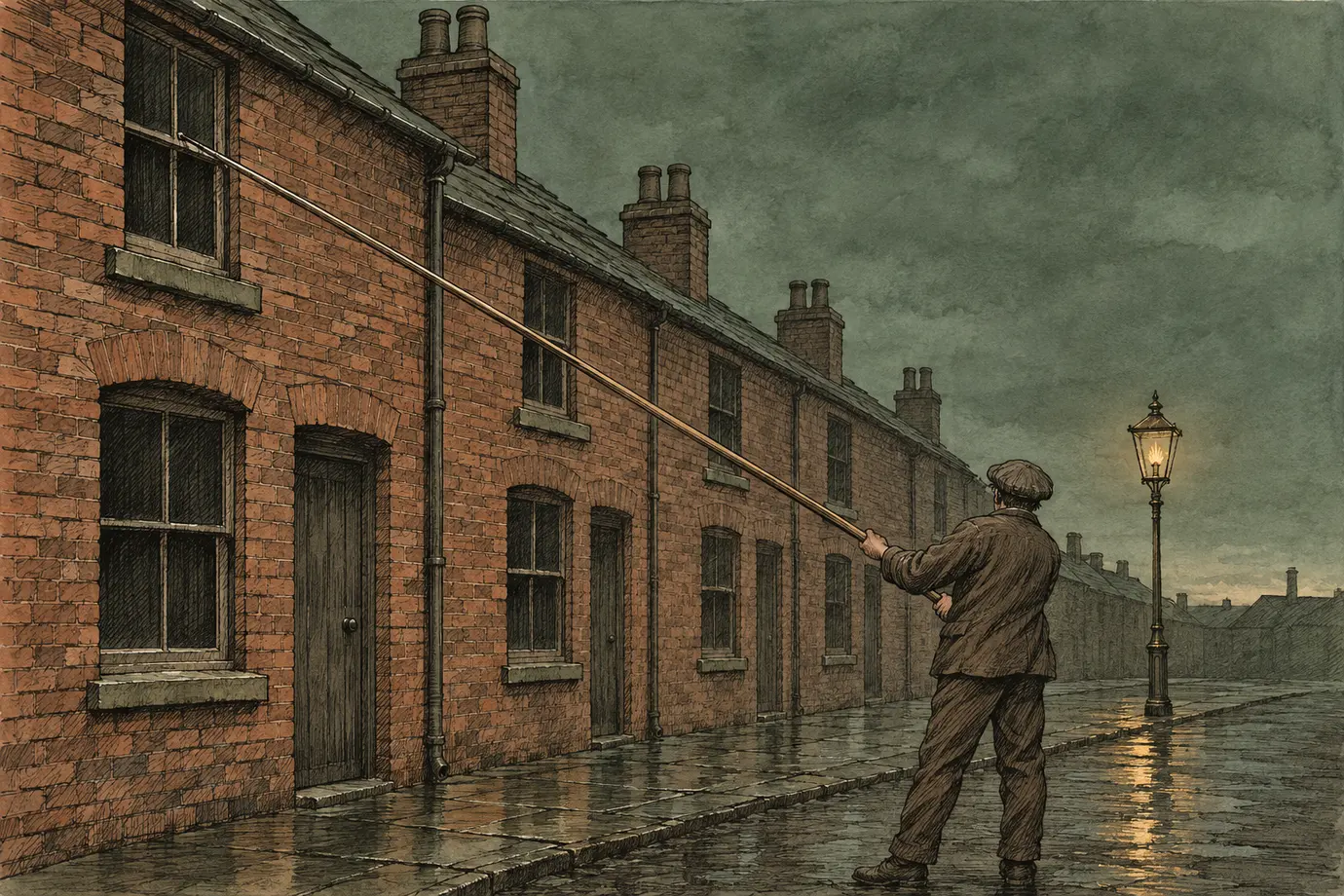
An illustration of a knocker-up's long rod reaching an upstairs window before dawn.
Illustration: Who Decided the Inch. Generated schematic image — not a photograph or historical record. No copyright is claimed in this generated illustration; if you reuse it, please keep this label.
Your phone alarm goes off, and your thumb finds the snooze button without looking. Getting up on time was once work that someone else could be paid to do. In the 1869 edition of Edwin Waugh’s Lancashire Sketches, small signboards over cottage doors in the back streets of Manchester offer “knocking-up” as a service. A knocker-up, Waugh explains, was employed to wake people who had to go to work early, tapping at their windows with a long wand, because “the factory-bell, like death, is inexorable in its call.”
That much is on record. For the rest, this page lists every source that was searched and read, and how far each one was read.
What records of knocker-uppers survive?
Two full descriptions written while the trade was working were found and read. One is Waugh’s sketch “The Knocker-Up,” printed in the third edition of Lancashire Sketches (1869) full text. The other is an unsigned article, “Experiences of a Knocker-up,” published in Chambers’s Journal on 17 November 1877 full text. Its writer reports a long conversation with an elderly woman, Mrs. Waters, in a northern industrial town he names only as B----.
Both accounts give weekly fees, in the British pence and shillings of their day. Waugh’s 1869 edition gives the Manchester rate as twopence to threepence a week for each person woken. In the 1877 account, Mrs. Waters says that customers woken before four o’clock paid her eighteenpence a week, those woken soon after four a shilling, and those woken between five and six from sixpence to threepence. She puts her own earnings over thirty years at never less than thirty shillings a week.
Parliament’s official record, Hansard, adds three later mentions, from 1948, 1967 and 1994 full text. Charles Dickens’s Great Expectations was also searched from start to finish; its one “knocked up,” in chapter VI, describes the worn-out Mr. Wopsle, and the trade is never named full text.
Two works could be read only as far as their titles. Arunima Datta’s 2020 article on knocker-ups in the Journal of Victorian Culture is listed at the bibliographic level, since its publication details were read and its text was not bibliographic. Volume 3 of Joseph Wright’s English Dialect Dictionary is in the same position, its library record read and its entry unread bibliographic.
The period’s newspapers sit in a paid archive and were not read. A dated price for a household clock from the same years and towns was searched for and could not be found, so this page makes no comparison of costs.
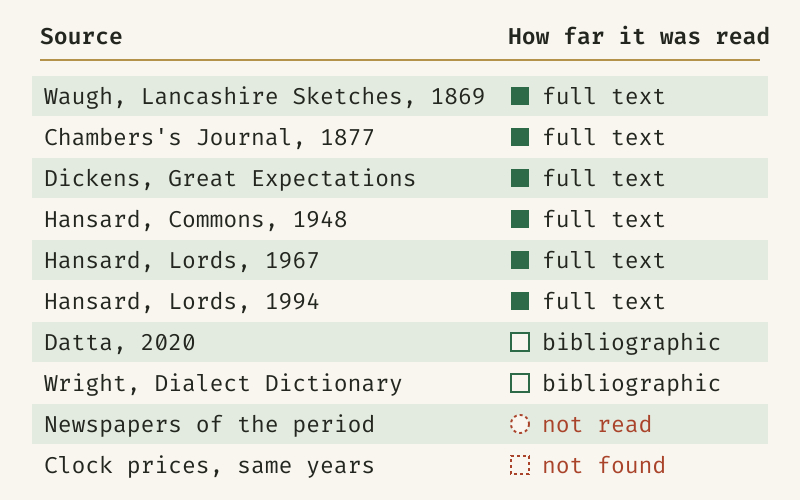
Ten searches for the knocker-up, each marked by how far it got; the newspapers were not read and no dated clock price was found.
Drawn from Waugh 1869, Chambers’s Journal 1877, Great Expectations and Hansard (full text), with Datta 2020 and Wright’s dictionary (bibliographic); the ten rows match the table below.
"Knocker-up records: what was searched and how far each was read" by Who Decided the Inch, https://whodecidedtheinch.com/lost-trades/knocker-upper/, licensed under CC BY 4.0, https://creativecommons.org/licenses/by/4.0/
Data: Edwin Waugh, Lancashire Sketches (1869); Chambers’s Journal, 17 November 1877; Charles Dickens, Great Expectations, chapter VI; Hansard, 1948, 1967 and 1994; Datta 2020 and Wright, The English Dialect Dictionary, vol. 3 (bibliographic)
| Source | Date | How far it was read | What it shows |
|---|---|---|---|
| Edwin Waugh, Lancashire Sketches, “The Knocker-Up” | 1869 (third edition) | full text | The trade at work in Manchester: wands, workers, customers |
| “Experiences of a Knocker-up,” Chambers’s Journal | 17 November 1877 | full text | One knocker-up’s account, as reported by an unnamed writer |
| Charles Dickens, Great Expectations, chapter VI | 1867 edition | full text | “Knocked up” for an exhausted man; the trade is not named |
| Hansard, House of Commons | 2 March 1948 | full text | An MP recalls the knocker-up and the early mill hours |
| Hansard, House of Lords | 26 January 1967 | full text | The name used for a party worker on polling day |
| Hansard, House of Lords | 10 January 1994 | full text | The knocker-up spoken of as a thing of the past |
| Arunima Datta, Journal of Victorian Culture | 2020 | bibliographic | Title and publication details only |
| Joseph Wright, The English Dialect Dictionary, vol. 3 | set dated 1898 to 1905 | bibliographic | Library record only; the entry was not read |
| Newspapers of the period | none | not read | Held in a paid archive |
| Dated clock prices of the same years | none | not found | Searched for; none found, so no cost comparison |
The records read, one claim per row (CSV) (source and license notes) Data: Edwin Waugh, Lancashire Sketches (1869); Chambers’s Journal, 17 November 1877; Charles Dickens, Great Expectations; Hansard, 1948, 1967 and 1994
What did they use to knock?
Waugh describes the knockers-up to be seen at dawn in Manchester. Men, and now and then a woman, hurried from house to house, holding up long, tapering wands like fishing rods. They were generally, he writes, old men still quick on their feet, or poor widows strong enough for the work. Their main customers were factory workers and men in the building trades.
The 1877 article, giving Mrs. Waters’s words as its writer reports them, says that when knocking-up first became a regular trade, knockers-up rapped or rang at their customers’ doors. Neighbors complained about the disturbance. The knocker-up also discovered that he was waking several people on each side who paid him nothing. Rods followed, so that a few taps on the bedroom window reached only the person who was supposed to hear them.
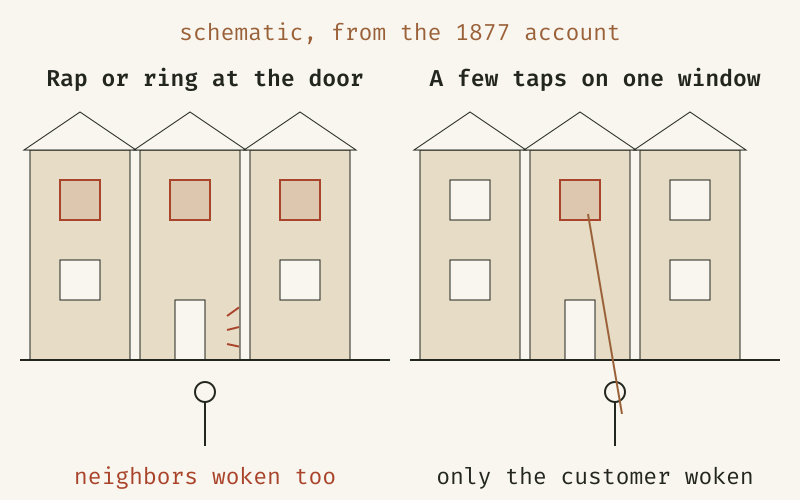
A schematic of the two ways of waking a customer described in the 1877 Chambers’s Journal account: a rap at the door that woke the neighbors too, and a rod that tapped only one bedroom window.
Drawn from Chambers’s Journal, 17 November 1877 (full text); a schematic of the account, not a picture of a real street.
This figure as text
- Rapping or ringing at the door: the customer wakes, and so do neighbors on each side who do not pay.
- A few taps with a rod on the bedroom window: only the customer wakes.
"Schematic: rapping at the door versus tapping one bedroom window" by Who Decided the Inch, https://whodecidedtheinch.com/lost-trades/knocker-upper/, licensed under CC BY 4.0, https://creativecommons.org/licenses/by/4.0/
Data: Chambers’s Journal, 17 November 1877
In the same 1877 account, Mrs. Waters says she was among the first to use rods, and near the first to earn money by knocking-up at all. No second source read for this page confirms either claim, so the Origin card records the beginning of the trade as unknown.
Who woke the knocker-upper?
The 1877 account answers this question in her own words. Mrs. Waters went to bed at nine and was up at half past two, because her earliest customer had to be awakened at three. Her husband woke her, along with an alarm clock, which the article spells “alarum.” After six or seven years at the work, she says, she began to wake naturally on her own.
The same account offers her explanation for why the trade was so widespread. People become so accustomed to an alarm clock, she says, that it fails to wake them, or they fall asleep again before it stops ringing. In this single account, the clock and the knocker-up operated side by side rather than one taking the other’s place.
When did the job end?
No record read for this page gives a date for the end of the trade, or a cause. The 1877 article closes on the opposite note for its own time. Its writer says he passed at least half a dozen knockers-up on a short early walk into town. The occupation, he writes, was overrun with competitors.
Hansard shows the word surviving in later memory. In a Commons debate on 2 March 1948, Stanley Prescott, member for Darwen, said he had been brought up on the knocker-up and the early hours when people had to go to the mills. On 26 January 1967 a peer, Lord Shepherd, applied the name to a different job: the party worker who calls on polling day to ask whether a voter has voted yet. Lord Rix, on 10 January 1994, spoke of the knocker-up or alarm clock “in days gone by.”
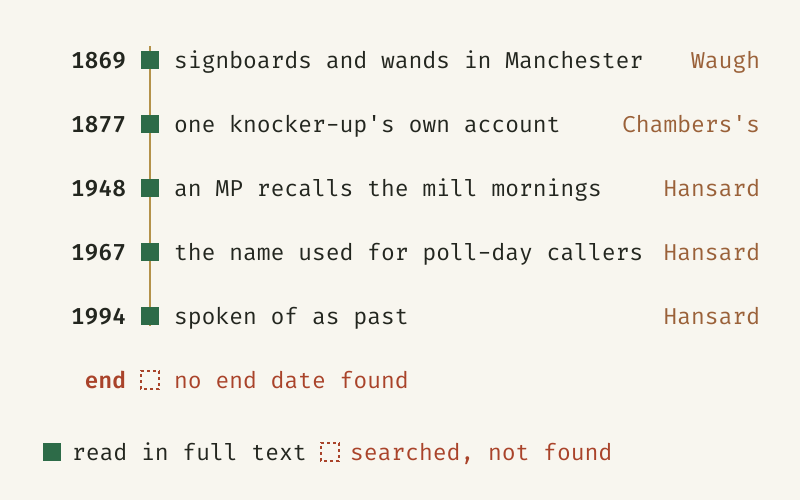
Every dated record of the knocker-up read for this page, from Waugh’s 1869 edition to a 1994 Lords speech; none gives a date for the end of the trade.
Drawn from Waugh 1869, Chambers’s Journal 1877 and Hansard for 1948, 1967 and 1994 (full text); rows sorted by date.
This figure as text
- 1869: Waugh describes signboards and wands in Manchester.
- 1877: Chambers’s Journal prints one knocker-up’s account.
- 1948: an MP recalls the knocker-up and the mill mornings.
- 1967: a peer uses the name for party workers on polling day.
- 1994: a peer speaks of the knocker-up as past.
- End of the trade: no date found in the records read.
"Knocker-up timeline: only the dates read for this page" by Who Decided the Inch, https://whodecidedtheinch.com/lost-trades/knocker-upper/, licensed under CC BY 4.0, https://creativecommons.org/licenses/by/4.0/
Data: Edwin Waugh, Lancashire Sketches (1869); Chambers’s Journal, 17 November 1877; Hansard, 1948, 1967 and 1994
Together these records show a trade described at work in an 1869 edition and in 1877, remembered from childhood in 1948, and spoken of as past by 1994. They do not show when the last paid knocker-up worked, how many there were, or what brought the occupation to an end. The newspapers in the paid archive and Datta’s study may contain those answers, but neither was read here. Other occupations in this section, such as the town crier and the switchboard operator, are traced the same way, record by record.
Sources
- Edwin Waugh, Lancashire Sketches, third edition (London: Simpkin, Marshall, & Co.; Manchester: Alexander Ireland & Co., 1869), "The Knocker-Up," p. 298 in the contents. Project Gutenberg ebook 46090. Public domain (EU: author d. 1890, per Project Gutenberg catalog record; US: published 1869). www.gutenberg.org/ebooks/46090How far it was read: full text; the sketch "The Knocker-Up" in the Project Gutenberg text of the 1869 third edition
- "Experiences of a Knocker-up," Chambers's Journal of Popular Literature, Science, and Art, No. 725 (Saturday, 17 November 1877). Unsigned. Project Gutenberg ebook 50841. Public domain (EU: anonymous, published 1877; US: published 1877). www.gutenberg.org/ebooks/50841How far it was read: full text; the whole article, including the writer's closing note
- Charles Dickens, Great Expectations, chapter VI (text of the 1867 edition). Project Gutenberg ebook 1400. Public domain (EU: author d. 1870, per Project Gutenberg catalog record; US: published 1867). www.gutenberg.org/ebooks/1400How far it was read: full text; whole text searched for the trade, chapter VI read
- Hansard, House of Commons, Trade Policy, HC Deb 02 March 1948 vol 448 c242 (Mr. Stanley Prescott, Darwen). Contains Parliamentary information licensed under the Open Parliament Licence v3.0. api.parliament.uk/historic-hansard/commons/1948/mar…How far it was read: full text; the debate page, column 242
- Hansard, House of Lords, London Government Bill, HL Deb 26 January 1967 vol 279 c697 (Lord Shepherd). Contains Parliamentary information licensed under the Open Parliament Licence v3.0. api.parliament.uk/historic-hansard/lords/1967/jan/2…How far it was read: full text; the debate page, column 697
- Hansard, House of Lords, Flexible Working, HL Deb 10 January 1994 vol 551 c46 (Lord Rix). Contains Parliamentary information licensed under the Open Parliament Licence v3.0. api.parliament.uk/historic-hansard/lords/1994/jan/1…How far it was read: full text; the debate page, column 46
- Arunima Datta, "Knocker Ups: A Social History of Waking Up in Victorian Britain's Industrial Towns," Journal of Victorian Culture 25, no. 3 (2020): 331–348. doi.org/10.1093/jvcult/vcaa013How far it was read: bibliographic
- Joseph Wright, ed., The English Dialect Dictionary, vol. 3 (H–L) (London: Oxford University Press; set dated 1898 to 1905). archive.org/details/englishdialectdi03wriguoftHow far it was read: bibliographic
Cite this page
Who Decided the Inch. “Knocker-Upper: In the Records Read, No End Date for the Job.” Published November 22, 2026. https://whodecidedtheinch.com/lost-trades/knocker-upper/. Accessed on the day you read it.
- To the original: how sources are read
- Marked in the margin: every correction
- Report an error on this page (contact@whodecidedtheinch.com)
Related entries
Lamplighter: The Job Is Older Than Gas Street Lighting
Picture credit
"Lantaarnopsteker (lamplighter), woodcut by Dirck de Bray" by Dirck de Bray, Rijksmuseum — https://commons.wikimedia.org/wiki/File:Lantaarnopsteker,_RP-P-OB-30.866.jpg — CC0 1.0 (https://creativecommons.org/publicdomain/zero/1.0/); modified: the Commons current version is cropped 8% horizontally and 6% vertically from the earlier upload, as stated in the file history, resized from 4,234 x 3,715 to 1,200 x 1,053 px
Switchboard Operator: British Dial Exchanges Took Decades
Picture credit
"Signal Corps telephone operators at switchboard, Toul, 1919 (SC-49623)" by Lt. Fox, United States Army Signal Corps (Army Signal Corps Photo SC-49623) — https://commons.wikimedia.org/wiki/File:SC-49623_Signal_Corps_telephone_operators_at_switchboard.jpg — Public domain (US: work of a U.S. Army Signal Corps photographer made in official duties, 17 U.S.C. §105, per the file page; EU: no separate basis traced (US federal work)); modified: resized from 2,729 x 2,012 to 1,200 x 885 px and saved in grayscale
 Illustration
Town Crier: The Crier’s Oyez Survives in a Courtroom
Illustration credit
Illustration: Who Decided the Inch. Generated schematic image — not a photograph or historical record. No copyright is claimed in this generated illustration; if you reuse it, please keep this label.