No. 3 Table and data page
Horsepower Definition: Farey Said Few Horses Could Match It
Who Decided the Inch Published
Origin card
Short answer
One horsepower is 33,000 foot-pounds of work per minute, or 550 foot-pounds per second, which NIST SP 811 converts to 745.6999 watts. John Farey's 1827 treatise traces the figure to James Watt's trials with strong horses from London breweries.
- Name
- Horsepower (550 ft·lbf/s), the unit of power
- Category
- Old Measures
- Earliest known record
- 1809 · review article, Account of the Steam Engine, p. 324 · The Edinburgh Review, vol. xiii, January issue (year per library catalog record); the earliest statement of the 33,000 read for this page, the one a footnote in John Farey's A Treatise on the Steam Engine (1827, p. 439) names as the first in printThe earliest known record is not the same as the time or place of invention.
- Origin attribution
- Documented in two sources read: the Edinburgh Review (1809) and Farey (1827) credit Boulton and Watt and trials with London brewers' horses; Farey dates the measure to about 1784; Watt's own trial records not yet read
- Key document
- Account of the Steam Engine, The Edinburgh Review (January 1809), p. 324 page scan; John Farey, A Treatise on the Steam Engine (1827), pp. 438-439 page scan; NIST SP 811 (2008 edition), Appendix B.8 full text
- Still in use?
- Yes: NIST SP 811 lists horsepower (550 ft·lbf/s) at 745.6999 W, beside metric, electric, U.K., water and boiler horsepower, as of 2026
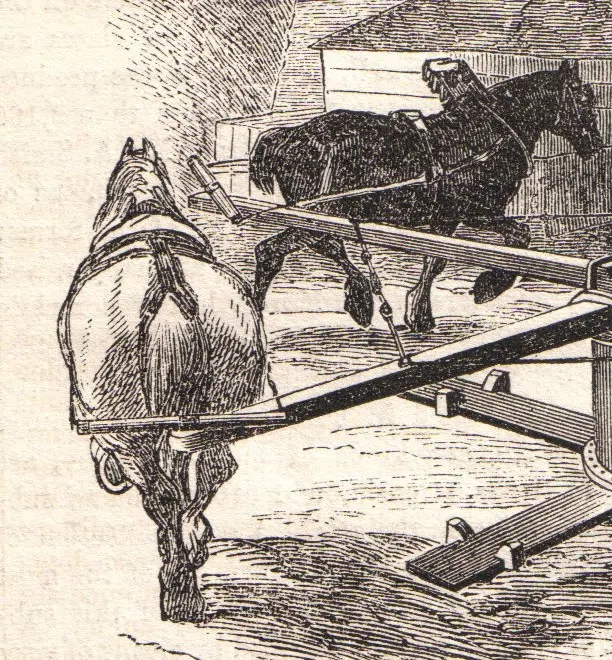
Two horses walk the arms of a horse gin, in a detail of an engraving that its file page says was printed in The Illustrated Exhibitor in 1851.
“Horse gin in use (detail), from The Illustrated Exhibitor, 1851”, Unknown engraver, The Illustrated Exhibitor (1851); Public Domain Mark.
Full credit
"Horse gin in use (detail), from The Illustrated Exhibitor, 1851" by Unknown engraver, The Illustrated Exhibitor (1851) — https://commons.wikimedia.org/wiki/File:Horse_Gin_in_use.jpg — Public domain (EU: anonymous engraving, published in The Illustrated Exhibitor in 1851, more than 70 years ago (70 years from publication); US: published before 1931; marked Public Domain Mark 1.0 on the file page); modified: cropped to the left part of the engraving (two horses and the gin arms)
Look at the label on a lawn mower or a blender, and a power rating is printed there. The unit behind that number was not set by any motor. When the rating is given in horsepower, the unit goes back to Boulton and Watt. Their first customers for engines that turned machinery, an 1827 treatise says, were the brewers and distillers of London, who wanted to know how many horses an engine would equal.
Today one horsepower is 33,000 foot-pounds of work per minute, the same as 550 foot-pounds per second, and NIST Special Publication 811 converts it to 745.6999 watts. John Farey's 1827 treatise on the steam engine says the 33,000 came from James Watt's trials with strong brewery horses. Farey adds that the standard was “very much beyond” the power of all but the very strongest horses.
What is the definition of horsepower?
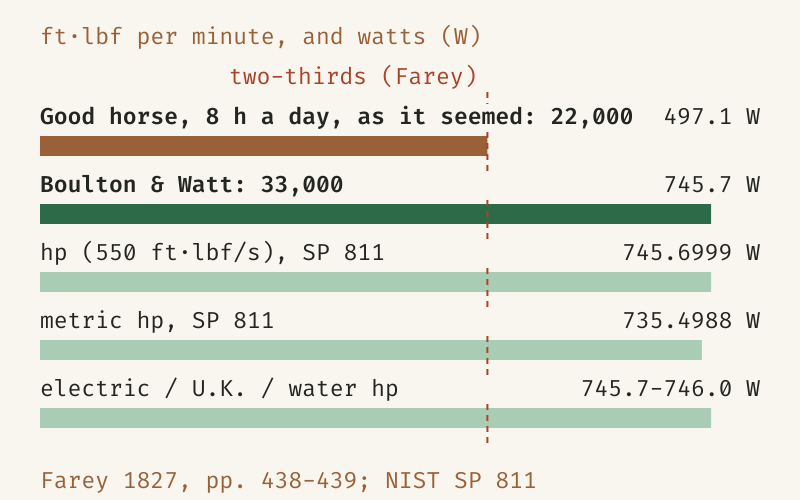
Farey's two figures in foot-pounds a minute, the 22,000 being what observations he reports seemed to show for a good horse, set beside the horsepowers in NIST SP 811, all in watts; boiler horsepower, at 9,809.50 W, is left off the scale.
Drawn from Farey 1827, pp. 438–439, read twice from the page scan; 150 × 220 recomputed to 33,000; Farey's 22,000 and 33,000 foot-pounds a minute divided by 60 and multiplied by SP 811's 1.355818 joules per foot-pound to give watts; the other values from NIST SP 811, Appendix B.8.
"One horsepower compared with a good horse's steady work" by Who Decided the Inch, https://whodecidedtheinch.com/old-measures/horsepower/, licensed under CC BY 4.0, https://creativecommons.org/licenses/by/4.0/
Data: John Farey, A Treatise on the Steam Engine (1827), pp. 438-439; NIST Special Publication 811 (2008 edition), Appendix B.8
Horsepower measures how quickly mechanical work gets done. A foot-pound is the work of lifting one pound through a height of one foot. Farey states the unit in those terms: 33,000 pounds “raised vertically through a space of one foot per minute.” Dividing by 60 seconds gives 550 foot-pounds every second, which is the form SP 811 writes into the unit's name.
NIST SP 811 full text, in its Appendix B.8, lists six different kinds of horsepower, each with its own conversion factor in watts. Five of them sit close together. One does not, so the exact name printed on a label matters.
| Horsepower, as SP 811 names it | Watts | Note |
|---|---|---|
| horsepower (550 ft·lbf/s) | 745.6999 | the unit defined above |
| horsepower (metric) | 735.4988 | about 1.4% smaller |
| horsepower (electric) | 746 | exact, per SP 811 |
| horsepower (U.K.) | 745.70 | conversion factor |
| horsepower (water) | 746.043 | conversion factor |
| horsepower (boiler) | 9,809.50 | a different scale; not in the chart |
The table as data (CSV, horsepower-0011.csv) (source and license notes) Data: John Farey, A Treatise on the Steam Engine (1827), pp. 438-439; NIST Special Publication 811 (2008 edition), Appendix B.8
Is metric horsepower the same?
No. SP 811 puts metric horsepower at 735.4988 watts, which is about 1.4 percent less than the 745.6999 watts of the horsepower defined as 550 foot-pounds per second. Boiler horsepower is a separate measure: at 9,809.50 watts it is more than 13 times larger, so the chart leaves it out.
The same question, where a particular number was first written down, also runs through the mile and shoe sizes.
Where did Watt's 33,000 come from?
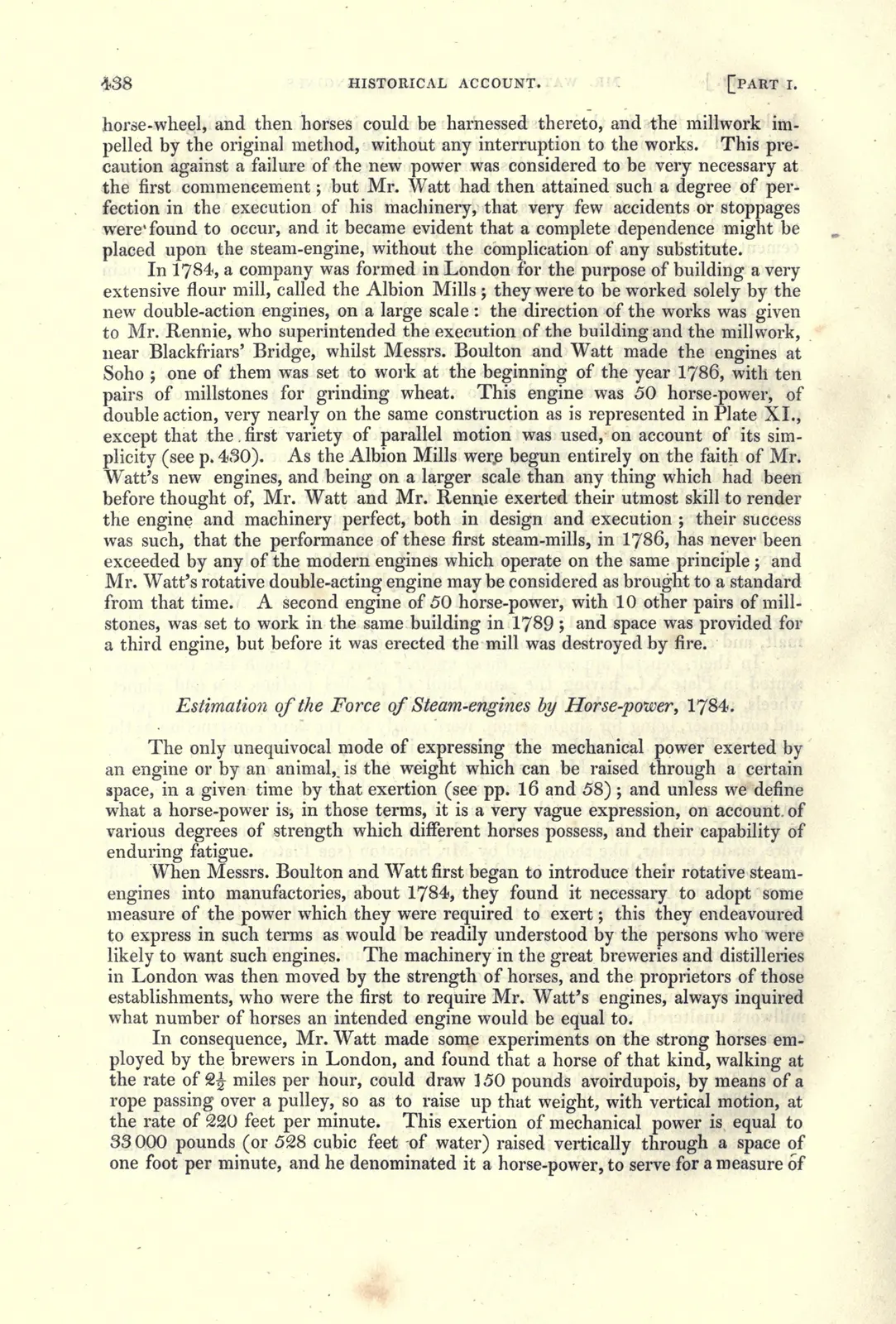
Page 438 of John Farey's A Treatise on the Steam Engine (1827), where the account of the horse trials begins.
"A Treatise on the Steam Engine (1827), page 438" by John Farey, A Treatise on the Steam Engine (London, 1827), p. 438 — https://archive.org/details/treatiseonsteame01fareuoft — Public domain (EU: author dated 1766-1826 per library catalog record (not otherwise checked), so dead more than 70 years ago (life plus 70 years); US: published before 1931 (London, 1827))
John Farey's A Treatise on the Steam Engine was printed in London in 1827, per the library catalog record. Its pages 438 and 439 page scan give the fullest account of the unit read for this page. Farey dates the measure to about 1784, when Boulton and Watt began installing rotative steam engines in factories.
At that time, Farey explains, horses moved the machinery in the great London breweries and distilleries. Their owners, he writes, “always inquired what number of horses an intended engine would be equal to.”
Watt answered with a practical test, which Farey describes across pages 438 and 439: “Mr. Watt made some experiments on the strong horses employed by the brewers in London, and found that a horse of that kind, walking at the rate of 2½ miles per hour, could draw 150 pounds avoirdupois, by means of a rope passing over a pulley, so as to raise up that weight, with vertical motion, at the rate of 220 feet per minute.”
Farey continues that this was “equal to 33 000 pounds (or 528 cubic feet of water) raised vertically through a space of one foot per minute, and he denominated it a horse-power, to serve for a measure of the power exerted by his steam-engines.”
That trial is why it is called horsepower. In Farey's account, Watt named the unit after the work of one strong brewery horse, so that customers could count an engine in horses. The arithmetic holds, since 150 × 220 = 33,000. A walking pace of 2½ miles an hour also works out to 220 feet a minute, so the weight rose exactly as fast as the horse walked.
Was the 33,000 in print before Farey?
Yes. A footnote on Farey's page 439 says the standard had first been stated in print in the Edinburgh Review, vol. xiii.
An article headed “Account of the Steam Engine” page scan ran in that volume's January 1809 issue; the month is printed on the page, and the year comes from the library catalog record. On page 324 it says that Boulton and Watt, “from the result of experiments made with the strong horses employed by the brewers in London,” assumed as their standard “a force able to raise thirty-three thousand lib. one foot high in a minute.” That 1809 page is the earliest statement of the 33,000 read for this page.
Can a real horse beat one horsepower?
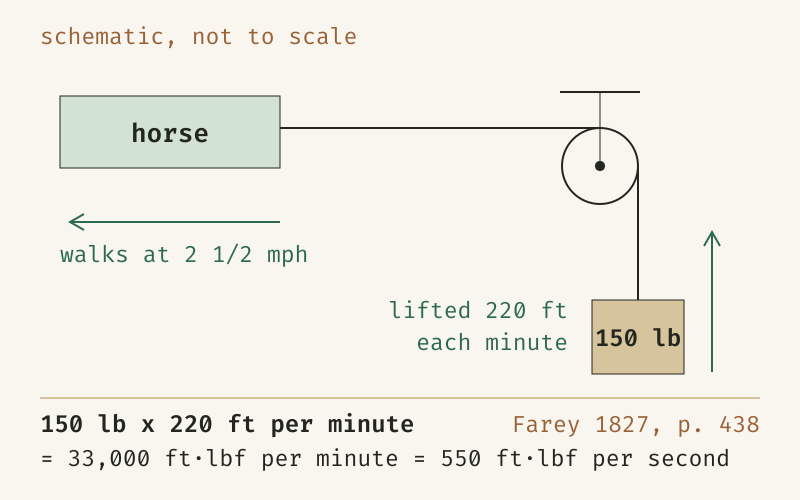
A schematic of the trial as Farey describes it: a horse walking at 2½ miles an hour raises 150 pounds 220 feet each minute; not to scale.
Drawn from Farey 1827, p. 438, read from the page scan; 150 × 220 recomputed to 33,000 and 2 1/2 miles an hour recomputed to 220 feet a minute; a schematic, not a copy of any drawing.
"Watt's trial horse as Farey describes it: 150 pounds raised 220 feet a minute" by Who Decided the Inch, https://whodecidedtheinch.com/old-measures/horsepower/, licensed under CC BY 4.0, https://creativecommons.org/licenses/by/4.0/
Data: John Farey, A Treatise on the Steam Engine (1827), p. 438
By Farey's account, only the very strongest horses could reach the standard, and not for long. On page 439 he writes that “Messrs. Boulton and Watt's standard for the horse-power, is very much beyond the actual power of any horses, except the very strongest, and they cannot long endure the exertion of raising 33 000 lbs., at the rate of 1 foot per minute.”
Farey then turns to horses at steady work. By his account, Smeaton and other engineers made many observations of horses working regularly in mills. Their results, he reports, seemed to show that a good horse could keep up 22,000 pounds raised one foot per minute while working 8 hours a day.
That is two-thirds of Watt's figure, Farey notes, so 30 such horses would have to pull together to match a 20-horsepower engine. An engine could also run without stopping. A horse could work only a third of the time, so Farey counts three relays, or 90 horses, to do what one 20-horsepower engine did. His conclusion is to regard horsepower as “a determined measure of mechanical power” that “bears that title without any direct reference to the actual power of horses.”
Two documents remain unread. Farey does not name the Smeaton writings behind the 22,000, and no text by Smeaton with that number turned up for this page, so the figure stands as Farey reports it. Watt's own notes of the brewery trials were not read either. Everything here about the trials comes from the 1809 review and from Farey, printed 25 and more than 40 years after 1784.
Sources
- A. Thompson and B. N. Taylor, Guide for the Use of the International System of Units (SI), NIST Special Publication 811, 2008 edition, Appendix B.8: Factors for Units Listed Alphabetically (National Institute of Standards and Technology, web version). U.S. Government work (17 U.S.C. §105). www.nist.gov/pml/special-publication-811/nist-…How far it was read: full text; Appendix B.8, rows for horsepower and foot pound-force
- John Farey, A Treatise on the Steam Engine, Historical, Practical, and Descriptive, vol. 1 (London: Longman, Rees, Orme, Brown and Green, 1827), pp. 438-439. Public domain (US: published 1827; EU: published 1827, so the author died more than 70 years ago; author dated 1766-1826 per library catalog record, not otherwise confirmed). archive.org/details/treatiseonsteame01fareuoftHow far it was read: page scan; pp. 438-439, the section on horse-power as a measure, 1784
- "Account of the Steam Engine," The Edinburgh Review, vol. 13, no. 26 (January 1809), p. 324. Public domain (US: published 1809; EU: published 1809, unsigned review). archive.org/details/sim_edinburgh-review-crit…How far it was read: page scan; p. 324, the paragraph on Boulton and Watt's standard
Cite this page
Who Decided the Inch. “Horsepower Definition: Farey Said Few Horses Could Match It.” Published November 22, 2026. https://whodecidedtheinch.com/old-measures/horsepower/. Accessed on the day you read it.
- To the original: how sources are read
- Marked in the margin: every correction
- Report an error on this page (contact@whodecidedtheinch.com)
Related entries
 Illustration
Inch History: Three Barleycorns, in a Rule With No Date
Illustration credit
Illustration: Who Decided the Inch. Generated schematic image — not a photograph or historical record. No copyright is claimed in this generated illustration; if you reuse it, please keep this label.
Why Is a Mile 5,280 Feet? 8 Furlongs, 40 Rods, 16.5 Feet
Picture credit
"175 miles to London" by Tim Green from Bradford — https://commons.wikimedia.org/wiki/File:175_miles_to_London_(16669202367).jpg — CC BY 2.0 (https://creativecommons.org/licenses/by/2.0/); modified: resized from 2,683 x 3,433 to 938 x 1,200 px, whole frame
Barleycorn Shoe Size: A 1912 Manual’s Third-of-an-Inch Step
Picture credit
"Shoemakers, from Das Ständebuch (The Book of Trades), 1568" by Jost Amman — https://commons.wikimedia.org/wiki/File:Shoemaker_Book_of_Trades.png — Public domain (EU: the file page's license tag gives the author's death as 1591 (PD-old-auto-expired), more than 70 years ago; US: published 1568, before 1931; marked Public Domain Mark 1.0 on the file page)