No. 3 Table and data page
Why Is a Mile 5,280 Feet? 8 Furlongs, 40 Rods, 16.5 Feet
Who Decided the Inch Published
Origin card
Short answer
A mile is 5,280 feet because it is counted up from smaller units: 8 furlongs of 40 rods of 16 1/2 feet, as NIST Handbook 44 (2026) lists it. The earliest statement of that chain found for this page is Owen Ruffhead's 1770 editor's abstract of an act of 1593.
- Name
- Mile
- Category
- Old Measures
- Earliest known record
- 1593 · act of Parliament (35 Eliz. c. 6), known here only from an editor's abstract · The Statutes at Large, vol. 2 (London, 1770), p. 676The earliest known record is not the same as the time or place of invention.
- Origin attribution
- Unknown: the abstract names no person, and no record of who chose 8 furlongs, or why, was found for this page.
- Key document
- 35 Eliz. c. 6, as abstracted in Ruffhead 1770, vol. 2, p. 676 editor's abstract; Weights and Measures Act 1824, s. I full text; Weights and Measures Act 1985, Sch. 1 full text; NIST Handbook 44 (2026), Appendix C full text
- Still in use?
- Yes, as of 2026: NIST Handbook 44 gives 1 mile as 5,280 feet, or 1.609344 kilometers exactly, and the current UK text of the 1985 Act lists Mile = 1760 yards.
This card as data (CSV) source and license notes
Data: NIST Handbook 44 (2026), Appendix C; Ruffhead, The Statutes at Large, vol. 2 (1770), p. 676 (editor's abstract); Weights and Measures Act 1824, s. I; Weights and Measures Act 1985, Sch. 1
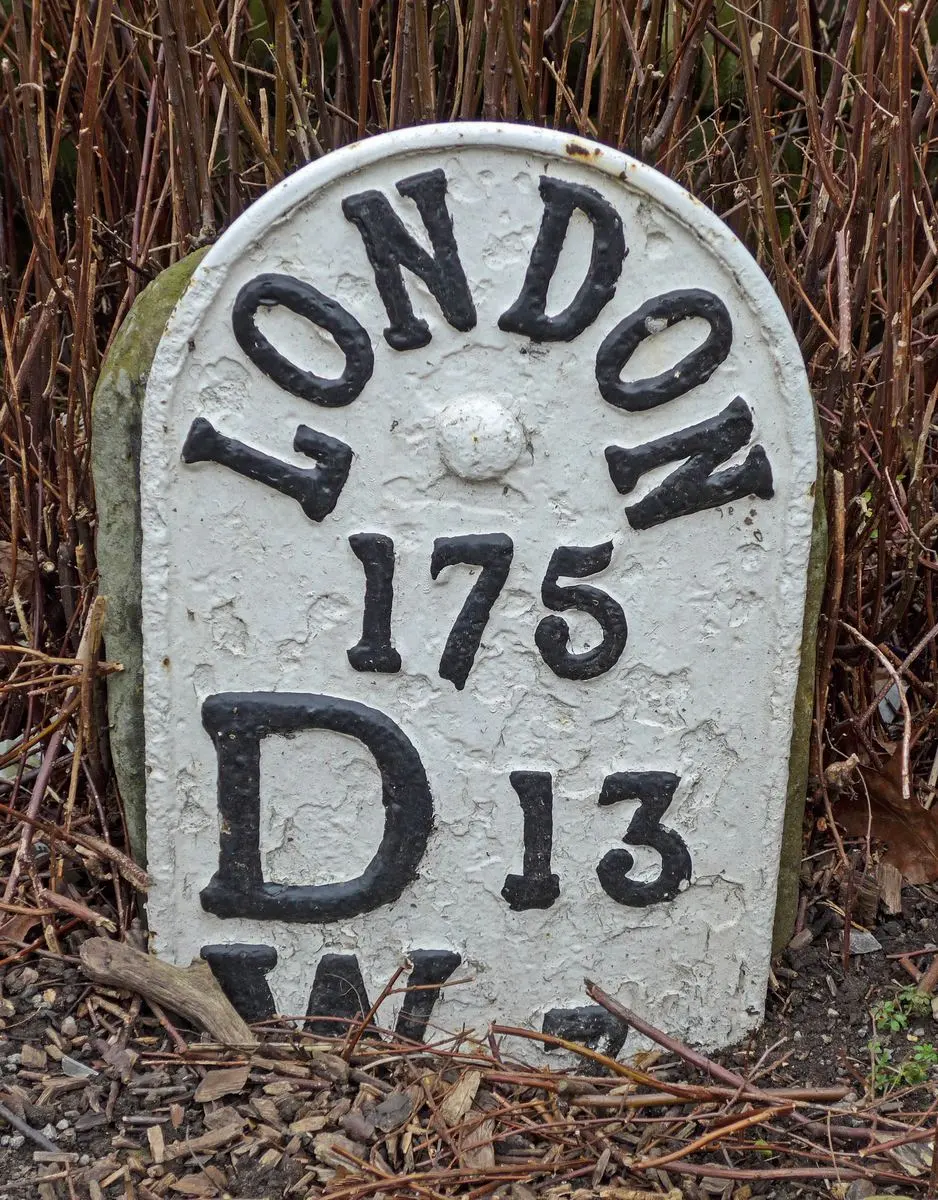
A white-painted milestone with raised black letters: LONDON and 175 across the top, D and 13 below, and a last line hidden in the twigs.
"175 miles to London" by Tim Green from Bradford — https://commons.wikimedia.org/wiki/File:175_miles_to_London_(16669202367).jpg — CC BY 2.0 (https://creativecommons.org/licenses/by/2.0/); modified: resized from 2,683 x 3,433 to 938 x 1,200 px, whole frame
Check the distance on a car's dashboard or a running app. Each mile it counts holds 5,280 feet, a total reached by multiplying smaller units.
NIST Handbook 44 (2026), Appendix C full text, lists the chain that produces it. Sixteen and a half feet make a rod, 40 rods make a furlong of 660 feet, and 8 furlongs make a mile of 5,280 feet. With the foot set at exactly 0.3048 meter, that mile is 1,609.344 meters.
How many feet are in a mile?
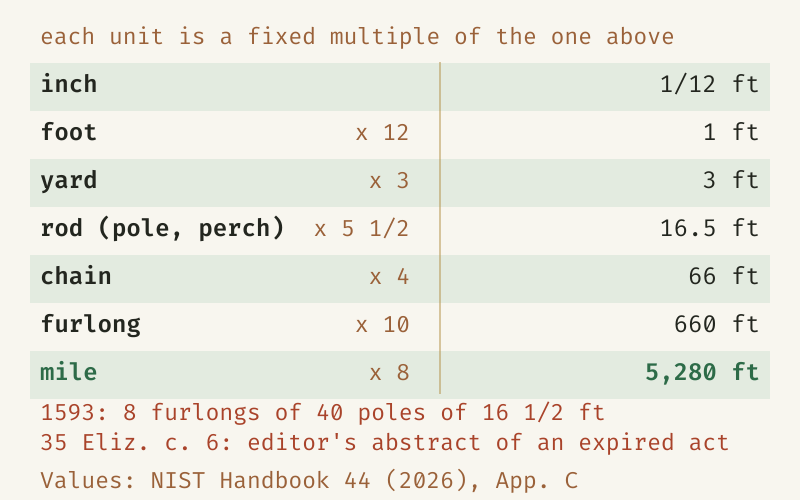
The steps from inch to mile as NIST Handbook 44 lists them, with the 1593 version beneath, known only from an editor's abstract of an expired act.
Drawn from NIST Handbook 44 (2026), Appendix C; 3 × 5 1/2 × 4 × 10 × 8 feet recomputed to 5,280 feet; the 1593 row from Ruffhead's 1770 editor's abstract of an expired act.
"Why a mile is 5,280 feet: from inch to mile, by NIST Handbook 44, with the 1593 abstract" by Who Decided the Inch, https://whodecidedtheinch.com/old-measures/mile/, licensed under CC BY 4.0, https://creativecommons.org/licenses/by/4.0/
Data: NIST Handbook 44 (2026), Appendix C; Ruffhead, The Statutes at Large, vol. 2 (1770), p. 676 (editor's abstract)
| Unit | Of the unit above | Feet | Source | How far it was read |
|---|---|---|---|---|
| inch | 1/12 | NIST Handbook 44 (2026), App. C | full text | |
| foot | 12 | 1 | NIST Handbook 44 (2026), App. C | full text |
| yard | 3 | 3 | NIST Handbook 44 (2026), App. C | full text |
| rod (pole, perch) | 5 1/2 | 16.5 | NIST Handbook 44 (2026), App. C | full text |
| chain | 4 | 66 | NIST Handbook 44 (2026), App. C | full text |
| furlong | 10 | 660 | NIST Handbook 44 (2026), App. C | full text |
| mile | 8 | 5,280 | NIST Handbook 44 (2026), App. C | full text |
| mile, 1593 | 8 furlongs of 40 poles of 16 1/2 ft | 5,280 | Ruffhead, Statutes at Large, vol. 2 (1770), p. 676 | editor's abstract |
| mile, 1824 (UK) | 1,760 yards | 5,280 | Weights and Measures Act 1824, s. I | full text |
The table as data (CSV, mile-0007-chain.csv) (source and license notes) Data: NIST Handbook 44 (2026), Appendix C; Ruffhead, The Statutes at Large, vol. 2 (1770), p. 676 (editor's abstract); Weights and Measures Act 1824, s. I
Read the table from the top and each line multiplies the one before, so twelve inches make a foot and three feet make a yard. The rod is the one awkward step, at 5 1/2 yards or 16 1/2 feet, and everything above it is a whole count again, with 4 rods to a chain, 10 chains to a furlong and 8 furlongs to a mile.
The odd-looking total comes from that single fractional step in the middle, because a furlong of 40 rods is 40 × 16 1/2 = 660 feet, and 8 furlongs are 5,280 feet. Counted in rods, a mile comes to 320; counted in inches, it comes to 63,360.
Where does the 1593 act come in?
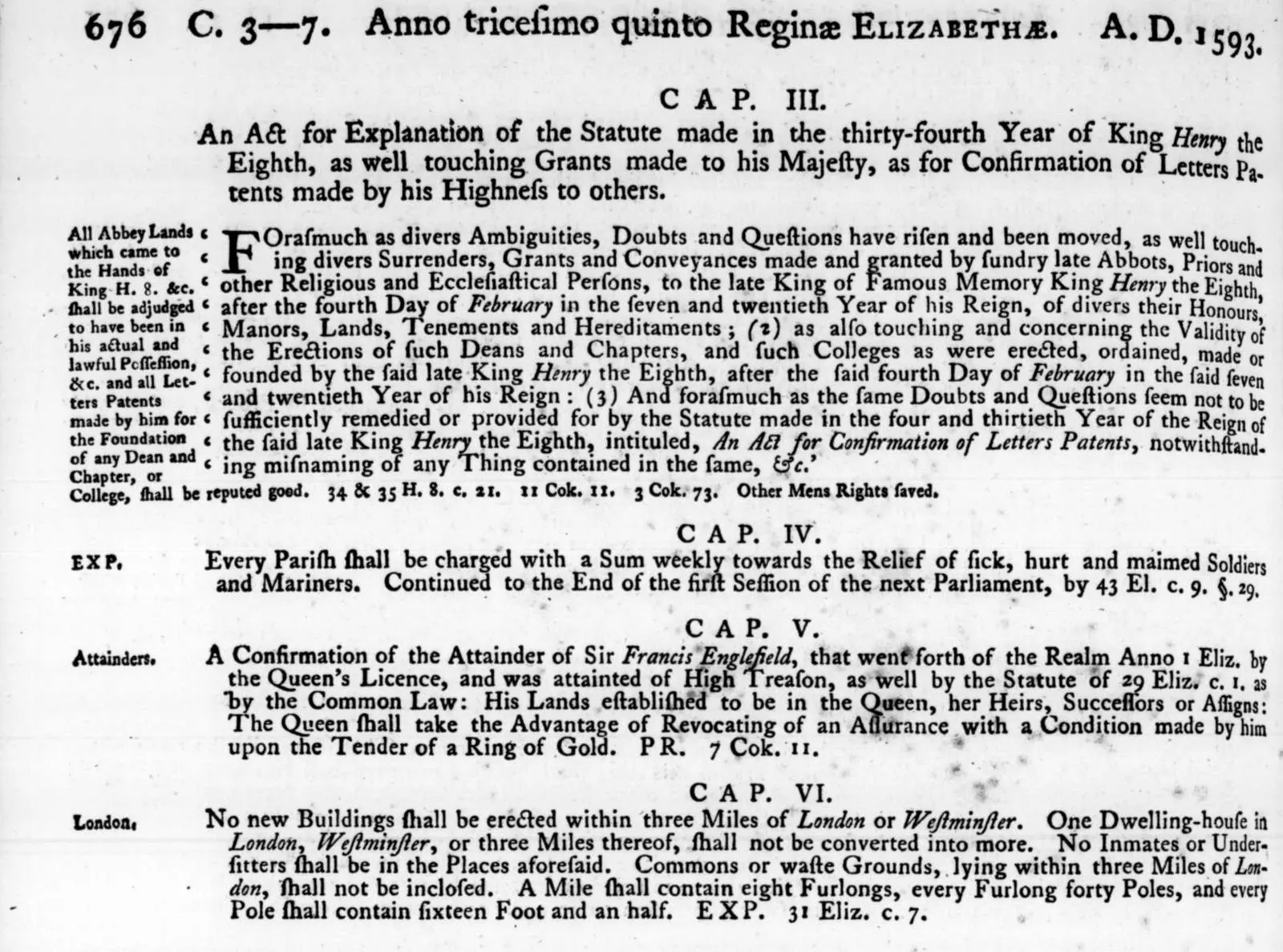
Part of page 676 of the second volume of Ruffhead's 1770 edition of the statutes; chapter VI, the last one shown, is his abstract of an expired act of 1593 that gives the mile as eight furlongs.
“35 Eliz. c. 6 as abstracted in The Statutes at Large, vol. 2 (London, 1770), p. 676”, Owen Ruffhead (editor), The Statutes at Large, vol. 2, new edition (London, 1770), page 676; public domain.
Full credit
"35 Eliz. c. 6 as abstracted in The Statutes at Large, vol. 2 (London, 1770), p. 676" by Owen Ruffhead (editor), The Statutes at Large, vol. 2, new edition (London, 1770), page 676 — https://archive.org/details/bim_eighteenth-century_public-general-acts-12_ruffhead-owen_1770_2 — Public domain (EU: printed in London in 1770, so its editor died more than 70 years ago (life plus 70 years; the editor's death date was not traced to a readable source); US: published before 1931 (London, 1770)); modified: cropped to the running head and chapters III to VI, converted to grayscale and resized to 1600 px wide
The earliest written version of the chain found for this page sits in Owen Ruffhead's edition of The Statutes at Large, printed in London in 1770, where page 676 of the second volume is headed “A.D. 1593.” Chapter VI on that page is not the act itself but Ruffhead's short summary of an act he marks “EXP.” editor's abstract.
Most of that summary is about London. As abstracted in 1770, the act barred new buildings within three miles of London or Westminster, stopped houses there from being split into more dwellings, and kept commons near London from being enclosed. Its last sentence turns to the measure: “A Mile shall contain eight Furlongs, every Furlong forty Poles, and every Pole shall contain sixteen Foot and an half.”
Multiplied out, the abstract's mile is 8 × 40 × 16 1/2 = 5,280 feet, the figure NIST gives today. The pole of 16 1/2 feet is the Handbook's rod under another of its names. Ruffhead's summary does not say why the rule appears in a law about building near London, and a summary does not carry the act's own wording. The act's text was not found for this page, so the 1593 act is cited here through the 1770 abstract, as the To the original page explains.
Why not 5,000?
NIST Handbook 44 gives one answer in a footnote to the mile full text. It says the mile was “Originally referred to as the ‘statute mile,’ when Queen Elizabeth I changed the definition of the mile from the Roman mile of 5 000 feet to the statute mile of 5 280 feet.” The footnote names no source for that history.
Ruffhead's abstract of the 1593 act gives only the chain. It mentions no earlier mile, no Roman measure and no 5,000. No text read for this page shows what length a mile had before 1593, so the account of a 5,000-foot mile is reported here as NIST's, not confirmed.
What is a furlong?
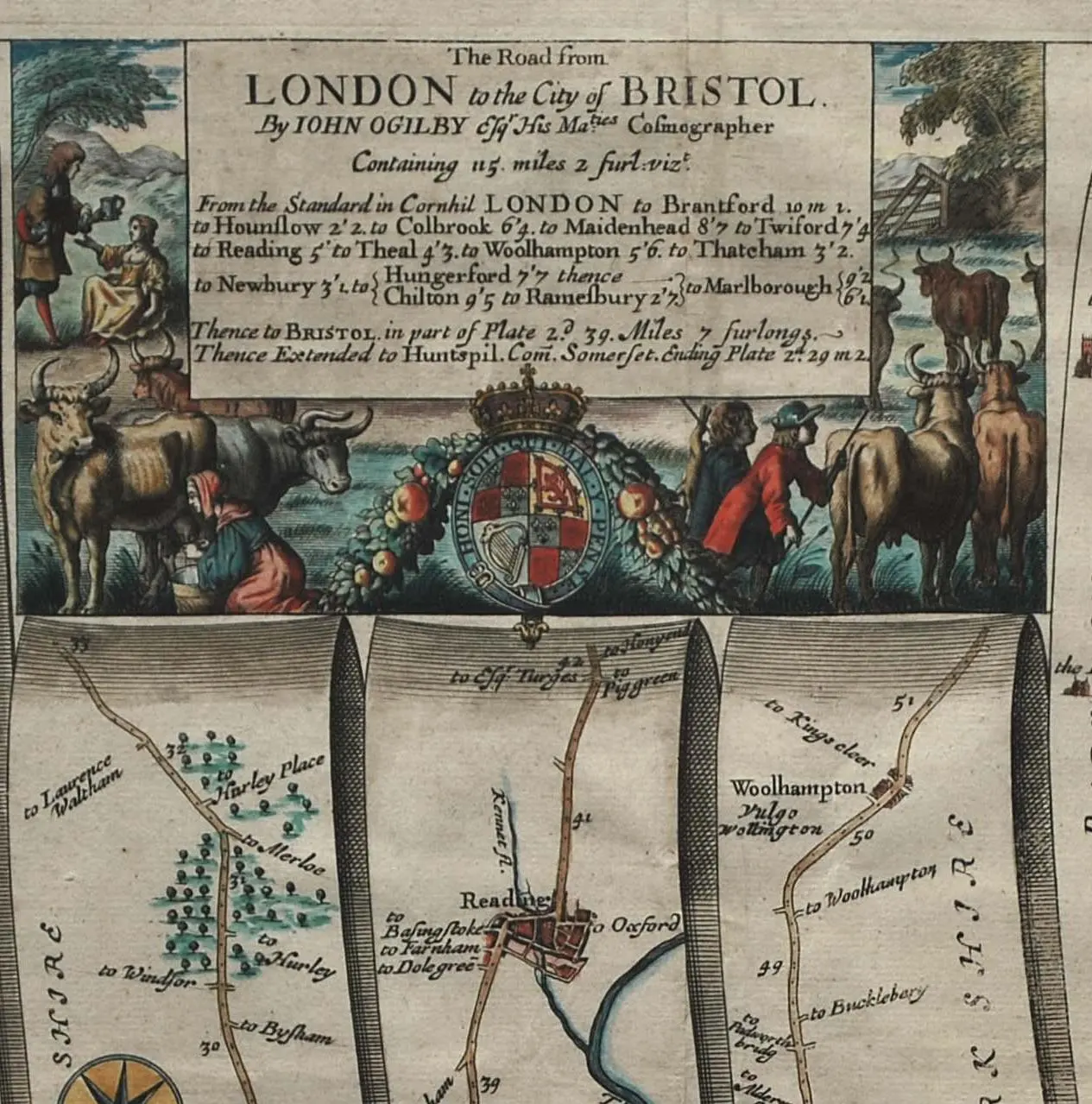
Part of John Ogilby's plate of the road from London to Bristol, dated 1675 on its file page; the title panel gives the whole route as 115 miles 2 furlongs.
“The Road from London to the City of Bristol, from Britannia (1675), detail”, John Ogilby; Public Domain Mark.
Full credit
"The Road from London to the City of Bristol, from Britannia (1675), detail" by John Ogilby — https://commons.wikimedia.org/wiki/File:John_Ogilby_-_The_Road_from_London_to_the_City_of_Bristol_(1675).jpg — Public domain (EU: the file page's license tag marks the work public domain where the term is the author's life plus 100 years or fewer (published 1675); US: published before 1931 (1675); marked Public Domain Mark 1.0 on the file page); modified: cropped to the title panel and the upper parts of the three middle road strips, saved as JPEG at the original pixel size
A furlong is 660 feet, or one eighth of a mile. NIST Handbook 44 gives both figures, and its conversion table puts the furlong at exactly 201.168 meters full text. In yards it is 220, so eight furlongs laid end to end make 1,760 yards.
Road distances could be written in both units together. John Ogilby's plate for the road from London to Bristol is drawn as seven strips side by side; its Commons file page dates it to 1675 and places it in his Britannia atlas. The title panel gives the length: “Containing 115 miles 2 furl.” page scan. The same panel gives the rest of the way to Bristol, on a second plate, as “39 Miles 7 furlongs,” and numbered marks along the road climb to 75 near Marlborough.
The plate itself does not say how long its mile is, and the rest of Ogilby's book was not read for this page.
When did the mile become 1,760 yards?
Among the laws read for this page, the first to count the mile in yards is the Weights and Measures Act 1824 (5 Geo. 4 c. 74). It fixed a brass Imperial Standard Yard and then counted the longer measures in it full text. Section I, on page 638 of the printed act, says “the Pole or Perch in Length shall contain Five such Yards and a Half, the Furlong Two hundred and twenty such Yards, and the Mile One thousand seven hundred and sixty such Yards.”
The count stayed the same, because 1,760 yards of 3 feet is 5,280 feet and 220 is one eighth of 1,760, so the 1824 mile still holds 8 furlongs, as in the 1770 abstract of the 1593 act. The inch sits at the smallest end of the same chain.
The current UK text of the Weights and Measures Act 1985, read on legislation.gov.uk on 21 November 2026, still lists “Mile = 1760 yards” and “Furlong = 220 yards” in Schedule 1, Part VI full text. That part is headed “Definitions of certain units which may not be used for trade except as supplementary indications.” The same page lists a 2025 Act, 2025 c. 20, s. 11(3), that omits Schedule 1, marked as a change not yet applied. NIST's tables also keep another old unit, the hand, at 4 inches.
What is still not known
The text of the 1593 act itself was not found for this page, so its exact wording, and whether it gives a reason for eight furlongs, is not known here. Ruffhead's summary names no person who chose the count. No document read here explains where the furlong or the 16 1/2-foot rod came from, and none besides NIST's footnote mentions a mile of 5,000 feet before 1593.
Sources
- NIST Handbook 44 (2026), Appendix C: General Tables of Units of Measurement. National Institute of Standards and Technology. U.S. Government work (17 U.S.C. §105). www.nist.gov/document/2026-nist-handbook-44-ap…How far it was read: full text; Appendix C, 2026 edition, tables and notes
- Owen Ruffhead (ed.), The Statutes at Large, vol. 2, new edition (London, 1770), p. 676: 35 Eliz. c. 6 (editor's abstract of an expired act). Public domain (EU and US: printed 1770). archive.org/details/bim_eighteenth-century_pu…How far it was read: editor's abstract; Ruffhead's 1770 summary of the expired act, vol. 2 p. 676
- Weights and Measures Act 1824 (5 Geo. 4 c. 74), 17 June 1824, ss. I-III, King's Printer copy on legislation.gov.uk. www.legislation.gov.uk/ukpga/Geo4/5/74/enactedHow far it was read: full text; ss. I-III, pp. 637-638 of the printed act
- John Ogilby, Britannia (London, 1675), plate: The Road from London to the City of Bristol. Public domain (EU and US: published 1675; Public Domain Mark on the Wikimedia Commons file page). commons.wikimedia.org/wiki/File:John_Ogilby_-_The_Road_…How far it was read: page scan; the London to Bristol plate as a whole, its title panel read from the image
- Weights and Measures Act 1985 (c. 72), Schedule 1, Part VI, current text on legislation.gov.uk. www.legislation.gov.uk/ukpga/1985/72/schedule/1How far it was read: full text; Schedule 1 as current on 21 November 2026Text license: Open Government Licence v3.0 (terms)

Cite this page
Who Decided the Inch. “Why Is a Mile 5,280 Feet? 8 Furlongs, 40 Rods, 16.5 Feet.” Published November 22, 2026. https://whodecidedtheinch.com/old-measures/mile/. Accessed on the day you read it.
- To the original: how sources are read
- Marked in the margin: every correction
- Report an error on this page (contact@whodecidedtheinch.com)
Related entries
 Illustration
Inch History: Three Barleycorns, in a Rule With No Date
Illustration credit
Illustration: Who Decided the Inch. Generated schematic image — not a photograph or historical record. No copyright is claimed in this generated illustration; if you reuse it, please keep this label.
Horsepower Definition: Farey Said Few Horses Could Match It
Picture credit
"Horse gin in use (detail), from The Illustrated Exhibitor, 1851" by Unknown engraver, The Illustrated Exhibitor (1851) — https://commons.wikimedia.org/wiki/File:Horse_Gin_in_use.jpg — Public domain (EU: anonymous engraving, published in The Illustrated Exhibitor in 1851, more than 70 years ago (70 years from publication); US: published before 1931; marked Public Domain Mark 1.0 on the file page); modified: cropped to the left part of the engraving (two horses and the gin arms)
Barleycorn Shoe Size: A 1912 Manual’s Third-of-an-Inch Step
Picture credit
"Shoemakers, from Das Ständebuch (The Book of Trades), 1568" by Jost Amman — https://commons.wikimedia.org/wiki/File:Shoemaker_Book_of_Trades.png — Public domain (EU: the file page's license tag gives the author's death as 1591 (PD-old-auto-expired), more than 70 years ago; US: published 1568, before 1931; marked Public Domain Mark 1.0 on the file page)