No. 1 Origin entry
Barber Pole: An 1813 Book Reads the White Stripe as Bandage
Who Decided the Inch Published
Origin card
Short answer
John Brand's Observations on Popular Antiquities (1813 edition) explains the striped pole as the sign of a barber who also let blood, its white band standing for the fillet, or bandage, around a bleeding patient's staff. Older verses the book quotes, back to 1708, already tie the barber's pole to surgeons.
- Name
- Barber pole
- Category
- Objects
- Earliest known record
- 1708 · verse in The British Apollo, quoted by Brand in 1813, the earliest dated mention of a colored pole found for this page · LondonThe earliest known record is not the same as the time or place of invention.
- Origin attribution
- Unknown: no maker or first user of the striped pole is named in the records read; Brand gives an explanation, not an origin
- Key document
- Brand, Observations on Popular Antiquities (1813), vol. 2, pp. 252-255 page scan; The British Apollo (1708), not yet read; The Antiquarian Repertory, not yet read
- Still in use?
- Yes, as a barbershop sign, as of 2026
This card as data (CSV) source and license notes
Data: John Brand, Observations on Popular Antiquities, ed. Henry Ellis (London, 1813), vol. 2, pp. 251-255 (public domain)
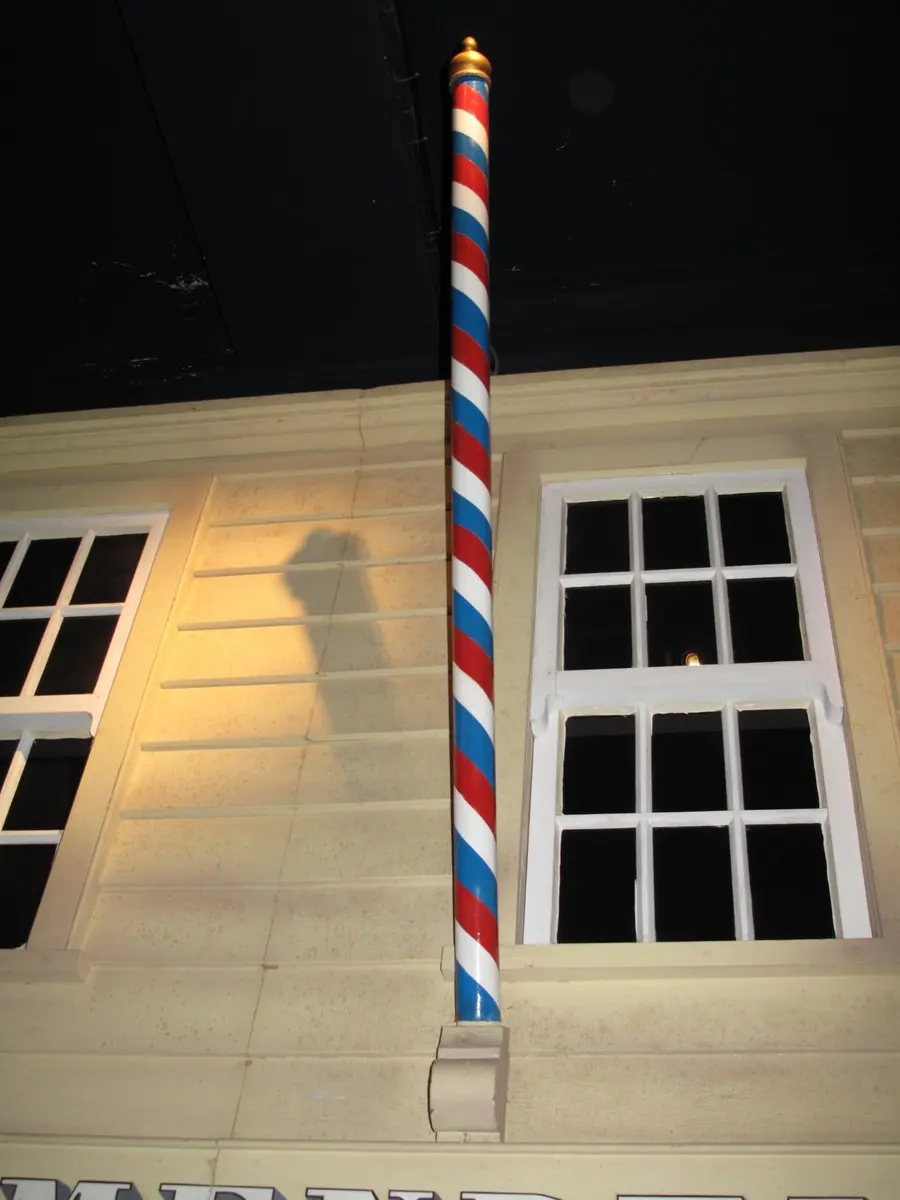
A barber's pole in the Auckland War Memorial Museum, painted with red, white and blue spirals and gold ends; the museum's record gives its length as 1,425 mm and no date.
"Barber's pole (AM 615460)" by Auckland Museum — https://commons.wikimedia.org/wiki/File:Barber%27s_pole_(AM_615460).jpg — CC BY 4.0 (https://creativecommons.org/licenses/by/4.0/); modified: resized
Next time you pass a barbershop, watch the stripes climb the pole by the door. Nothing about a haircut needs a spiral of colors, and the old books that explain the pole point to a different job.
Why is a barber pole striped?
The fullest early account found for this page is in John Brand's Observations on Popular Antiquities, a survey of English customs, in the edition revised by Henry Ellis in 1813 page scan. Under the heading “Barbers Signs,” Brand writes that a barber's shop “is generally distinguished by a long Pole instead of a Sign” (vol. 2, p. 251).
He weighs several guesses about it, including one that traces it to “the word Poll or Head” (p. 254), and then gives the one he likes best, which he says he found in the Antiquarian Repertory, a work not read for this page.
Brand's page then reads that “the true Intention of that party-coloured Staff was to shew that the Master of the Shop practised Surgery, and could breathe a Vein as well as mow a Beard: such a Staff being to this Day, by every Village practitioner, put into the hand of a patient undergoing the operations of phlebotomy. The white Band, which encompasses the Staff, was meant to represent the fillet thus elegantly twined about it” (vol. 2, p. 254).
Phlebotomy is the old medical word for opening a vein to let blood. A fillet is a narrow band or bandage. Brand has it twined about the staff itself. In this reading, the pole copies the staff a patient gripped while being bled, and the white stripe stands for the bandage.
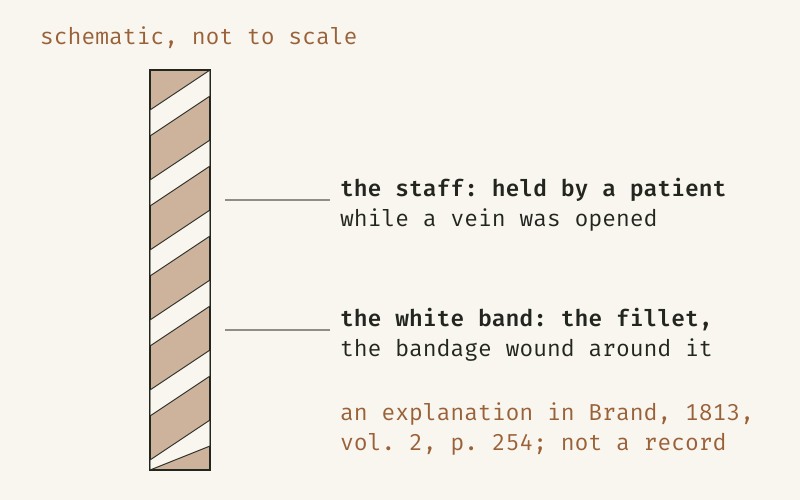
A schematic, not to scale, of Brand's 1813 reading: the staff a patient held while a vein was opened, with the white band as the bandage.
Drawn from Brand, Observations on Popular Antiquities (1813), vol. 2, p. 254, read from the page scan; a schematic of the explanation, not of any surviving pole.
"Brand's 1813 reading of the barber pole (schematic)" by Who Decided the Inch, https://whodecidedtheinch.com/objects/barber-pole/, licensed under CC BY 4.0, https://creativecommons.org/licenses/by/4.0/
Data: John Brand, Observations on Popular Antiquities, ed. Henry Ellis (London, 1813), vol. 2, p. 254 (public domain)
Brand backs the reading with two pictures he names: a barber's shop in Comenius's Orbis pictus, where the patient “is represented with a Pole or Staff in his hand,” and an illumination in a missal from the time of Edward I. Neither picture was found for this page.
Where does the bandage story come from?
The story says the white stripe is a bandage; the document says this is one writer's explanation, borrowed from another book.
The good story
The white stripe is the bandage of a patient being bled, as Brand's 1813 Observations on Popular Antiquities explains it, crediting the Antiquarian Repertory.
The paper trail
Brand gives an explanation and names no shop, date or maker of a first pole; the Antiquarian Repertory itself was not read for this page. Brand, vol. 2, pp. 253–254 page scan
The good story
A law made barbers use blue and white striped poles, as Lord Thurlow told the House of Lords on 17 July 1797, according to Brand.
The paper trail
No statute naming pole colors was found for this page, and Thurlow's words are known here only as Brand prints them. Brand, vol. 2, pp. 254–255 page scan
The good story
The barber's red is there to look like blood, as in John Gay's fable of a barber's shop, which Brand quotes.
The paper trail
In Gay's lines the red rags line cups in the window “to look like blood,” while the pole is hung with pewter basins. Brand, vol. 2, p. 255 page scan
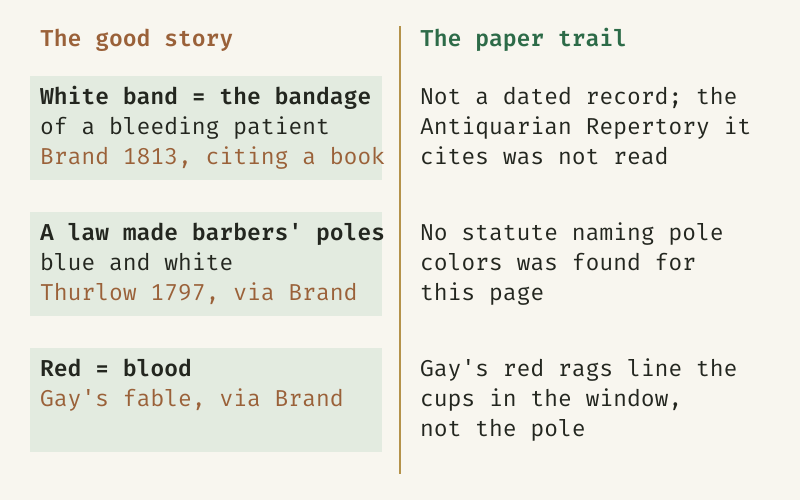
Three stories about the barber pole beside what the pages of Brand's 1813 book actually show.
Drawn from Brand, Observations on Popular Antiquities (1813), vol. 2, pp. 253–255, read from the page scans.
This figure as text
the figure's three rows.
- The white band as a bleeding patient's bandage: Brand's 1813 explanation, citing a book not read for this page; an explanation, not a dated record.
- A law making barbers' poles blue and white: Lord Thurlow's 1797 claim, as Brand quotes it; no statute naming pole colors was found for this page.
- Red as blood: in Gay's fable, as Brand quotes it, the red rags line the cups in the window, not the pole.
"The barber pole: the good story and the paper trail" by Who Decided the Inch, https://whodecidedtheinch.com/objects/barber-pole/, licensed under CC BY 4.0, https://creativecommons.org/licenses/by/4.0/
Data: John Brand, Observations on Popular Antiquities, ed. Henry Ellis (London, 1813), vol. 2, pp. 253-255 (public domain)
Street signs gather stories like this. The traffic light has a disputed first of its own, and the paper clip carries a national legend.
Did barbers really let blood?
The books Brand quotes describe barbers who did more than cut hair. None of them is a shop record. He quotes the Athenian Oracle, a question-and-answer collection, saying that in England barbers “were in some sort the Surgeons of old times.”
The same passage adds that “In Cities and corporate Towns, they still retain their name of Barber Chirurgions,” chirurgeon being an old spelling of surgeon. “They therefore used to hang their Basons out upon Poles, to make known at a distance to the weary and wounded Traveller where all might have recourse” (pp. 251–252).
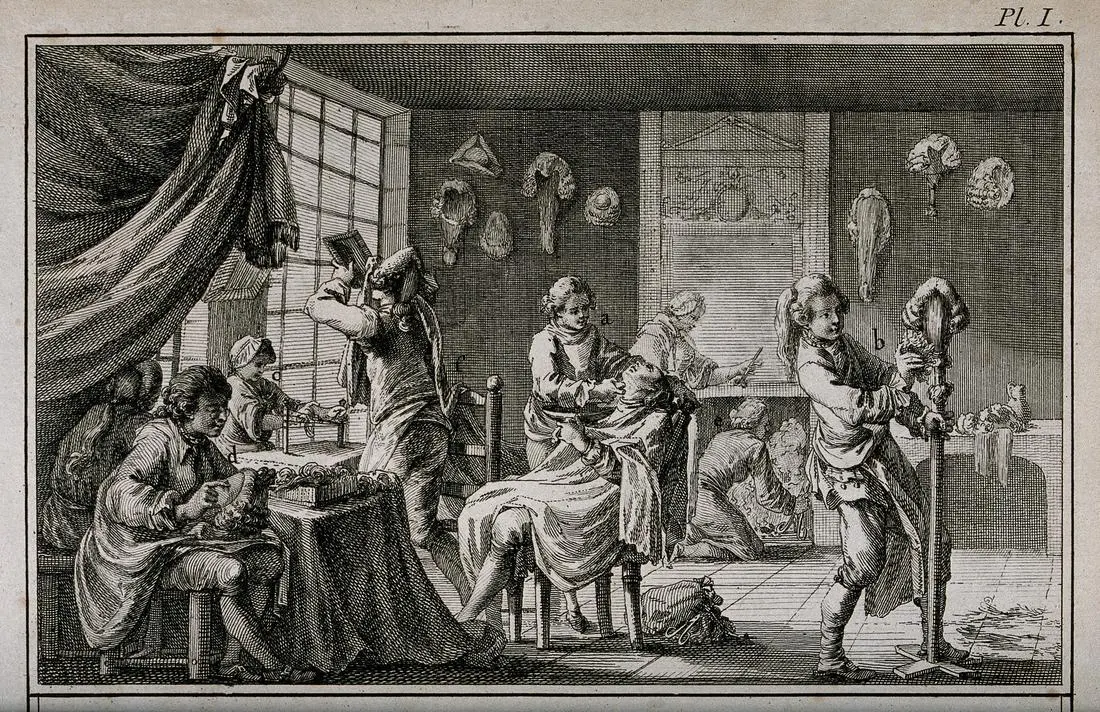
A barber's and wig-maker's shop in an engraving that its file page describes as by Robert Bénard after J.-R. Lucotte, 1762: a customer is shaved in the center while wigs are dressed around him. No pole appears in the scene.
"A barber's and wig-maker's establishment, above; shaving" by Wellcome Library, London. Wellcome Images — https://commons.wikimedia.org/wiki/File:A_barber%27s_and_wig-maker%27s_establishment,_above;_shaving_Wellcome_V0019607.jpg — CC BY 4.0 (https://creativecommons.org/licenses/by/4.0/); modified: resized
John Gay's fable “The Goat without a Beard,” as Brand prints it, describes a barber's shop in six lines, with a pole hung with pewter basins, a string of pulled teeth, and cups in the window. The barber is the man “Who shav'd, drew Teeth, and breath'd a Vein” (p. 255). The explanation Brand adopts, quoted above, adds that “to this Day” every village practitioner handed a staff to a patient being bled. The page does not make clear whether that day is Brand's or the earlier book's.
These are descriptions in verse and in a book of customs. They show that writers of the 1700s and early 1800s linked the barber's trade with letting blood, but not what any particular shop did. Bloodletting appears on this page only as history.
What did Henry VIII's act say about barbers and blood?
The Statutes at Large printed in 1618 page scan give chapter 42 of the thirty-second year of Henry VIII as “An Act concerning Barbors and Surgeons to be of one Companie” (p. 699). It covers London only.
It joins the Barbers of London and the Surgeons into one company, then rules that no one using barbery or shaving in the City of London, its suburbs or a mile around “shall occupie any Surgerie, letting of bloud, or any other thing” of surgery, “drawing of teeth onely excepted” (p. 700; the printed long s is set here as s).
A proviso at the end of the act allows anyone who is neither barber nor surgeon to keep a barber or surgeon in his house as a servant, practicing barbery, surgery or either there, or elsewhere by the master's license.
The same page bars surgeons there from shaving, and orders everyone using surgery in that area to “haue an open signe” where they live, so that people passing by would know where to go for help “in time of necessitie.” The act does not say what the sign looked like. It names no pole and no colors.
When was the striped pole first written about?
The earliest dated mention of a colored pole found for this page is a verse question printed in The British Apollo in London in 1708. Brand quotes it in a footnote (p. 252): “And why a Barber at Port-hole / Puts forth a party-colour'd Pole?” Party-colored means painted in more than one color.
The verse answer traces the pole to surgeons of ancient Rome who later “joyn'd the other Trade of trimming,” and “Thus twisted both their Trades together.” The 1708 periodical itself was not read, so the date rests on Brand's footnote.
Brand quotes an undated joke as well, from Gayton's Festivious Notes upon Don Quixote, a book he cites by page but not by year. In it “The Barber hath a long pole elevated; and at the end of it a Labell” with “this word Money” written on it, so that pole and label together read “Pole-money” (pp. 252–253). That pole carries a pun. No colors are mentioned at all.
In the pages read for this entry, blue enters in 1797. Brand reports that Lord Thurlow spoke in the House of Lords on 17 July 1797, arguing to postpone a bill to incorporate the surgeons.
Thurlow said “that by a Statute still in force, the Barbers and Surgeons were each to use a Pole. The Barbers were to have theirs blue and white, striped, with no other appendage; but the Surgeons, which was the same in other respects, was likewise to have a Galley-pot and a red Rag, to denote the particular nature of their Vocation” (pp. 254–255). Thurlow names no statute, and none naming pole colors was found for this page.
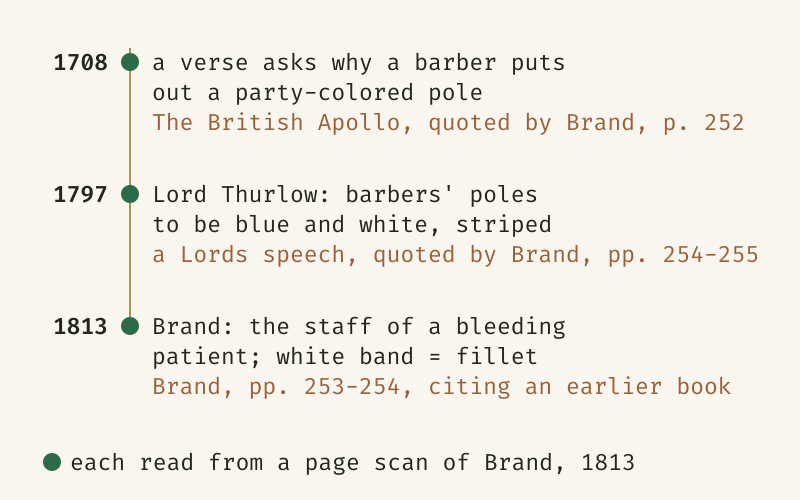
Three dated records of the barber pole, each read in the page scans of Brand's 1813 book, which quotes the first two.
Drawn from Brand, Observations on Popular Antiquities (1813), vol. 2, pp. 252–255, read from the page scans; each row names whose words it reports.
"The barber pole in dated records" by Who Decided the Inch, https://whodecidedtheinch.com/objects/barber-pole/, licensed under CC BY 4.0, https://creativecommons.org/licenses/by/4.0/
Data: John Brand, Observations on Popular Antiquities, ed. Henry Ellis (London, 1813), vol. 2, pp. 252-255 (public domain)
| Date | What the record says | Whose words | Read |
|---|---|---|---|
| 1708 | A barber “puts forth a party-colour'd Pole” | The British Apollo, quoted by Brand, p. 252 | page scan of Brand |
| 17 July 1797 | A statute “still in force” gave barbers blue and white striped poles | Lord Thurlow, quoted by Brand, pp. 254–255 | page scan of Brand |
| 1813 | The staff is a bleeding patient's; the white band is the fillet | Brand, citing the Antiquarian Repertory, pp. 253–254 | page scan |
The table as data (CSV, barber-pole-sources.csv) (source and license notes) Data: John Brand, Observations on Popular Antiquities, ed. Henry Ellis (London, 1813), vol. 2, pp. 251-255 (public domain)
Which barber pole questions have no source yet?
The Antiquarian Repertory, which Brand credits with the bandage reading, was not read, and neither was the 1708 British Apollo.
No source read for this page explains why some poles turn, or why a pole like the Auckland one carries red, white and blue together. Thurlow's claim speaks of blue and white only. Henry VIII's act is the only statute read from its page, and it covers London alone; no later statute or guild charter was read, so this entry gives no date for when barbers in general stopped letting blood.
Sources
- John Brand, Observations on Popular Antiquities, arranged and revised with additions by Henry Ellis, vol. 2 (London: F. C. and J. Rivington, 1813), pp. 251–255, “Barbers Signs.” Public domain (EU: author d. 1806, editor d. 1869, per library catalog record; US: published 1813). archive.org/details/observationsonpo02branuoftHow far it was read: page scan; vol. 2, pp. 251–255
- The Statutes at Large (London, 1618), pp. 575, 578-579 and 699-700: 27 Hen. 8 c. 6, An Act for the increase and breede of Horses (pp. 575, 578-579); 32 Hen. 8 c. 42, An Act concerning Barbors and Surgeons to be of one Companie (pp. 699-700). Public domain (EU and US: printed 1618). archive.org/details/bim_early-english-books-1…How far it was read: page scan; pp. 575, 578-579 and 699-700
Cite this page
Who Decided the Inch. “Barber Pole: An 1813 Book Reads the White Stripe as Bandage.” Published November 22, 2026. https://whodecidedtheinch.com/objects/barber-pole/. Accessed on the day you read it.
- To the original: how sources are read
- Marked in the margin: every correction
- Report an error on this page (contact@whodecidedtheinch.com)
Related entries
QWERTY Keyboard: In the 1878 Patent, a Drawing, Not a Claim
Picture credit
"Remington No. 1 typewriter, Wisconsin Historical Museum (DSC02806)" by Daderot — https://commons.wikimedia.org/wiki/File:Remington_No._1_typewriter,_made_by_Remington_%26_Songs,_Ilion,_NY,_1873-1878,_the_first_Sholes_%26_Glidden_model_typewriter_made_by_Remington_-_Wisconsin_Historical_Museum_-_DSC02806.JPG — CC0 1.0 (https://creativecommons.org/publicdomain/zero/1.0/); modified: resized
 Illustration
Paper Clip: Vaaler’s 1901 U.S. Patent Drew a Different Shape
Illustration credit
Illustration: Who Decided the Inch. Generated schematic image — not a photograph or historical record. No copyright is claimed in this generated illustration; if you reuse it, please keep this label.
 Illustration
Who Invented the Traffic Light? London Had a Signal by 1869
Illustration credit
Illustration: Who Decided the Inch. Generated schematic image — not a photograph or historical record. No copyright is claimed in this generated illustration; if you reuse it, please keep this label.