No. 1 Origin entry
Paper Clip: Vaaler’s 1901 U.S. Patent Drew a Different Shape
Who Decided the Inch Published
Origin card
Short answer
No document read for this page shows who first bent the double-loop paper clip. Johan Vaaler, the Norwegian named on a 1999 memorial stone as its developer, patented a clip in the United States in 1901 whose drawings show hoops with two side-by-side tongues instead.
- Name
- Paper clip
- Category
- Objects
- Earliest known record
- 1893 · editorial notice of the Gem Paper Clip in The Phonographic World, as transcribed on a Commons file page · New YorkThe earliest known record is not the same as the time or place of invention.
- Origin attribution
- Unknown: no document read names who first made the double-loop clip; Vaaler's 1901 U.S. patent covers other shapes
- Key document
- U.S. Patent 675,761, Johan Vaaler, 1901 page scan; Gem Paper Clip notice, The Phonographic World, January 1893 editor's abstract; memorial plaque of 23 October 1999 full text; a German patent of the inventor's, dated 12 November 1899 by the plaque, not yet read
- Still in use?
- Yes, the double-loop wire clip is a common office supply, as of 2026
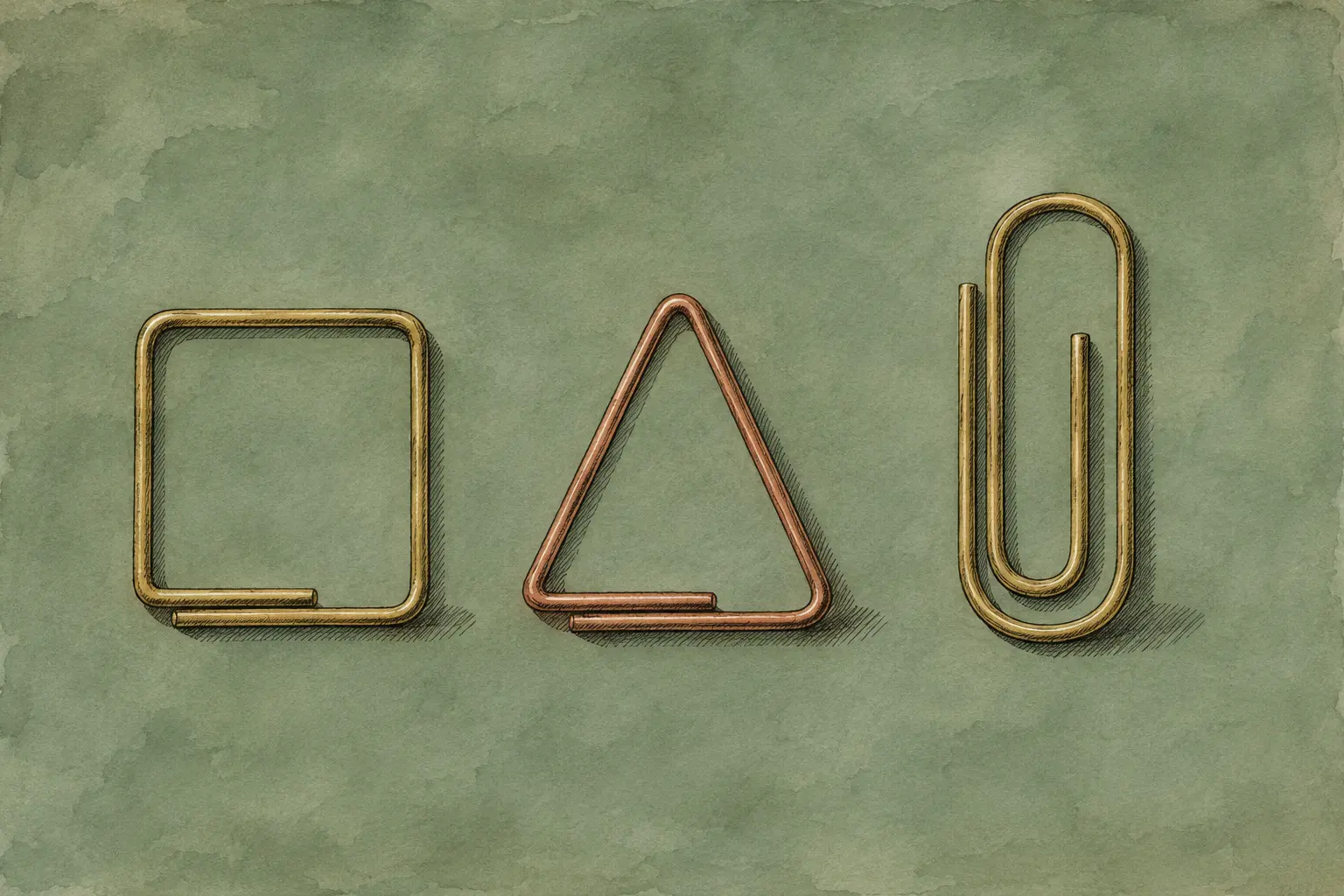
An illustration of three ways to bend one wire into a paper clip: a square hoop and a triangular hoop with side-by-side ends, and the double loop.
Illustration: Who Decided the Inch. Generated schematic image — not a photograph or historical record. No copyright is claimed in this generated illustration; if you reuse it, please keep this label.
Unbend a paper clip from your desk drawer and count the turns in the wire. A common office clip bends back on itself three times, so that one loop sits inside another, and that shape is not the one drawn in the patent of the Norwegian credited with it.
U.S. Patent 675,761, granted to Johan Vaaler of Christiania, Norway, on June 4, 1901 page scan, describes a wire hoop whose two ends lie side by side as “tongues,” pointing in opposite directions. Its drawing sheet shows square-cornered, rounded and triangular hoops. None of its 14 figures is the double loop. No document read for this page names who first bent that shape.
Who invented the paper clip?
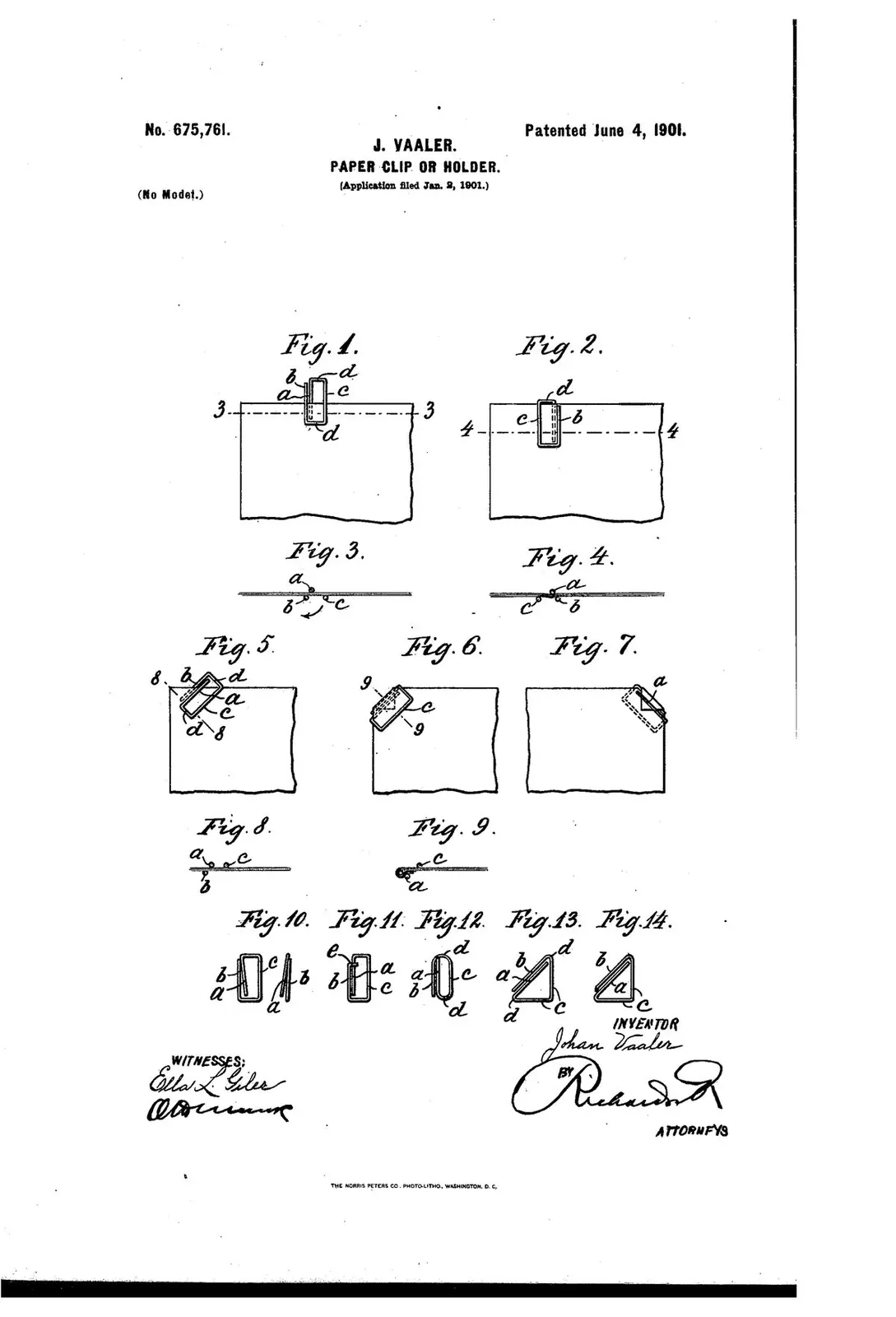
The drawing sheet of U.S. Patent 675,761, granted to Johan Vaaler on June 4, 1901: 14 figures, showing the clip on sheets of paper at an edge and at a corner, in section, and in five modified forms.
“U.S. Patent 675,761, Paper Clip or Holder (1901), drawing sheet”, J. Vaaler, Paper Clip or Holder, U.S. Patent 675,761 (1901), drawing sheet; United States Patent and Trademark Office; public domain.
Full credit
"U.S. Patent 675,761, Paper Clip or Holder (1901), drawing sheet" by J. Vaaler, Paper Clip or Holder, U.S. Patent 675,761 (1901), drawing sheet; United States Patent and Trademark Office — https://image-ppubs.uspto.gov/dirsearch-public/print/downloadPdf/0675761 — Public domain (EU: inventor Johan Vaaler died 1910 (per his memorial plaque), more than 70 years ago (life plus 70 years); also, the draughtsman is not named on the sheet and the drawing was published in 1901, more than 70 years ago (70 years from publication, expired 1971); US: U.S. patent drawing published 1901, before 1931; patent text and drawings are typically not subject to copyright); modified: whole page resized to 1200 px wide and saved in grayscale
The documents read for this page do not answer that with a single name. The patent read here is Vaaler's, filed in the United States on January 2, 1901, and titled “Paper Clip or Holder.” On p. 1, its first line of substance calls it a set of “Improvements in Paper Clips or Holders,” so the patent itself treats paper clips as something that already existed.
The same page of the specification, read from the page scan, describes a clip made of “a spring material, such as a piece of wire, that is bent to a rectangular, triangular, or otherwise shaped hoop, the end parts of which wire piece form members or tongues lying side by side in contrary directions.” The papers slide into the gap between the two tongues. The body of the clip is then turned “about one hundred and eighty degrees” over one tongue, and the spring of the wire holds the sheets.
The single claim, on p. 2, says the same thing in patent language. The tongues and the body are “disposed in different planes in order that there may normally be an opening between them for insertion of the paper sheets.” A patent records what an inventor asked to protect, not whether the clip was ever made or sold, and no record of Vaaler's clip in production was read for this page.
Patents often settle less than the story around them. The zipper is another fastener whose history runs through more than one patent.
Who was Johan Vaaler?
The patent calls him “a subject of the King of Sweden and Norway, residing at Christiania, Norway.” A memorial plaque on a stone raised for him on 23 October 1999 full text gives more. It says he was born at Vaaler in 1866 and died in Oslo in 1910, and it calls him one of the district's inventors.
Where did the Gem shape come from?
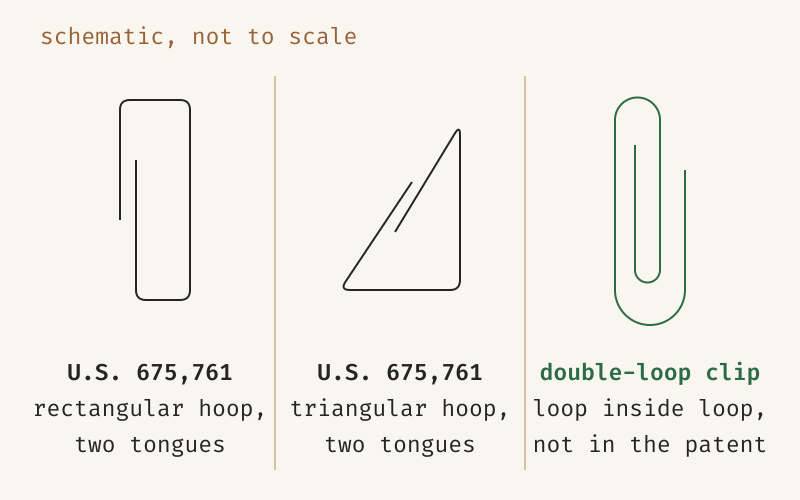
A schematic, not to scale: two of the shapes covered by Vaaler's 1901 patent beside the double-loop clip, which is not among the patent's figures.
Drawn from the claim and specification of U.S. Patent 675,761, read from the page scan; a schematic, not a copy of the patent drawing.
This figure as text
the figure's three shapes.
- Rectangular hoop, U.S. Patent 675,761 (1901): one wire, its two end tongues lying side by side in opposite directions.
- Triangular hoop, same patent: the same two tongues, along the long side of the triangle.
- Double-loop clip: the wire turns one loop inside another; this shape is not among the patent's 14 figures.
"Two ways to bend a paper clip: Vaaler's 1901 hoops and the double-loop clip" by Who Decided the Inch, https://whodecidedtheinch.com/objects/paper-clip/, licensed under CC BY 4.0, https://creativecommons.org/licenses/by/4.0/
Data: U.S. Patent 675,761 (Johan Vaaler, 1901), claim and specification
The Commons file page for a Norwegian paper clip stamp calls the double-loop clip “the common Gem clip” editor's abstract. The earliest record of the Gem name found for this page is from 1893. Another file page on Wikimedia Commons transcribes an editorial note in The Phonographic World, a New York magazine, from January 1893 editor's abstract. According to that transcription, the note said the Gem Paper Clip had just been placed on the market by Cushman & Denison of New York.
That is eight years before Vaaler's U.S. application. The magazine itself was not read for this page, though, and the transcription does not describe the clip's shape. The transcription puts a clip called the Gem on sale in 1893. What that clip looked like, and who first bent it, is not in any document read here.
| Date | Record | Read |
|---|---|---|
| January 1893 | The Gem Paper Clip goes on the market in New York, per a Commons transcription | editor's abstract |
| 12 November 1899 | Vaaler's German patent, as dated on his 1999 memorial plaque; the patent itself not read | full text of the plaque |
| 2 January 1901 | Vaaler files U.S. application for a paper clip or holder | page scan |
| 4 June 1901 | U.S. Patent 675,761 granted; 14 figures, none a double loop | page scan |
The table as data (CSV, paper-clip-patents.csv) (source and license notes) Data: U.S. Patent 675,761 (Johan Vaaler, 1901); Memorial plaque to Johan Vaaler (1999); Commons file page transcribing The Phonographic World, January 1893
The barber pole is another object whose story is older than its paper trail.
Why is Norway credited?
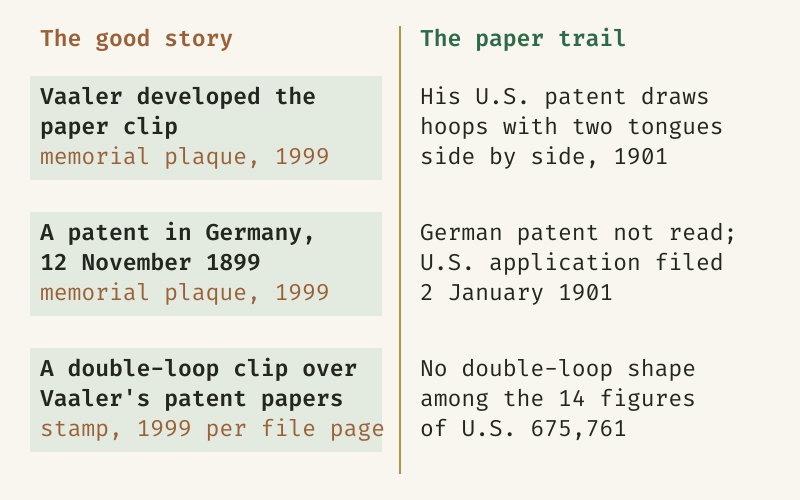
Three claims about Vaaler and the paper clip beside what the 1901 patent and the other records read for this page show.
Drawn from U.S. Patent 675,761 (page scan); the 1999 memorial plaque, read from a photograph (full text); the stamp's Commons file page (editor's abstract).
This figure as text
the figure's three rows.
- Vaaler developed the paper clip, as the 1999 memorial plaque says: his U.S. patent of 1901 draws hoops whose two tongues lie side by side.
- A patent in Germany on 12 November 1899, as the plaque says: the German patent was not read for this page; the U.S. application was filed on 2 January 1901.
- A double-loop clip over Vaaler's patent papers, on a Norwegian stamp dated 1999 by its file page: no double-loop shape is among the 14 figures of U.S. Patent 675,761.
"Three Norwegian claims about the paper clip beside what the documents read show" by Who Decided the Inch, https://whodecidedtheinch.com/objects/paper-clip/, licensed under CC BY 4.0, https://creativecommons.org/licenses/by/4.0/
Data: U.S. Patent 675,761 (Johan Vaaler, 1901); Memorial plaque to Johan Vaaler (1999); Commons file page of the 1999 Norwegian paper clip stamp
The memorial plaque puts Norway's claim in plain words. It says Vaaler “Utviklet papirklemmen/bindersen,” in this page's translation “developed the paper clip,” and that he received a patent for it in Germany on 12 November 1899. The plaque names Aurskog Historielag, Aurskog-Høland Kommune and Lierfoss og Omegn Vel as the groups that raised the stone.
A red Norwegian stamp marked “Norge 4.00” shows a white double-loop clip laid over the faint lettering of a patent document, including the word PATENTSCHRIFT. Its Commons file page dates the stamp to 1999 editor's abstract and describes the lettering as a German patent document of 1901 issued to the same inventor. The plaque gives 12 November 1899. The two sources disagree on the German patent's date.
The good story
Johan Vaaler developed the paper clip, as the memorial plaque raised for him in 1999 says.
The paper trail
His U.S. Patent 675,761 of 1901 describes a hoop whose two tongues lie side by side, and calls itself an improvement in paper clips. page scan
The good story
Vaaler's clip is the double-loop shape, as a Norwegian stamp shows it over his patent papers.
The paper trail
None of the 14 figures on the patent's drawing sheet is a double loop. page scan
The good story
He patented the clip in Germany on 12 November 1899, as the plaque says.
The paper trail
The German patent was not read for this page. The U.S. application is dated 2 January 1901. page scan
Why did Norwegians wear paper clips in 1940?
The clip had a meaning in Norway before the stone and the stamp. A notice dated Sarpsborg, 18 November 1940 full text, signed by Gunnar Lie, warned against “de små papirklemmer anbragt i jakkeopslaget eller kåpen,” in this page's translation “the small paper clips placed in the jacket lapel or the coat.” Anyone found with “slike merker,” such badges, “blir arrestert,” will be arrested.
The Commons file page for the museum photograph of the notice says it came from Nasjonal Samling, a Norwegian fascist party of the World War II years, and that the clips were worn as a sign of national unity and resistance editor's abstract. The notice itself does not mention Vaaler, and no document read for this page connects the 1940 badges to him.
Several things remain unknown. No record read here shows who first bent the double-loop clip, what the 1893 Gem looked like, or whether Vaaler's own design was ever made. The German patent that the plaque dates to 1899 has not yet been read. The page on To the original explains how patents are read for entries like this one.
Sources
- Johan Vaaler, Paper Clip or Holder, U.S. Patent 675,761, application filed January 2, 1901, patented June 4, 1901 (United States Patent Office): drawing sheet, specification and claim. U.S. patent, published 1901; USPTO: patent text and drawings typically not subject to copyright; inventor d. 1910 according to his memorial plaque. image-ppubs.uspto.gov/dirsearch-public/print/downloadPd…How far it was read: page scan; all three pages: drawing sheet with Figs. 1-14, specification and claim
- Memorial plaque to Johan Vaaler on the stone raised 23 October 1999 by Aurskog Historielag with Aurskog-Høland Kommune and Lierfoss og Omegn Vel; photograph by Øyvind Holmstad, 2013, on its Wikimedia Commons file page (CC BY-SA 3.0). commons.wikimedia.org/wiki/File:Info_p%C3%A5_bindersste…How far it was read: full text; every line of the plaque read from the photograph
- Paper clip stamp 1999.jpg, Wikimedia Commons file page (Norwegian postage stamp, Norge 4.00); description by the uploader. commons.wikimedia.org/wiki/File:Paper_clip_stamp_1999.jpgHow far it was read: editor's abstract; the file page description, and the stamp image it shows
- GemPaperClipAdvertisementJan1893.png, Wikimedia Commons file page, transcribing an editorial note in The Phonographic World, vol. 8 no. 5 (New York, January 1893). commons.wikimedia.org/wiki/File:GemPaperClipAdvertiseme…How far it was read: editor's abstract; the file page's transcription of the editorial note; the magazine and the advertisement image not read
- Advarsel til befolkningen i Sarpsborg og omegn. Fra rikshirdsveit nr. 1, signed Gunnar Lie, Sveitfører, Sarpsborg, 18 November 1940 (newspaper notice); photograph by Wolfmann, 2017, at Norway's Resistance Museum, on its Wikimedia Commons file page (CC BY-SA 4.0). commons.wikimedia.org/wiki/File:Norway%27s_WW2_Resistan…How far it was read: full text; the whole notice read from the photograph; party and context from the file page


Cite this page
Who Decided the Inch. “Paper Clip: Vaaler’s 1901 U.S. Patent Drew a Different Shape.” Published November 22, 2026. https://whodecidedtheinch.com/objects/paper-clip/. Accessed on the day you read it.
- To the original: how sources are read
- Marked in the margin: every correction
- Report an error on this page (contact@whodecidedtheinch.com)
Related entries
QWERTY Keyboard: In the 1878 Patent, a Drawing, Not a Claim
Picture credit
"Remington No. 1 typewriter, Wisconsin Historical Museum (DSC02806)" by Daderot — https://commons.wikimedia.org/wiki/File:Remington_No._1_typewriter,_made_by_Remington_%26_Songs,_Ilion,_NY,_1873-1878,_the_first_Sholes_%26_Glidden_model_typewriter_made_by_Remington_-_Wisconsin_Historical_Museum_-_DSC02806.JPG — CC0 1.0 (https://creativecommons.org/publicdomain/zero/1.0/); modified: resized
Barber Pole: An 1813 Book Reads the White Stripe as Bandage
Picture credit
"Barber's pole (AM 615460)" by Auckland Museum — https://commons.wikimedia.org/wiki/File:Barber%27s_pole_(AM_615460).jpg — CC BY 4.0 (https://creativecommons.org/licenses/by/4.0/); modified: resized
 Illustration
Who Invented the Traffic Light? London Had a Signal by 1869
Illustration credit
Illustration: Who Decided the Inch. Generated schematic image — not a photograph or historical record. No copyright is claimed in this generated illustration; if you reuse it, please keep this label.