No. 1 Origin entry
Who Invented the Zipper? Start With an 1893 Clasp Locker
Who Decided the Inch Published
Origin card
Short answer
No single inventor is named by the records read for this page. They start with United States patent 504,038, granted to Whitcomb Judson of Chicago on August 29, 1893, for a clasp locker: a sliding guide that hooks or unhooks a whole row of clasps in one movement.
- Name
- Zipper
- Category
- Objects
- Earliest known record
- 1893 · U.S. Patent 504,038, Clasp Locker or Unlocker for Shoes, filed November 7, 1891, the earliest record found for this page · United States Patent OfficeThe earliest known record is not the same as the time or place of invention.
- Origin attribution
- Unknown: two patents were read, Judson's 1893 clasp locker and Sundback's 1917 separable fastener; neither shows who made the fastener in use today
- Key document
- U.S. Patent 504,038, Whitcomb L. Judson, 1893 page scan; U.S. Patent 1,219,881, Gideon Sundback, 1917 page scan; the earliest printed use of the word zipper, not yet read
- Still in use?
- Yes, fasteners closed by one sliding pull are common on clothing and bags, as of 2026
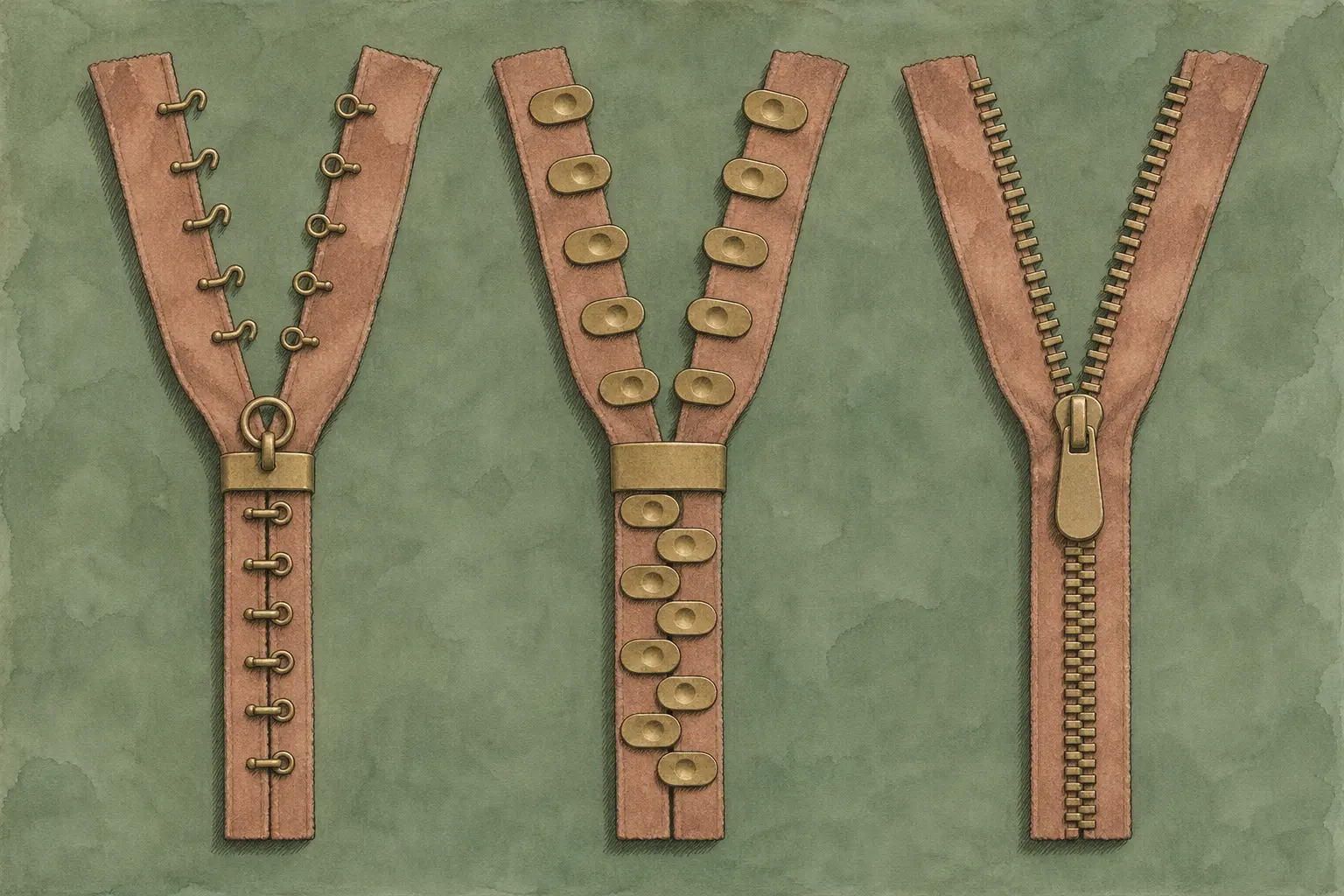
An illustration of fasteners closed by a sliding piece, hooked clasps beside separate metal teeth; not a copy of any patent drawing.
Illustration: Who Decided the Inch. Generated schematic image — not a photograph or historical record. No copyright is claimed in this generated illustration; if you reuse it, please keep this label.
Run the zipper on your jacket up and down, and feel the teeth catch. One small pull closes the whole row, and that single movement had to be described on paper before anyone could patent it.
The paper trail found here begins with Whitcomb L. Judson's U.S. Patent 504,038 of 1893 page scan, and none of its four pages uses the word zipper. It calls the device a “clasp locker or unlocker for shoes,” a sliding guide for “engaging or disengaging an entire series of clasps by a single continuous movement” (specification p. 1).
Who invented the zipper?
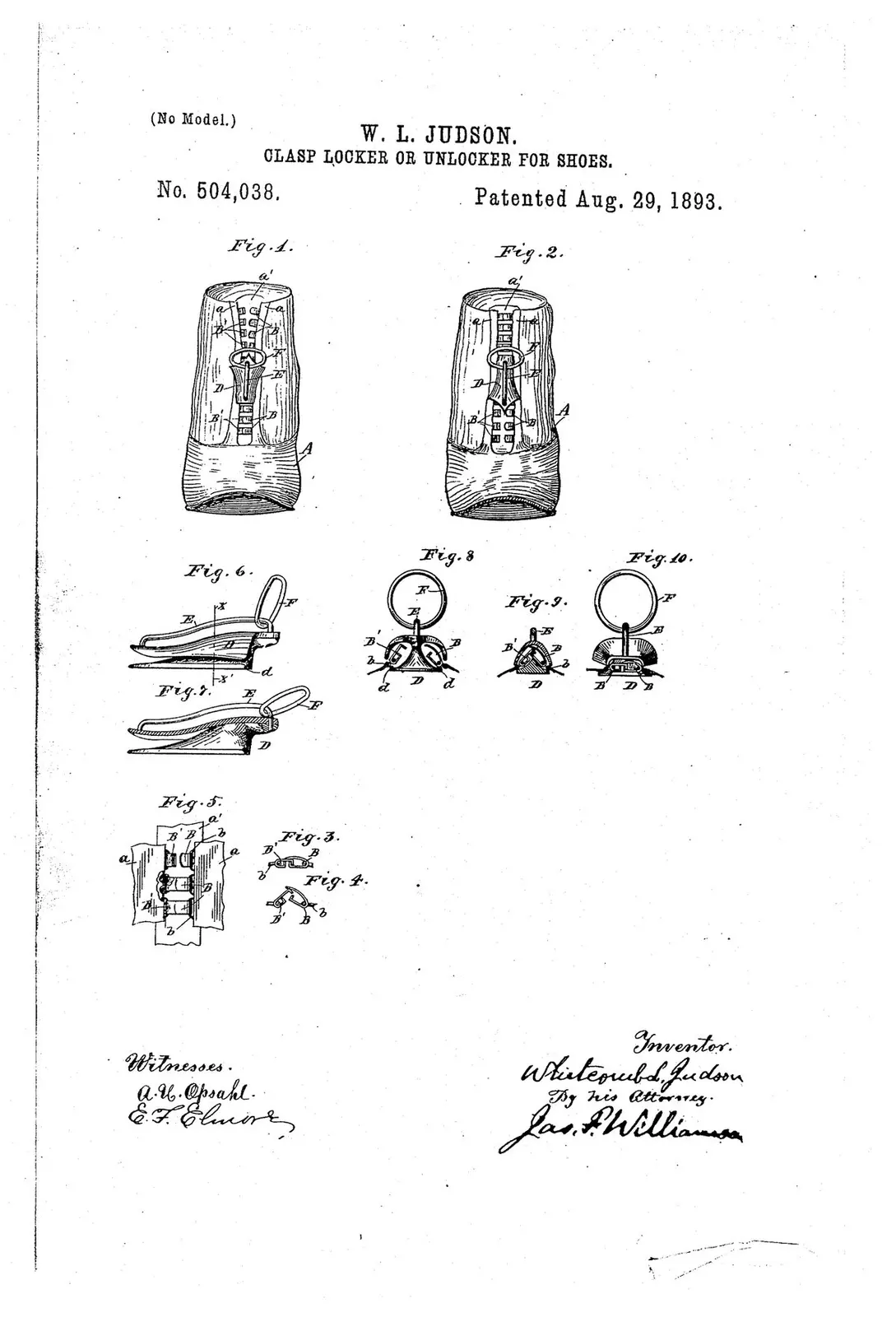
The drawing sheet of U.S. Patent 504,038, granted to Whitcomb L. Judson on August 29, 1893: a boot with its row of clasps and the guide, then the clasps and the guide in detail, in ten numbered figures.
“U.S. Patent 504,038, Clasp Locker or Unlocker for Shoes (1893), drawing sheet”, W. L. Judson, Clasp Locker or Unlocker for Shoes, U.S. Patent 504,038 (1893), drawing sheet; United States Patent and Trademark Office; public domain.
Full credit
"U.S. Patent 504,038, Clasp Locker or Unlocker for Shoes (1893), drawing sheet" by W. L. Judson, Clasp Locker or Unlocker for Shoes, U.S. Patent 504,038 (1893), drawing sheet; United States Patent and Trademark Office — https://image-ppubs.uspto.gov/dirsearch-public/print/downloadPdf/0504038 — Public domain (EU: the draughtsman is not named on the sheet and the drawing was published in 1893, more than 70 years ago (70 years from publication); the inventor's death year was not traced to a source read for this page; US: U.S. patent drawing published 1893, before 1931; patent text and drawings are typically not subject to copyright); modified: whole page resized to 1200 px wide and saved in grayscale
The documents read for this page answer with a starting point, not a single name. According to the printed heading of his specification, Judson filed his application on November 7, 1891, and renewed it on February 18, 1893, so the patent dated August 29, 1893, came out nearly two years after the original filing. Its drawing sheet carries ten figures, and the first two show the same boot with the guide closing the row and then opening it.
The specification (p. 1) says the invention “was especially designed, for use as a shoe-fastener.” It adds at once that it “is capable of general application” wherever such clasps are used, “as for example, to mail-bags, belts, and the closing of seams uniting flexible bodies.” Yet the drawing sheet shows only the shoe.
The patent gives its own reason for adding a guide (specification p. 1). The clasps could be hooked “one at a time in succession” by hand, “But this is a tedious operation,” and hooking them that way made it difficult to draw the two flaps of a shoe together under the proper strain.
The second page of the specification imagines how the finished shoe would look. The clasps “may be easily and cheaply made of any suitable metal,” it says, and may be very small, so that a properly fitted shoe would have a neat appearance and be comfortable to the wearer. Besides hooking the clasps, it adds, the guide draws the parts of the shoe tightly about the foot.
A patent records what an inventor asked to protect, but it does not show who made the fastener sold today. The one later patent read for this page, from 1917, is set out further down. The paper clip is another desk-drawer fastener whose credited inventor's 1901 U.S. patent drew a different shape.
Who was Whitcomb Judson?
The patent says little about him beyond his name and address (specification p. 1): Whitcomb L. Judson, “a citizen of the United States, residing at Chicago, in the county of Cook and State of Illinois.” Jas. F. Williamson signed the drawing sheet as his attorney and witnessed the specification together with Charles O. Henthorn. Nothing more about Judson's life or later work was read for this page.
How did the 1893 clasp locker work?
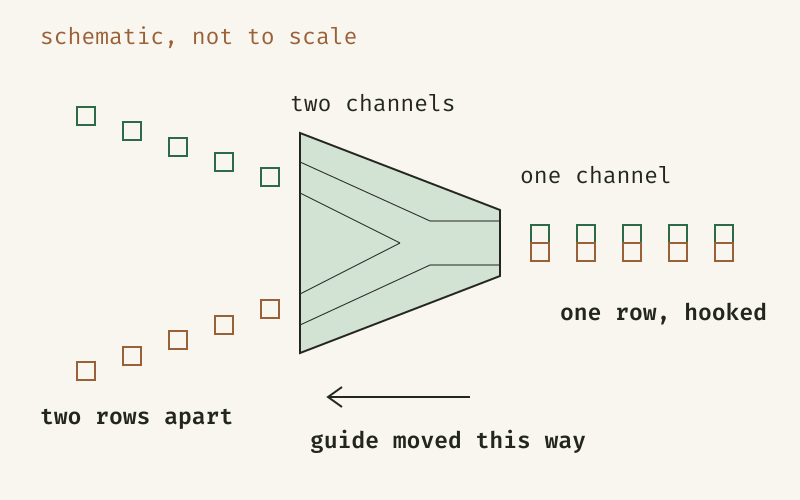
A schematic, not to scale: the guide block of Judson's 1893 claim, with two channels at one end that merge into one channel at the other.
Drawn from claim 1 and the specification of U.S. Patent 504,038, read from the page scan; a schematic, not a copy of the patent drawing.
"Judson's guide block: two channels that merge into one (schematic)" by Who Decided the Inch, https://whodecidedtheinch.com/objects/zipper/, licensed under CC BY 4.0, https://creativecommons.org/licenses/by/4.0/
Data: U.S. Patent 504,038 (Whitcomb L. Judson, 1893), claim 1 and specification
The fastener itself is a row of two-part clasps, with one half attached to each flap of the shoe. The specification (p. 1) says the hook parts can only engage “when thrown upward, so that the parts stand at an angle to each other of about ninety degrees,” roughly the corner of a page. Bringing every pair to that angle by hand, one by one, was the tedious part, and the guide does it for the whole row in one pass.
Claim 1 (specification p. 2) describes “a guide-block, having two guide-ways, which are separated at one end thereof, and converge into a single guide-way, at the other end thereof.” Moved one way along the row, the block brings the two halves together inside it and leaves them hooked; moved back, it delivers them separated. Seven claims in all cover the block, its channels and the ring on top.
That ring is what a hand pulls. The patent calls it a “finger-pull” (specification p. 2) and carries it on a bail fixed to the top of the block, so that the pull can shift to the front or the back end depending on the direction of travel. The slider on a jacket today also has two channels at one end and one at the other, although that comparison is this page's, not the patent's.
The good story
The clasp locker worked in practice: Judson's 1893 patent says its “practicability” “has been demonstrated by actual usage of the same.”
The paper trail
That sentence is the inventor's own statement in his patent (specification p. 2). No record of the clasp locker being made, sold or worn was read for this page. page scan
The good story
It was a fastener for shoes, as the patent's title, Clasp Locker or Unlocker for Shoes, says.
The paper trail
The specification (p. 1) says it “is capable of general application” and names mail-bags, belts and seams. The drawing sheet shows only a boot. page scan
The traffic light is another everyday object whose first appearance the records complicate.
What did Sundback's fastener change?
A later patent takes a different route to the same job. U.S. Patent 1,219,881, granted on March 20, 1917, to Gideon Sundback of Meadville, Pennsylvania, is titled a “separable fastener” and names “garments and other purposes” (specification p. 1) page scan. The application was filed on August 27, 1914.
Its specification (p. 1) says the locking members on the two tapes, which it calls stringers, “are all alike, and therefore interchangeable.” Each member has a cup shape, “so that the outside of one member nests within the recess of an adjoining member when in locked relation.” The members on one stringer alternate with those on the other, and a slider with a Y-shaped channel locks them when moved one way and unlocks them when moved back.
The patent states its own aims on the same page: “to decrease the weight and bulk, to increase the flexibility and security of locking,” and to use one form of member on both stringers “instead of the different forms heretofore employed on the respective stringers.” It does not name the earlier fasteners it has in mind. Like Judson's patent, it records a design, not when such fasteners were made or sold.
Where did the name zipper come from?
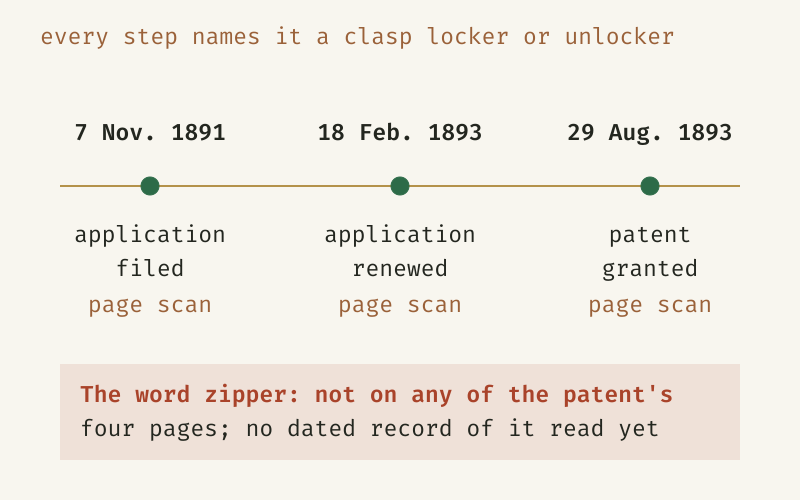
The three dates printed on U.S. Patent 504,038, each under the name clasp locker or unlocker; no dated record of the word zipper has been read for this page.
Drawn from the drawing sheet and specification heading of U.S. Patent 504,038, read from the page scan; dates placed in order.
"U.S. Patent 504,038, step by step, under the name clasp locker or unlocker" by Who Decided the Inch, https://whodecidedtheinch.com/objects/zipper/, licensed under CC BY 4.0, https://creativecommons.org/licenses/by/4.0/
Data: U.S. Patent 504,038 (Whitcomb L. Judson, 1893), drawing sheet and specification heading
Not from the 1893 patent, which does not print the word zipper anywhere on its drawing sheet or on its three pages of specification and claims page scan. Judson's own words for the parts are clasps, fasteners, the guide, the hand-device and the finger-pull. His title for the whole is a clasp locker or unlocker. Sundback's 1917 patent does not print the word either; it calls the device a separable fastener page scan.
| Date | Record | Name used | Read |
|---|---|---|---|
| 7 November 1891 | Application filed by Whitcomb L. Judson of Chicago | clasp locker or unlocker for shoes | page scan |
| 18 February 1893 | Application renewed, serial no. 462,923 | clasp locker or unlocker for shoes | page scan |
| 29 August 1893 | U.S. Patent 504,038 granted | clasp locker or unlocker for shoes | page scan |
The table as data (CSV, zipper-patents.csv) (source and license notes) Data: U.S. Patent 504,038 (Whitcomb L. Judson, 1893)
Several questions stay open. No record read for this page shows whether the clasp locker was ever sold, whether any later patent built on Judson's guide, or who first made a fastener like the one on a jacket today. No dated printing of zipper as the fastener's name has been read yet either. The page on To the original explains how patents are read for entries like this one.
Sources
- Whitcomb L. Judson, Clasp Locker or Unlocker for Shoes, U.S. Patent 504,038, application filed November 7, 1891, renewed February 18, 1893, patented August 29, 1893 (United States Patent Office): drawing sheet, specification and claims. U.S. patent, published 1893; USPTO: patent text and drawings typically not subject to copyright. image-ppubs.uspto.gov/dirsearch-public/print/downloadPd…How far it was read: page scan; all four pages: drawing sheet with Figs. 1-10, specification and seven claims
- Gideon Sundback, Separable Fastener, U.S. Patent 1,219,881, application filed August 27, 1914, serial no. 858,848, patented March 20, 1917 (United States Patent Office): drawing sheet, specification and claims. U.S. patent, published 1917; USPTO: patent text and drawings typically not subject to copyright; drawing not reproduced on this page. image-ppubs.uspto.gov/dirsearch-public/print/downloadPd…How far it was read: page scan; all five pages: drawing sheet, specification, eleven claims and a later disclaimer page
Cite this page
Who Decided the Inch. “Who Invented the Zipper? Start With an 1893 Clasp Locker.” Published November 22, 2026. https://whodecidedtheinch.com/objects/zipper/. Accessed on the day you read it.
- To the original: how sources are read
- Marked in the margin: every correction
- Report an error on this page (contact@whodecidedtheinch.com)
Related entries
QWERTY Keyboard: In the 1878 Patent, a Drawing, Not a Claim
Picture credit
"Remington No. 1 typewriter, Wisconsin Historical Museum (DSC02806)" by Daderot — https://commons.wikimedia.org/wiki/File:Remington_No._1_typewriter,_made_by_Remington_%26_Songs,_Ilion,_NY,_1873-1878,_the_first_Sholes_%26_Glidden_model_typewriter_made_by_Remington_-_Wisconsin_Historical_Museum_-_DSC02806.JPG — CC0 1.0 (https://creativecommons.org/publicdomain/zero/1.0/); modified: resized
Barber Pole: An 1813 Book Reads the White Stripe as Bandage
Picture credit
"Barber's pole (AM 615460)" by Auckland Museum — https://commons.wikimedia.org/wiki/File:Barber%27s_pole_(AM_615460).jpg — CC BY 4.0 (https://creativecommons.org/licenses/by/4.0/); modified: resized
 Illustration
Paper Clip: Vaaler’s 1901 U.S. Patent Drew a Different Shape
Illustration credit
Illustration: Who Decided the Inch. Generated schematic image — not a photograph or historical record. No copyright is claimed in this generated illustration; if you reuse it, please keep this label.