No. 4 Origin entry
Yo-Yo History: In the Records Read, the Toy Had Other Names
Who Decided the Inch Published
Origin card
Short answer
In the sources read for this page, the toy goes by other names before yo-yo. A fashion plate that its Commons file page dates to 1791 shows it, called a bandalore in England at the time, the page says; the present name is in print by July 1916, in a magazine article listing it among Filipino toy names.
- Name
- Yo-yo
- Category
- Playthings
- Earliest known record
- 1791 · fashion-journal plate, as dated by its file page · Wikimedia CommonsThe earliest known record is not the same as the time or place of invention.
- Origin attribution
- Unknown: the documents read for this page do not establish an inventor or a place of origin
- Key document
- Plate of a woman with the toy, Journal des Luxus und der Moden, October 1791, per its file page editor's abstract; Myles A. Garcia, Pedro and the Yo-yo: Man and Myth, Positively Filipino, 2021 full text; Filipino Toys, Scientific American Supplement, July 1, 1916, p. 4 page scan
- Still in use?
- Yes: the toy is still sold and played with under the name yo-yo (as of 2026)
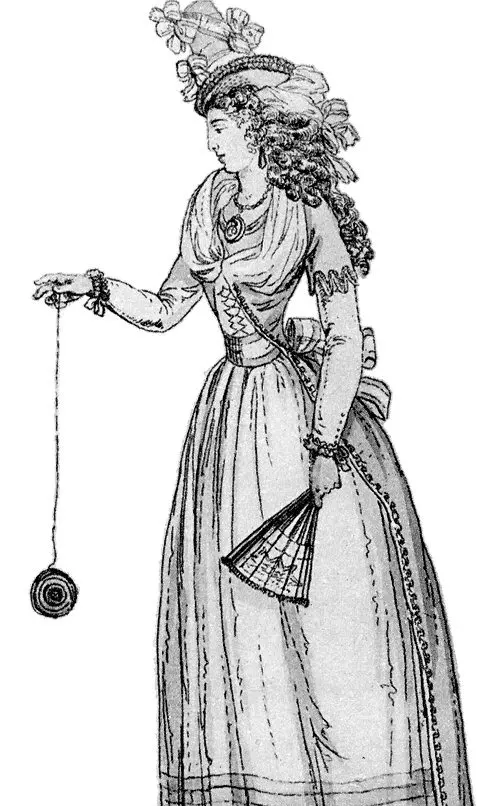
A woman with the toy and a folding fan, from a fashion plate dated 1791 by its file page; the bottom edge of the plate is cropped.
“A woman playing with an early form of the yo-yo, fashion plate, 1791”, Unknown artist; Public Domain Mark.
Full credit
"A woman playing with an early form of the yo-yo, fashion plate, 1791" by Unknown artist — https://commons.wikimedia.org/wiki/File:1791-Yo-Yo-Bandalore.jpg — Public domain (EU: anonymous fashion plate, first published in 1791 (per the file page), more than 70 years ago (70 years from publication); US: published before 1931; marked Public Domain Mark 1.0 on the file page); modified: cropped: the bottom 37 pixels of the plate removed (full width kept, 492 x 806 from 492 x 843)
Wind a length of string around one finger, then let your hand drop. The string seems too plain to have a history, but the toy that climbs back up a string like it turns up under other names in the older records found for this page.
The earliest dated picture of the toy found for this page is a fashion plate. Its Wikimedia Commons file page editor's abstract says the plate appeared in the German Journal des Luxus und der Moden in October 1791. The same page calls the toy an early form of the yo-yo, known in England at the time as a bandalore. The documents read here could not confirm when the toy's present name first reached print.
What was the yo-yo called before?
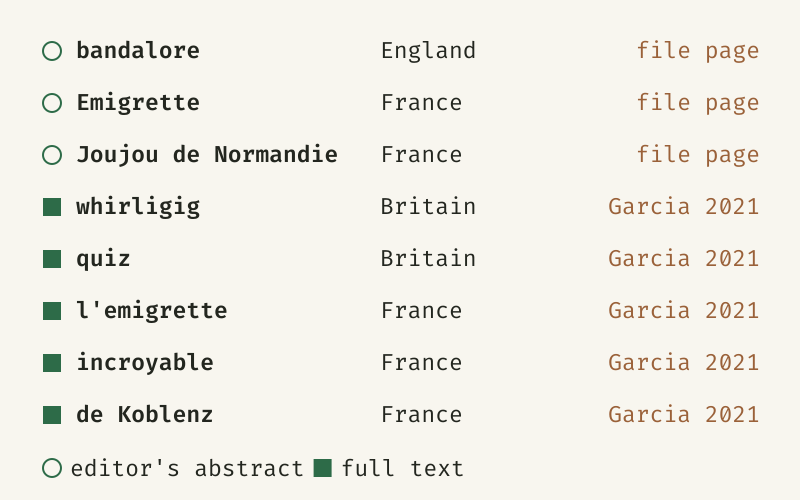
Eight older names for the yo-yo, each marked by how far its source was read, from editor's abstract to full text; none is traced to a period document.
Drawn from the Commons file page of the 1791 plate (editor's abstract) and Myles A. Garcia's 2021 article in Positively Filipino (full text).
This figure as text
- bandalore, England, 1791: the file page's description editor's abstract.
- Emigrette, France, 1791: the most common French word at the time, according to the file page editor's abstract.
- Joujou de Normandie, France, 1888: a caption in Racinet's Le Costume historique, as the file page reports it editor's abstract.
- whirligig, Britain: Garcia's list full text.
- quiz, Britain: Garcia's list, as lower-class slang full text.
- l'emigrette, France: Garcia's list full text.
- incroyable, France: Garcia's list full text.
- de Koblenz, France: Garcia's list full text.
"Yo-yo: older names for the toy, with how each source was read" by Who Decided the Inch, https://whodecidedtheinch.com/playthings/yo-yo/, licensed under CC BY 4.0, https://creativecommons.org/licenses/by/4.0/
Data: Commons file page, 1791-Yo-Yo-Bandalore.jpg (description); Myles A. Garcia, Pedro and the Yo-yo: Man and Myth, Positively Filipino (2021)
The plate carries no caption in the copy on the file page. A woman in a plumed, ribboned hat and a long gown holds the end of a string between her fingers, and a round spool with ringed sides hangs at the bottom of it. Her other hand holds a half-open folding fan. The toy is drawn as part of the outfit, held as lightly as the fan.
The names come from the file page's description, not from the plate. That description says the toy was called a bandalore in England then, and that the most common French word for it at the time was Emigrette. It adds that a version of the same picture in Racinet's Le Costume historique (1888) is captioned Joujou de Normandie. Racinet's book survives in a public scan bibliographic, but the captioned page was not checked against its image for this page.
Myles A. Garcia's 2021 article in Positively Filipino full text adds more names. He writes that the British called the toy a whirligig or, in lower-class slang, a quiz, and he lists the French names l'emigrette, incroyable and de Koblenz. He ties the last one to the German city where French aristocrats fled during the Revolution. Garcia names no period source for any of them, so each name stays his account.
Garcia goes one step further with the Norman name, which he spells jou-jou de Normandie. He suggests it may be the forerunner of the present name, but he offers no document that links them. The plate's file page makes no such link either.
When did the name yo-yo appear?
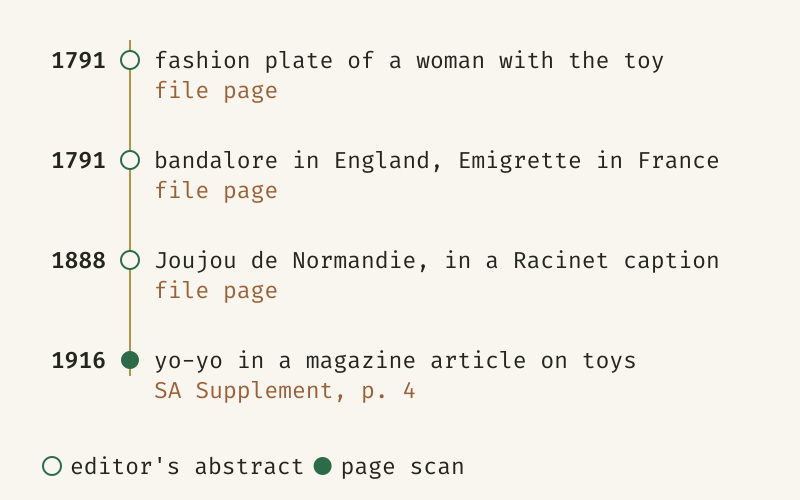
The dated rows found for this page: three from a file page, an editor's abstract, and a 1916 row read from the magazine's page scan.
Drawn from the Commons file page of the 1791 plate (editor's abstract) and page 4 of Scientific American Supplement, July 1, 1916 (page scan), for the 1916 row.
"Yo-yo: the dated rows found for this page, with how each was read" by Who Decided the Inch, https://whodecidedtheinch.com/playthings/yo-yo/, licensed under CC BY 4.0, https://creativecommons.org/licenses/by/4.0/
Data: Commons file page, 1791-Yo-Yo-Bandalore.jpg (description and source field); Scientific American Supplement, no. 2113 (July 1, 1916), p. 4, Filipino Toys
Garcia reports that a July 1916 issue of Scientific American Supplement printed instructions for making the toy, presented it as a Filipino toy, and was the first publication to use the term yoyo in print.
The July 1, 1916 issue of Scientific American Supplement page scan does carry an article titled “Filipino Toys” on its page 4. It says: “Sumpit (blowgun), pana (arrow), and yo-yo, however, are names very generally used throughout the islands.” A footnote says the article came from the Philippine Craftsman. That source was not read for this page, so whether 1916 is the first use in print stays open.
The same page reports that “a patent was recently secured upon the yo-yo by a firm in the United States,” without naming the firm or the patent page scan. It also says the toy “has been extensively manufactured in the Province of Rizal and in the Philippine School of Arts and Trades” page scan.
Garcia also reports a December 1916 article in the El Paso Herald about a school in Manila that mass-produced goods, yo-yos among them, for American children in the colony. That newspaper was not read for this page. Before the July 1916 page, the sources read here know the toy only by other names.
| Name | Place | Date | Source | How far it was read |
|---|---|---|---|---|
| bandalore | England | 1791 | Commons file page | editor's abstract |
| Emigrette | France | 1791 | Commons file page | editor's abstract |
| Joujou de Normandie | France | 1888 | Commons file page, on a Racinet caption | editor's abstract |
| whirligig | Britain | 17th to 18th century | Garcia 2021 | full text |
| quiz | Britain | 17th to 18th century | Garcia 2021 | full text |
| l'emigrette | France | 18th century | Garcia 2021 | full text |
| incroyable | France | 18th century | Garcia 2021 | full text |
| de Koblenz | France | 18th century | Garcia 2021 | full text |
| yo-yo | Philippines, in a US magazine | July 1916 | Scientific American Supplement, p. 4 | page scan |
The table as data (CSV, yo-yo-names.csv) (source and license notes) Data: Commons file page, 1791-Yo-Yo-Bandalore.jpg (description); Myles A. Garcia, Pedro and the Yo-yo: Man and Myth, Positively Filipino (2021); Scientific American Supplement, no. 2113 (July 1, 1916), p. 4
Toys pick up their names and their uses in different orders. The jigsaw puzzle turns up first as a cut map that its library description calls educational, and Froebel gifts were sold by number in a kindergarten catalog.
Was the yo-yo a weapon?
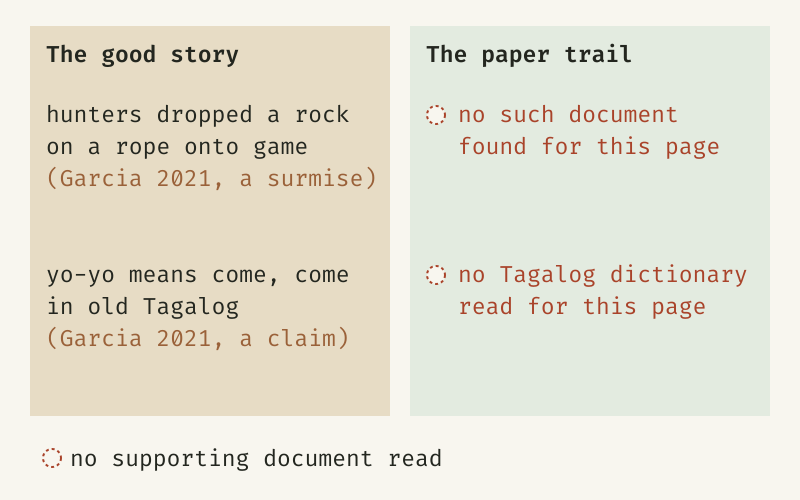
Two stories about the yo-yo's past beside what the documents read for this page show; neither story is traced to a document.
Drawn from Garcia's 2021 article (full text) for both stories; the paper-trail column records what was found for this page.
This figure as text
- Story: hunters in the Philippines dropped a heavy rock on a rope from trees onto game and pulled it up again, a surmise relayed by Garcia in 2021. Paper trail: no document describing such a tool was found for this page.
- Story: yo-yo means “come, come” in an old form of Tagalog, a claim Garcia reports and rejects. Paper trail: no Tagalog dictionary was read for this page.
"Was the yo-yo a weapon? The good story and the paper trail" by Who Decided the Inch, https://whodecidedtheinch.com/playthings/yo-yo/, licensed under CC BY 4.0, https://creativecommons.org/licenses/by/4.0/
Data: Myles A. Garcia, Pedro and the Yo-yo: Man and Myth, Positively Filipino (2021)
Garcia's article takes up the question under the heading “Toy or Weapon?” and relays a surmise: hunters in the Philippines in the 1500s sat in trees with a heavy rock on a rope, dropped it on passing game and pulled it back up after a miss. Garcia calls that method inefficient. As for the wider story of Filipino origins, he calls it “apocryphal.”
The good story
The yo-yo began as a hunting tool in the Philippines: hunters in trees dropped a heavy rock on a rope onto game and pulled it back up. Myles A. Garcia relays this as a surmise in Positively Filipino (2021), under the heading “Toy or Weapon?”
The paper trail
No document describing such a tool, or the toy used as a weapon, was found for this page. Garcia himself calls the story of indigenous Filipino origins “apocryphal” and names no document for it full text.
The good story
Yo-yo means “come, come” in an old form of Tagalog. Garcia reports this claim in the same article and rejects it.
The paper trail
No Tagalog dictionary was read for this page, and Garcia names none for the claim or for his rejection full text.
This page does not settle the weapon story either way. A missing record does not show that something never happened, so the story stays on the left side of the ledger until a document turns up.
Several questions stay open. The 1791 journal page and the Racinet caption were not checked against their scanned images, so the dates for the older names rest on a file page and on Garcia. Who first sold the toy under its present name, and when that name spread, remains unknown from the documents read here.
Sources
- A woman playing with an early form of the yo-yo, fashion plate dated 1791, unknown artist; description and source field as given on its Wikimedia Commons file page, which names the Journal des Luxus und der Moden, October 1791. Public domain (EU: anonymous, published 1791; US: published before 1931). commons.wikimedia.org/wiki/File:1791-Yo-Yo-Bandalore.jpgHow far it was read: editor's abstract; the description and source field written on the file page, with the plate itself viewed
- A. Racinet, Le Costume historique (Paris: Firmin-Didot et Cie, 1888), 6 vols. Public domain (EU: author d. 1893, per library catalog record; US: published 1888). archive.org/details/lecostumehistori05raciHow far it was read: bibliographic; title, publisher and date only; the captioned plate page was not checked against its image
- Myles A. Garcia, Pedro and the Yo-yo: Man and Myth, Positively Filipino, April 27, 2021. positivelyfilipino.squarespace.com/magazine/pedro-and-the-yo-yo-man-…How far it was read: full text; the whole article
- Scientific American Supplement, vol. 82, nos. 2113 to 2117 (July 1916). Public domain in the US (published 1916). archive.org/details/sim_scientific-american-s…How far it was read: page scan; no. 2113 (July 1, 1916), p. 4, the article Filipino Toys by Alva R. Brane

Cite this page
Who Decided the Inch. “Yo-Yo History: In the Records Read, the Toy Had Other Names.” Published November 22, 2026. https://whodecidedtheinch.com/playthings/yo-yo/. Accessed on the day you read it.
- To the original: how sources are read
- Marked in the margin: every correction
- Report an error on this page (contact@whodecidedtheinch.com)
Related entries
Teddy Bear History: From a Cartoon Cub to 1907 Book Titles
Picture credit
"Drawing the Line in Mississippi, by Clifford K. Berryman, 1902" by Clifford K. Berryman — https://commons.wikimedia.org/wiki/File:Drawing_the_line_in_Mississippi_LCCN2008678324.jpg — Public domain (EU: Clifford K. Berryman died 1949 (per library catalog record, as given on the file page), more than 70 years ago (life plus 70 years); US: published before 1931 (1902); marked Public Domain Mark 1.0 on the file page)
Jigsaw Puzzle History: A 1766 Map Cut Along Its Borders
Picture credit
"Europe divided into its kingdoms &c., by J. Spilsbury, 1766" by John Spilsbury, British Library — https://commons.wikimedia.org/wiki/File:Spilsbury_jigsaw_-_John_Spilsbury,_1766_-_BL.jpg — CC0 1.0 (https://creativecommons.org/publicdomain/zero/1.0/); modified: resized from 1,434 x 1,342 to 1,200 x 1,123 px
 Illustration
Froebel Gifts: A Ball, a Cube, Then Blocks Cut Into Parts
Illustration credit
Illustration: Who Decided the Inch. Generated schematic image — not a photograph or historical record. No copyright is claimed in this generated illustration; if you reuse it, please keep this label.