No. 1 Long read
QWERTY Keyboard: In the 1878 Patent, a Drawing, Not a Claim
Who Decided the Inch Published
Origin card
Short answer
According to Yasuoka and Yasuoka (2011), the letter order was reworked in rounds from 1868 to 1882, by Sholes and his partners, telegraph buyers, Remington mechanics and, last, a Remington sales firm. Sholes's 1878 patent draws the keyboard, but none of its 14 claims concerns letter order or typing speed.
- Name
- QWERTY keyboard
- Category
- Objects
- Earliest known record
- 1878 · U.S. patent drawing, No. 207,559, Fig. 3 (application filed March 1875), the earliest primary record of this letter order read for this page · U.S. Patent OfficeThe earliest known record is not the same as the time or place of invention.
- Origin attribution
- Unknown: only one history could be read for this page; in it, Yasuoka and Yasuoka (2011) trace the letter order through changes by Sholes and his partners, two telegraph-company buyers, two Remington mechanics, Sholes again and a Remington sales firm, 1868 to 1882
- Key document
- U.S. Patent 79,265 (1868) page scan; U.S. Patent 207,559 (1878), Fig. 3 and claims page scan; Yasuoka and Yasuoka, On the Prehistory of QWERTY (2011) full text
- Still in use?
- Yes: Yasuoka and Yasuoka call the 1882 letter order the QWERTY arrangement as seen nowadays, as of 2011
This card as data (CSV) source and license notes
Data: U.S. Patents 79,265 and 207,559; Koichi Yasuoka and Motoko Yasuoka, On the Prehistory of QWERTY, ZINBUN 42 (2011)
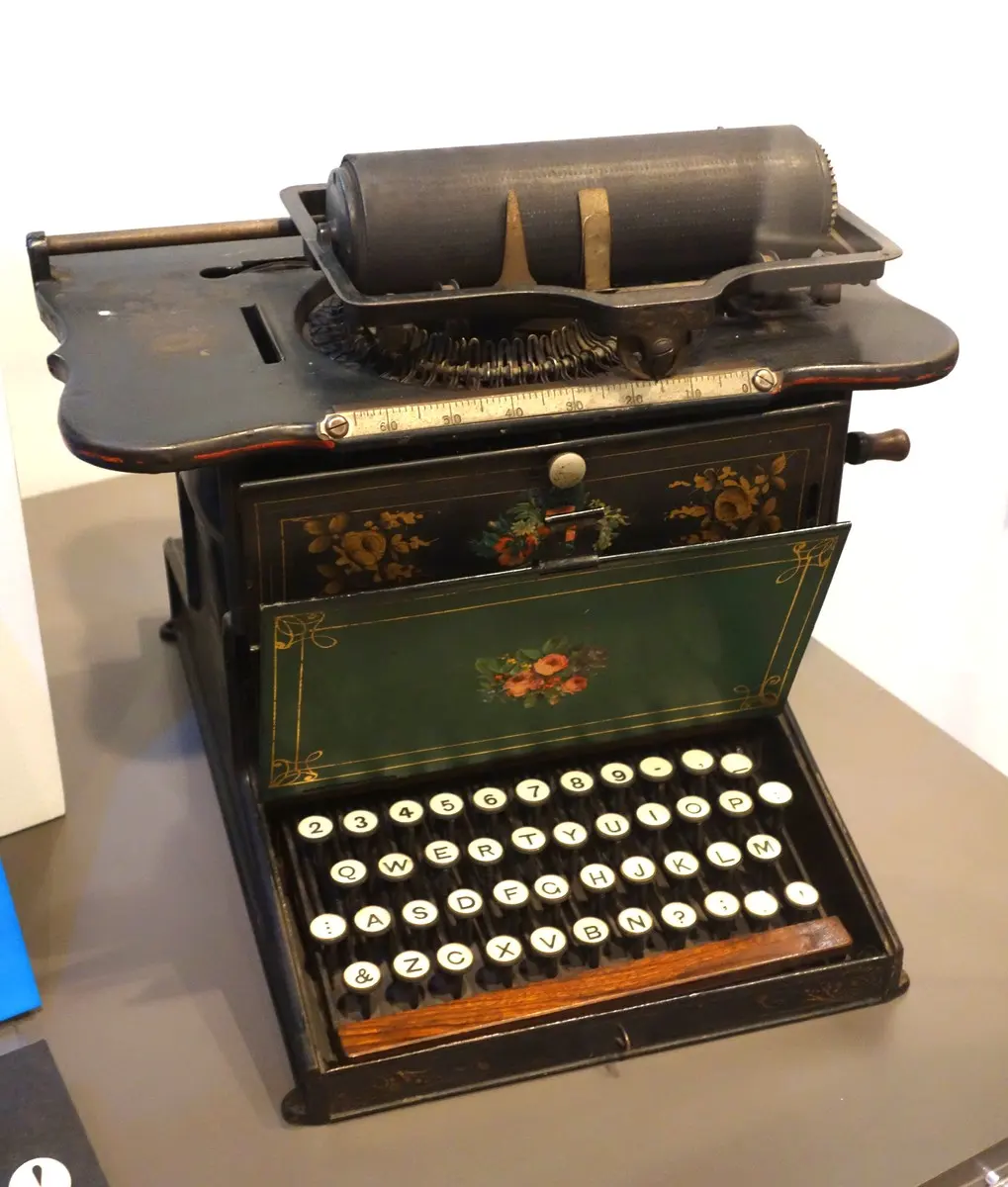
A Remington No. 1 typewriter on display in the Wisconsin Historical Museum; its file page calls it the first Sholes & Glidden model made by Remington, at Ilion, New York, 1873 to 1878.
"Remington No. 1 typewriter, Wisconsin Historical Museum (DSC02806)" by Daderot — https://commons.wikimedia.org/wiki/File:Remington_No._1_typewriter,_made_by_Remington_%26_Songs,_Ilion,_NY,_1873-1878,_the_first_Sholes_%26_Glidden_model_typewriter_made_by_Remington_-_Wisconsin_Historical_Museum_-_DSC02806.JPG — CC0 1.0 (https://creativecommons.org/publicdomain/zero/1.0/); modified: resized
Glance at the top row of a keyboard near you, where Q, W, E, R, T and Y come first. That order feels as settled as the alphabet, yet its letters were still being moved in 1882, eight years after the machine went on sale.
The QWERTY layout comes from the Sholes & Glidden Type-Writer. E. Remington & Sons put it on sale in April 1874, according to a 2011 history by Koichi and Motoko Yasuoka full text. The patent that C. Latham Sholes got on August 27, 1878, U.S. Patent 207,559, already shows the top row QWERTYUIOP in its Fig. 3 page scan.
According to the Yasuokas, a Remington model of 1882 made the last moves: M went next to N, and C and X swapped places. The story that the letters were set out to slow typists down finds no support in that patent. None of its 14 claims is about the order of the letters.
Who designed the QWERTY keyboard?
The patents point first to Christopher Latham Sholes, a Milwaukee inventor named in them as C. Latham Sholes. U.S. Patent 79,265 went to Sholes, Carlos Glidden and Samuel W. Soule, and it is dated June 23, 1868 page scan. Its text calls for “a key-board similar to the key-board of a piano.” The drawing shows a row of piano-style keys at the front of a wooden case.
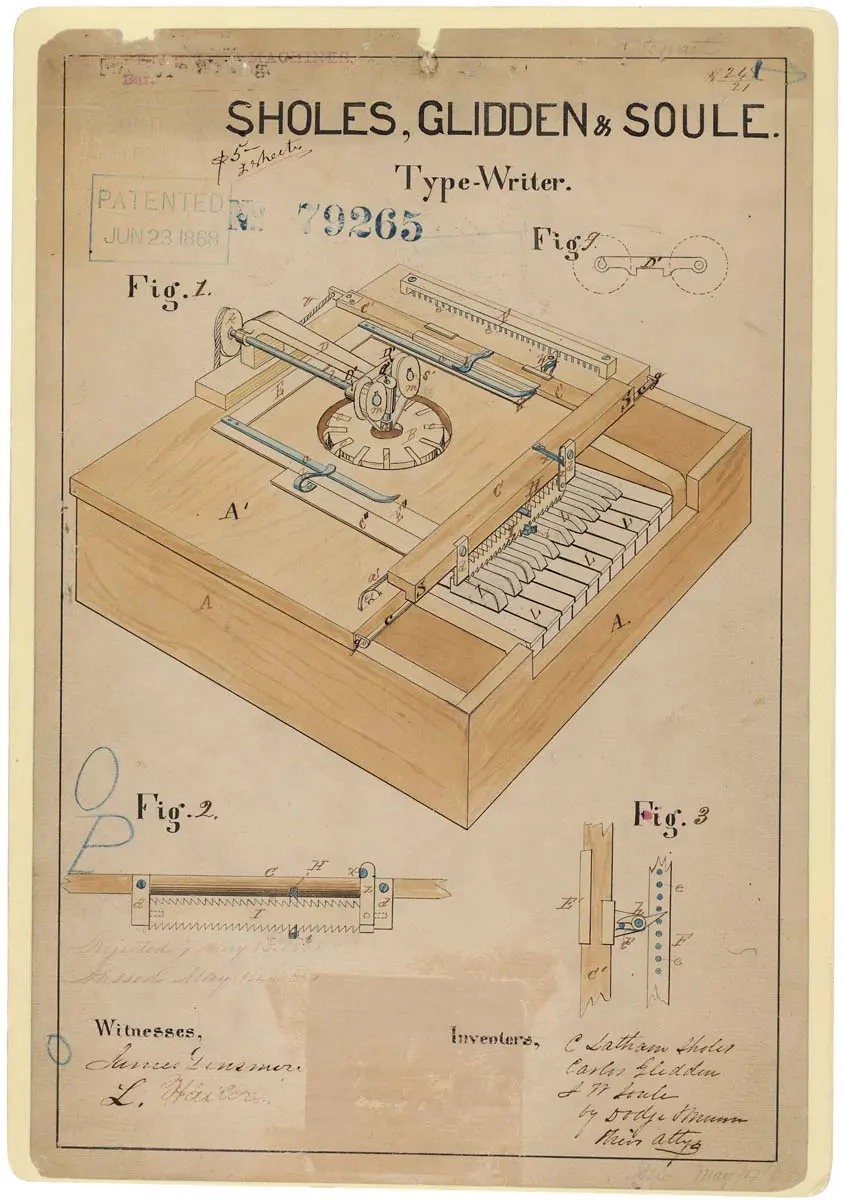
The first sheet of the drawing for U.S. Patent 79,265 by Sholes, Glidden and Soule, stamped as patented on June 23, 1868; the keys at the front are laid out like a piano's.
“Drawing for a Typewriter, U.S. Patent 79,265 (National Archives 595503)”, Unknown illustrator, for Christopher L. Sholes, Carlos Glidden and J. W. Soule; U.S. National Archives; Public Domain Mark.
Full credit
"Drawing for a Typewriter, U.S. Patent 79,265 (National Archives 595503)" by Unknown illustrator, for Christopher L. Sholes, Carlos Glidden and J. W. Soule; U.S. National Archives — https://commons.wikimedia.org/wiki/File:Drawing_for_a_Typewriter_-_NARA_-_595503_(page_1).jpg — Public domain (EU: drawing by an unnamed illustrator, published 1868, more than 70 years ago (70 years from publication); US: U.S. patent drawing published 1868, before 1931; marked Public Domain Mark 1.0 on the file page)
Koichi Yasuoka of Kyoto University and Motoko Yasuoka of Kyoto University of Foreign Studies traced the keyboard in a 2011 paper, working from patents, old papers and surviving machines. By their account, the first machine went in November 1868 to Edward Payson Porter, who ran a telegraph college in Chicago.
That machine had 28 keys that looked like a piano's, the Yasuokas write. The keys ran in alphabetical order: A to N from left to right, then O to Z back from right to left. Its early users were Morse receivers, telegraph clerks who wrote out each message as the code came in. Porter, they report, wanted numerals on the machine for that work.
Who were the other hands?
In September 1870, according to the Yasuokas, Sholes and his partner James Densmore took the machine to New York. There they showed it to George Harrington and Daniel Craig of the American Telegraph Works. The two men promised to buy several machines, but they asked for many changes, a new keyboard among them. On March 1, 1873, Densmore signed a contract with E. Remington & Sons to make the machine.
Two Remington men, William Jenne and Jefferson Clough, finished a trial model in the autumn of 1873, the Yasuokas report. They moved R next to E, into the spot the period had held. Sholes did not like their layout. He asked for Y to go to the center, which put Y next to T, as in the top row of the patent drawing.
The Yasuokas list the rounds in order: Sholes and his partners, then Harrington and Craig, then Jenne and Clough, then Sholes again, and last a Remington sales firm in 1882. Their verdict is short: “There was no consistent policy towards QWERTY.” The lone-inventor answer is tidy, but the paper trail reads more like a relay race, with the baton passed at least four times.
That sequence rests on one paper. Yasuoka and Yasuoka (2011) is the only source read for this page that traces the rounds between 1868 and 1874, so each step in it is their account.
Was QWERTY designed to slow typists down?
The story says yes. The Yasuokas quote a 1982 computing bulletin that says the layout “was intended to slow down the operator so that type bars would not jam.” The documents say something else.
Sholes's patent 207,559 ends with 14 numbered claims, the part of a patent that states what it covers page scan. They deal with the platen, the roller the paper is pressed against. They also cover the paper carriage, the ratchets that space letters and lines, the stops, a bell and the inking ribbon. None of them mentions the order of the letters or how fast anyone should type.
In this patent the letter arrangement is drawn, not claimed. The patent text lists the drawing as “Fig. 3, a view of the key-board.” The Yasuokas write that Sholes patented the arrangement, and they cite this patent for it; in the printed patent, though, the arrangement sits in a drawing, not in a claim.
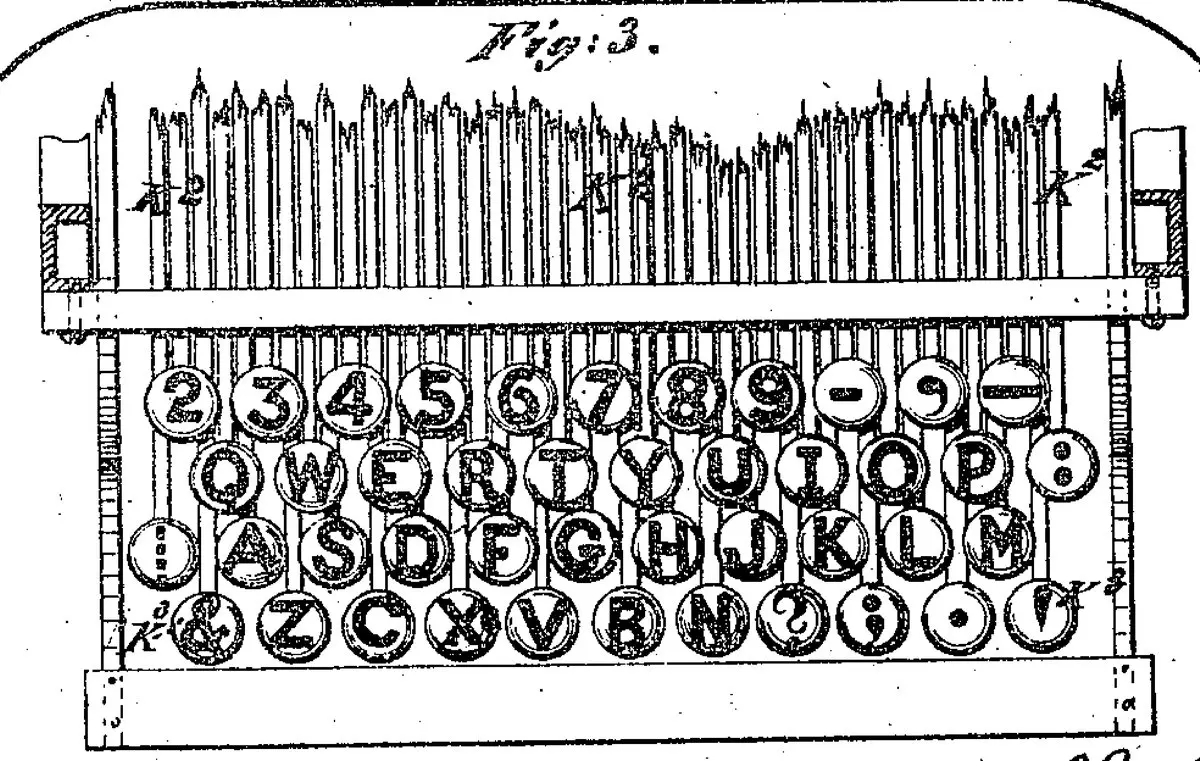
Fig. 3 of U.S. Patent 207,559, dated August 27, 1878, cropped from the second drawing sheet: the key-board, with the letter rows QWERTYUIOP, ASDFGHJKLM and ZCXVBN.
“U.S. Patent 207,559, Type-Writing Machine (1878), drawing sheet 2, Fig. 3”, C. L. Sholes, Type-Writing Machine, U.S. Patent 207,559 (1878), drawing sheet 2, Fig. 3; United States Patent and Trademark Office; public domain.
Full credit
"U.S. Patent 207,559, Type-Writing Machine (1878), drawing sheet 2, Fig. 3" by C. L. Sholes, Type-Writing Machine, U.S. Patent 207,559 (1878), drawing sheet 2, Fig. 3; United States Patent and Trademark Office — https://image-ppubs.uspto.gov/dirsearch-public/print/downloadPdf/0207559 — Public domain (EU: the draughtsman is not named on the sheet and the drawing was published in 1878, more than 70 years ago (70 years from publication); the inventor's death year was not traced to a source read for this page; US: U.S. patent drawing published 1878, before 1931; patent text and drawings are typically not subject to copyright); modified: cropped to Fig. 3 (the key-board) from drawing sheet 2, resized to 1,200 px wide and saved in grayscale
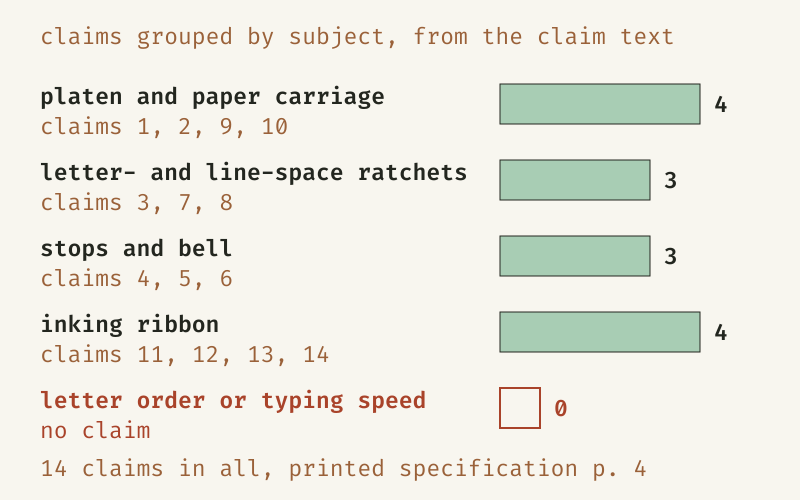
The 14 claims of U.S. Patent 207,559, grouped by subject; no claim concerns the order of the letters or the speed of typing.
Drawn from the claim text of U.S. Patent 207,559, printed specification p. 4, read from the page scan; the claims grouped by subject and recounted to 14.
This figure as text
the claims by subject.
- Platen and paper carriage: claims 1, 2, 9 and 10.
- Letter- and line-space ratchets: claims 3, 7 and 8.
- Stops and bell: claims 4, 5 and 6.
- Inking ribbon: claims 11, 12, 13 and 14.
- Letter order or typing speed: no claim.
"U.S. Patent 207,559 (1878): the subjects of its 14 claims" by Who Decided the Inch, https://whodecidedtheinch.com/objects/qwerty-keyboard/, licensed under CC BY 4.0, https://creativecommons.org/licenses/by/4.0/
Data: C. Latham Sholes, U.S. Patent 207,559 (1878), claims 1-14 (public domain in the US)
A patent records what an inventor asked for and was granted. It does not say why a keyboard was laid out one way. The Yasuokas add a practical point against the slow-down story. A Morse receiver has to keep pace with the sender, they argue, so a keyboard built to slow its user down would have failed its first buyers.
A swap like this is what origin laundering names: a plain, tangled origin replaced, retelling by retelling, by a story that is easier to repeat. Here one tidy motive stands in for several rounds of changes. Neither Sholes patent read for this page states that motive. The term describes the retelling and makes no claim about anyone's intent.
Did Sholes arrange the keys to stop jams?
A milder version says the letters were spread out so the typebars would not collide. Typebars are the arms that carry the letters and swing up to strike the paper. On the Sholes & Glidden they hang in a ring, which the Yasuokas call the basket. A 1980 survey by Hisao Yamada, as the Yasuokas quote it, said Sholes put the typebars for some common letter pairs “at opposite locations across the round basket.”
The Yasuokas report that they checked surviving Sholes & Glidden machines, among them one at the Milwaukee Public Museum. Their table uses letter-pair counts from 1949, and it ranks TH (counted with HT) as the most common pair in English. The T and H typebars sit 180 degrees apart, straight across the ring like 12 and 6 on a clock face.
For ER, counted with RE as the second most common pair, the gap is just 16 degrees. That is less than three minute marks on the same clock. The Yasuokas also report that the basket did not follow the keyboard in any regular way. This does not rule out jamming as one concern, but the basket kept no single rule of holding common pairs apart.
Why is R next to E, and is TYPEWRITER all on one row?
Every letter of TYPEWRITER sits on the top row of a QWERTY keyboard. A popular story says that was the point. The economist Paul David wrote in 1986, as the Yasuokas report, that some said R was moved so a salesman could impress buyers by quickly typing the brand name TYPE WRITER.
The Yasuokas trace how Stephen Jay Gould picked up the idea and spread it, and they argue against it from the dates. According to them, the brand name Sholes & Glidden Type-Writer was settled in May 1873. That was before Jenne and Clough moved R into the period's old spot next to E.
They also ask why SHOLES and GLIDDEN could not be typed on one row, and where the hyphen of TYPE-WRITER was meant to go. Sales shows, they add, were done by taking down Morse code or dictation.
Their own idea about S comes from the telegraph. In American Morse code, the Yasuokas write, the signal for Z was often mixed up with the more common pair SE. At the start of a word, a receiver sometimes could not tell which was meant until more letters came. In their opinion, that is a reason to put S next to both Z and E. No second, independent source for this idea was found for this page.
How the 1878 drawing compares with the 1882 keyboard
Each letter key in Fig. 3 of patent 207,559 was set beside the 1882 layout that the Yasuokas print as their Fig. 9. They describe that 1882 order in one line: “It was the QWERTY keyboard arrangement as seen nowadays.” Only letter keys were counted, row by row from left to right, skipping number and symbol keys.
A letter counts as in place when it sits in the same row and in the same order among that row's letters. By that test, 25 of the 26 letters sit in the same row, and 23 of the 26 sit in the same row and the same order. C and X are swapped, and in 1878 M ends the home row instead of following N.
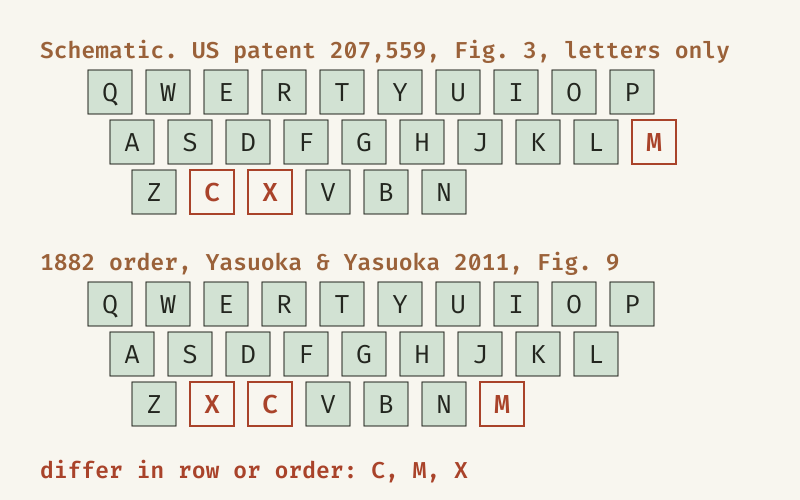
A schematic of the letter keys of Fig. 3 in the 1878 patent above the 1882 order that the Yasuokas call the arrangement seen nowadays; only C, X and M differ in row or in order within the row.
Drawn from Fig. 3 of U.S. Patent 207,559 (page scan) and the 1882 letter order according to Yasuoka & Yasuoka 2011, Fig. 9 (full text); same row and same order recomputed letter by letter; a schematic, not a copy of the patent drawing.
"QWERTY letters in Sholes's 1878 patent drawing and in the 1882 order" by Who Decided the Inch, https://whodecidedtheinch.com/objects/qwerty-keyboard/, licensed under CC BY 4.0, https://creativecommons.org/licenses/by/4.0/
Data: C. Latham Sholes, U.S. Patent 207,559 (1878), drawing sheet 2, Fig. 3 (public domain in the US); Koichi Yasuoka and Motoko Yasuoka, On the Prehistory of QWERTY, ZINBUN 42 (2011), p. 168, Fig. 9
| Row | 1878 patent, Fig. 3 | 1882 order, Fig. 9 of the 2011 paper | Letters that differ |
|---|---|---|---|
| Top | QWERTYUIOP | QWERTYUIOP | none |
| Home | ASDFGHJKLM | ASDFGHJKL | M |
| Bottom | ZCXVBN | ZXCVBNM | C, X, M |
The table as data (CSV, qwerty-keyboard-1878-patent-vs-today.csv) (source and license notes) Data: C. Latham Sholes, U.S. Patent 207,559 (1878), drawing sheet 2, Fig. 3; Koichi Yasuoka and Motoko Yasuoka, On the Prehistory of QWERTY, ZINBUN 42 (2011), p. 168, Fig. 9
The drawing's number row runs only from 2 to 9. The Yasuokas note that the letter I also served as the numeral 1, and O as 0.
The good story
Sholes set out the keyboard to slow typists down, as a 1982 computing bulletin quoted by Yasuoka & Yasuoka puts it.
The paper trail
The 14 claims of U.S. Patent 207,559 cover the platen, carriage, ratchets, stops, bell and ribbon, and none covers letter order or typing speed page scan.
The good story
Sholes put common letter pairs on opposite sides of the typebar basket, as Hisao Yamada's 1980 survey is quoted by Yasuoka & Yasuoka.
The paper trail
In surviving Sholes & Glidden machines, T and H sit 180 degrees apart in the basket but E and R only 16 degrees apart, Yasuoka & Yasuoka report full text.
The good story
R was moved so salesmen could type TYPE WRITER on one row, a suggestion passed on in Paul David's 1986 essay, as quoted by Yasuoka & Yasuoka.
The paper trail
The brand name Sholes & Glidden Type-Writer was settled in May 1873, before R took the period's place next to E, Yasuoka & Yasuoka report full text.
The good story
Sholes arrived at the 1873 keyboard by experiment, as Yamada's 1980 survey is quoted by Yasuoka & Yasuoka.
The paper trail
Yasuoka & Yasuoka trace changes by telegraph buyers and Remington mechanics before 1874 and by a Remington sales firm in 1882 full text.
The barber pole is another street-side object whose popular story is set against the records. Another object followed through its patents is the zipper.
When did the keyboard become today's QWERTY?
According to the Yasuokas, E. Remington & Sons put out the Remington Type-Writer No. 2 in January 1878. It had 40 keys and an upper case key that moved the platen, so one key could print both a capital and a small letter. Its letter layout, as they print it, matches Fig. 3 of the patent dated that August. Its buyers, they write, were mostly shorthand writers, not telegraph clerks.
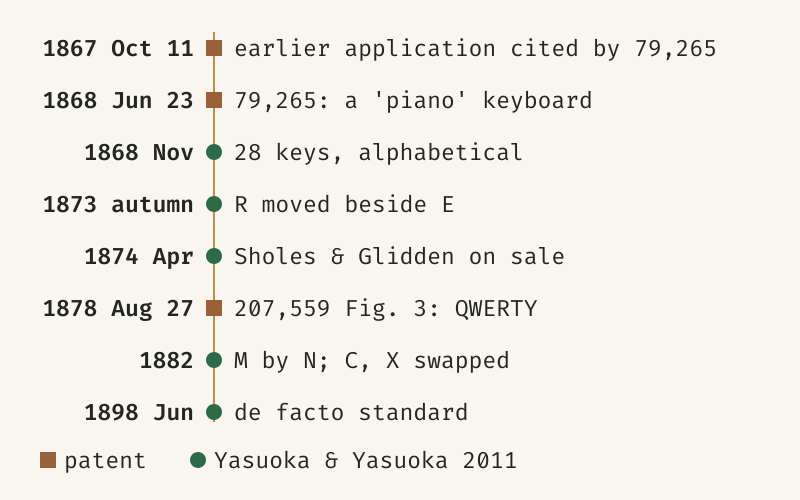
Eight dated steps: the October 1867 application that patent 79,265 refers to, the patents of 1868 and 1878, and five steps that the Yasuokas report, from the first machine in November 1868 to the de facto standard of June 1898.
Drawn from the dates of U.S. Patents 79,265 and 207,559 and the sequence as Yasuoka & Yasuoka 2011 report it, a single source.
This figure as text
the eight dated steps.
- October 11, 1867: the application for an earlier type-writing machine that patent 79,265 says it improves.
- June 23, 1868: U.S. Patent 79,265, with a key-board “similar to the key-board of a piano.”
- November 1868: the first machine, with 28 keys in alphabetical order, goes to Edward Payson Porter, according to the Yasuokas.
- Autumn 1873: Jenne and Clough move R next to E, the Yasuokas report.
- April 1874: the Sholes & Glidden Type-Writer goes on sale, according to the Yasuokas.
- August 27, 1878: U.S. Patent 207,559, whose Fig. 3 shows the rows QWERTYUIOP, ASDFGHJKLM and ZCXVBN.
- 1882: the Remington Standard Type-Writer No. 2 moves M next to N and swaps C and X, the Yasuokas report.
- June 1898: QWERTY has become the de facto standard, the Yasuokas write.
"QWERTY's paper trail, 1867 to 1898" by Who Decided the Inch, https://whodecidedtheinch.com/objects/qwerty-keyboard/, licensed under CC BY 4.0, https://creativecommons.org/licenses/by/4.0/
Data: U.S. Patent 79,265 (1868) and U.S. Patent 207,559 (1878), dates from the printed specifications (public domain in the US); Koichi Yasuoka and Motoko Yasuoka, On the Prehistory of QWERTY, ZINBUN 42 (2011), pp. 162-169
The last letter moves came in 1882. On August 1 that year, the Yasuokas report, Remington signed a sole selling deal with William Wyckoff and Henry Benedict. The two set up Wyckoff, Seamans & Benedict with Clarence Seamans. Their Remington Standard Type-Writer No. 2 moved M next to N and swapped C and X. The Yasuokas say these changes were made to get around patents held by the Type Writer Company.
How did QWERTY become the standard?
The Yasuokas follow the spread through company history. On March 30, 1893, Wyckoff, Seamans & Benedict and a partner founded the Union Typewriter Company. It held shares in five leading typewriter makers: Remington, Caligraph, Yost, Densmore and Smith-Premier.
As those firms put QWERTY on their machines, the Yasuokas write, it had become the de facto standard by June 1898. De facto means the standard in practice, not by any rule.
The computer link came later. The Yasuokas report that Teletype machines, a kind of printing telegraph, took up QWERTY in the 1910s. From the 1940s to the 1970s those machines served as computer terminals in the United States, the United Kingdom and Japan. The Yasuokas argue that this is why computer keyboards in those countries became QWERTY too.
Is the Dvorak keyboard faster than QWERTY?
U.S. Patent 2,040,248, “Typewriter Keyboard,” was filed on May 21, 1932, and dated May 12, 1936, under the name A. Dvorak et al. bibliographic. In 1990 the economists Liebowitz and Margolis published The Fable of the Keys in the Journal of Law & Economics bibliographic. Only the titles and dates of these two documents were read for this page, so this entry takes no side on whether the Dvorak layout is faster.
Several questions stay open. The keyboards of 1870 to 1873 are known here only through the Yasuokas' account.
Apart from the 1882 changes, which the Yasuokas tie to patents, no document read for this page explains most single moves, such as Sholes's wish to put Y in the center. The patents show what was claimed and drawn, not why each letter sits where it does. Whether jamming was one concern among others is not settled by the records read.
Sources
- C. Latham Sholes, assignor to the Type Writer Company, “Improvement in Type-Writing Machines,” U.S. Patent 207,559, dated August 27, 1878; application filed March 1875. Drawing sheet 2 (Fig. 3); claims 1–14. U.S. patent, published 1878; USPTO: patent text and drawings typically not subject to copyright. image-ppubs.uspto.gov/dirsearch-public/print/downloadPd…How far it was read: page scan; drawing sheet 2 (Fig. 3) and printed specification pp. 1, 3 and 4 (claims 1–14)
- Koichi Yasuoka and Motoko Yasuoka, “On the Prehistory of QWERTY,” ZINBUN 42 (2011): 161–174. Institute for Research in Humanities, Kyoto University. doi:10.14989/139379. doi.org/10.14989/139379How far it was read: full text; pp. 161–174, with Figs. 7, 8 and 9 checked on the printed pages
- C. Latham Sholes, Carlos Glidden and Samuel W. Soule, “Improvement in Type-Writing Machines,” U.S. Patent 79,265, dated June 23, 1868. U.S. patent, published 1868; USPTO: patent text and drawings typically not subject to copyright. image-ppubs.uspto.gov/dirsearch-public/print/downloadPd…How far it was read: page scan; drawing sheet 2 and printed specification p. 1; drawing sheet 1 from the National Archives copy
- S. J. Liebowitz and Stephen E. Margolis, “The Fable of the Keys,” Journal of Law & Economics 33, no. 1 (1990): 1–25. doi:10.1086/467198. doi.org/10.1086/467198How far it was read: bibliographic
Cite this page
Who Decided the Inch. “QWERTY Keyboard: In the 1878 Patent, a Drawing, Not a Claim.” Published November 22, 2026. https://whodecidedtheinch.com/objects/qwerty-keyboard/. Accessed on the day you read it.
- To the original: how sources are read
- Marked in the margin: every correction
- Report an error on this page (contact@whodecidedtheinch.com)
Related entries
Barber Pole: An 1813 Book Reads the White Stripe as Bandage
Picture credit
"Barber's pole (AM 615460)" by Auckland Museum — https://commons.wikimedia.org/wiki/File:Barber%27s_pole_(AM_615460).jpg — CC BY 4.0 (https://creativecommons.org/licenses/by/4.0/); modified: resized
 Illustration
Paper Clip: Vaaler’s 1901 U.S. Patent Drew a Different Shape
Illustration credit
Illustration: Who Decided the Inch. Generated schematic image — not a photograph or historical record. No copyright is claimed in this generated illustration; if you reuse it, please keep this label.
 Illustration
Who Invented the Traffic Light? London Had a Signal by 1869
Illustration credit
Illustration: Who Decided the Inch. Generated schematic image — not a photograph or historical record. No copyright is claimed in this generated illustration; if you reuse it, please keep this label.